Take that first step - Use "NEW15" to get 15% off on your first session!

Take that first step  Use "NEW15" to get 15% off on your first session! Take that first step  Use "NEW15" to get 15% off on your first session! Take that first step  Use "NEW15" to get 15% off on your first session!

16 min read

Generalised Anxiety Disorder (GAD): Symptoms, Causes & Treatment

[post_author_reviewer]
generalised anxiety disorder
Generalised Anxiety Disorder? GAD? There is a particular kind of person who is always prepared. They have thought through every possible outcome before a meeting. They have mentally rehearsed the difficult conversation three days in advance. They lie awake at night cataloguing everything that could go wrong — with their health, their parents back home, their children’s education, their job security, their marriage. From the outside, they may look responsible, thorough, even admirable. From the inside, it is exhausting.
In many South Asian families, this constant state of readiness is praised rather than questioned. The mother who worries about everyone is caring. The father who cannot switch off from work concerns is hardworking. The NRI professional who cannot stop planning for every contingency is responsible. What rarely gets named is that for some people, this is not a personality trait or a virtue. It is Generalised Anxiety Disorder, a recognised clinical condition that can be treated.

Need to Talk to Someone?

Book a private online session with a licensed therapist
GAD is one of the most common anxiety disorders worldwide, yet it is also one of the most frequently missed — particularly in South Asian communities where chronic worry is culturally normalised, where physical symptoms are attributed to physical causes, and where seeking psychological help carries its own set of anxieties.

What Is Generalised Anxiety Disorder?

Generalised Anxiety Disorder is a chronic anxiety condition characterised by persistent, excessive worry about a wide range of topics that is difficult to control, present on most days, and accompanied by physical and psychological symptoms that impair daily functioning.
The word “generalised” is important. Unlike specific phobias, which centre on one thing, or panic disorder, which involves sudden intense episodes, GAD spreads across multiple domains of life simultaneously. A person with GAD does not worry only about their health, or only about money. They worry about both, and about their children, and their ageing parents, and the political situation, and whether they said something wrong last Tuesday. The worry shifts topic but rarely stops.
According to the World Health Organisation, anxiety disorders are the most prevalent mental health conditions globally, affecting an estimated 301 million people. GAD accounts for a significant proportion of these cases, and the WHO has identified it as a leading cause of disability worldwide.
The formal diagnostic criteria, as set out in the DSM-5 by the American Psychiatric Association, require the following to be present for a GAD diagnosis: excessive anxiety and worry occurring more days than not for at least six months, about multiple events or activities; difficulty controlling the worry; and at least three associated symptoms from a defined list (in adults), including restlessness, fatigue, difficulty concentrating, irritability, muscle tension, and sleep disturbance. The symptoms must cause clinically significant distress or impairment, and must not be better explained by another condition or substance.
What this means in practice is that a six-week period of intense worry during a genuine crisis does not constitute GAD. The condition involves a pattern that is sustained, pervasive, and resistant to ordinary reassurance.

How GAD Differs from Normal Worry

This is one of the questions I am asked most often in clinical practice, and the answer matters because it determines whether someone seeks help or continues to assume their experience is just how they are.
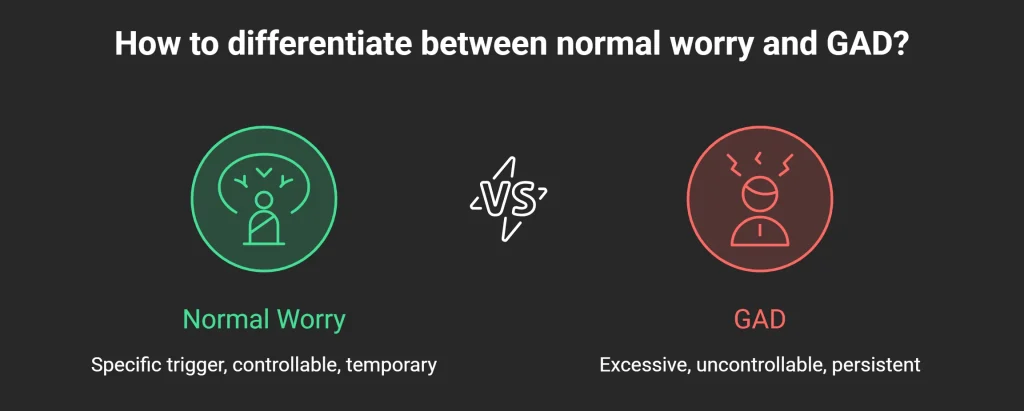
Everyone worries. Worry is a cognitive tool designed to help us anticipate and prepare for difficulties. The question is whether the worry is proportionate, controllable, and bounded.
In ordinary worry, there is usually a specific trigger, a reason. The worry subsides when the situation resolves, or when the person has done what they can. It does not typically prevent sleep every night or interfere with concentration at work. Most people can shift their attention away from a worry when necessary.
What is GAD?
In GAD, the worry is excessive relative to the actual likelihood or severity of the feared outcome. It is persistent across situations, not tied to one concern. Crucially, it feels uncontrollable — people with GAD often describe knowing logically that their worry is disproportionate, while being completely unable to stop it. The worry also tends to cascade: resolving one concern simply moves the mind on to the next, so there is never a genuine sense of relief.
Research published in Behaviour Research and Therapy has identified a specific cognitive pattern in GAD called intolerance of uncertainty — a heightened sensitivity to the possibility that something bad might happen, combined with the belief that uncertainty itself is threatening and must be eliminated. This explains why reassurance from others provides only temporary relief in GAD: the underlying need is not for the specific answer, but for certainty itself, which no one can provide.
For South Asians, this pattern can be particularly hard to identify because intolerance of uncertainty is culturally reinforced. When families have experienced real adversity — partition, migration, financial precarity, political instability — the sense that the world is unpredictable and must be vigilantly monitored is not paranoia, it is a learnt response to real experience. Understanding that this response has become self-sustaining, and is now producing suffering rather than protection, is often the first step towards change.

Symptoms of GAD: What to Look For

Psychological Symptoms

The most prominent feature of GAD is worry that the person experiences as difficult or impossible to control. This is not the same as thinking about problems — it is a cognitive process that tends to run in loops, returning to the same fears repeatedly without reaching resolution.
Alongside excessive worry, GAD commonly involves:
  • Difficulty concentrating, often described as a mind that feels “full” or constantly distracted
  • Irritability that seems disproportionate to the immediate situation
  • A persistent sense that something bad is about to happen, even without a specific threat
  • Difficulty making decisions, driven by fear of choosing wrongly
  • Seeking excessive reassurance from others, which provides only brief relief

Physical Symptoms

This is where GAD is most often missed in South Asian clinical settings. The physical symptoms of GAD are real, measurable, and often the primary reason people seek medical help.
According to research published in Primary Care Companion to the Journal of Clinical Psychiatry, between 40 and 60 per cent of patients presenting to primary care physicians with medically unexplained symptoms meet the diagnostic criteria for an anxiety disorder. In Kerala and across South Asia, where there is a well-documented tendency to express psychological distress somatically, this figure is likely even higher.
Physical symptoms associated with GAD include persistent muscle tension (commonly in the neck, shoulders, and jaw), headaches, fatigue that does not resolve with rest, disturbed sleep, gastrointestinal problems including nausea and irritable bowel syndrome, and a heightened startle response. Some people also experience trembling, sweating, or frequent urination.

Sleep Disturbance

Sleep problems in GAD deserve particular mention because they are both a symptom and a driver of the condition. Difficulty falling asleep due to a racing mind, waking during the night to resume worry, or waking very early with an immediate sense of dread are all characteristic of GAD. Sleep deprivation worsens cognitive function and emotional regulation, which in turn makes the worry harder to manage — a cycle that can be very difficult to break without structured intervention.

What Causes GAD?

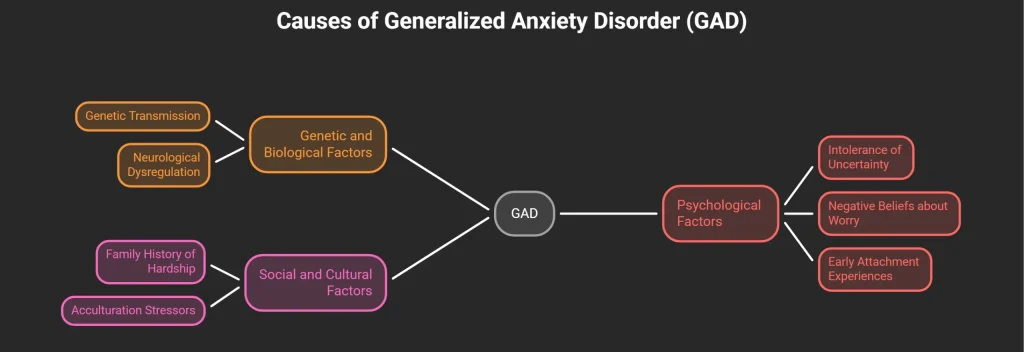
GAD does not have a single cause. The evidence points to a combination of biological, psychological, and social factors.

Genetic and Biological Factors

There is a meaningful heritable component to GAD. According to the American Psychological Association, first-degree relatives of people with anxiety disorders are significantly more likely to develop one themselves, suggesting both genetic transmission and the influence of shared family environment. Neurologically, GAD involves dysregulation in the circuits connecting the amygdala (the brain’s threat-detection centre) and the prefrontal cortex (which regulates and contextualises threat responses). In GAD, the amygdala tends to fire too readily, and the prefrontal cortex’s moderating influence is insufficient to counter it.

Psychological Factors

Certain cognitive styles increase the risk of developing GAD. Intolerance of uncertainty, described above, is the most robustly researched. Other contributing patterns include negative beliefs about worry itself (the paradoxical belief that worrying is dangerous, which itself generates anxiety) and a perfectionist orientation that makes any outcome short of certainty feel unacceptable.
what causes GAD?
Early attachment experiences also matter. Children who grew up in environments that felt unpredictable, where parental responses were inconsistent or where genuine threats were present, often develop a heightened vigilance that persists long after it is needed.

Social and Cultural Factors

For South Asians, the social context of GAD is particularly significant. Families that have navigated economic hardship, displacement, or social precarity across generations may have passed on a model of the world as fundamentally unsafe. The Keralite parent who sacrificed everything for their children’s education and now cannot stop worrying about whether those children will succeed is not simply neurotic — they are operating from a learnt framework in which vigilance was once genuinely protective.
For NRIs and diaspora communities, additional layers of social anxiety are common: uncertainty about immigration status, social isolation in a foreign country, the pressure of maintaining two cultural identities simultaneously, and the guilt of being geographically distant from ageing parents. Research published in Transcultural Psychiatry has identified these acculturation-related stressors as significant risk factors for the development of GAD in migrant South Asian populations.

How GAD Is Diagnosed

GAD is diagnosed through clinical assessment by a qualified mental health professional. There is no blood test or scan that identifies it. The assessment typically involves a structured clinical interview covering the nature, duration, and severity of worry and associated symptoms, a review of physical symptoms, an exploration of how the anxiety is affecting daily functioning, and the exclusion of other conditions (medical and psychiatric) that could explain the symptoms.
Several validated screening tools are used in both clinical and research settings. The GAD-7, a seven-item self-report questionnaire developed by Spitzer et al. and widely used by the NHS and international health systems, is one of the most well-established. It asks about the frequency of GAD-related symptoms over the past two weeks, producing a score that indicates minimal, mild, moderate, or severe anxiety. A score of 10 or above is generally considered a clinical threshold warranting further assessment.
One reason GAD is underdiagnosed in South Asian communities is that the clinical presentation often differs from what is described in Western research literature. Physical complaints may predominate. The person may not frame their experience as “anxiety” at all. And there is a strong likelihood that they will have spoken to a GP about their headaches or digestive problems for years before a psychological assessment is ever suggested.

Effective Treatments for GAD

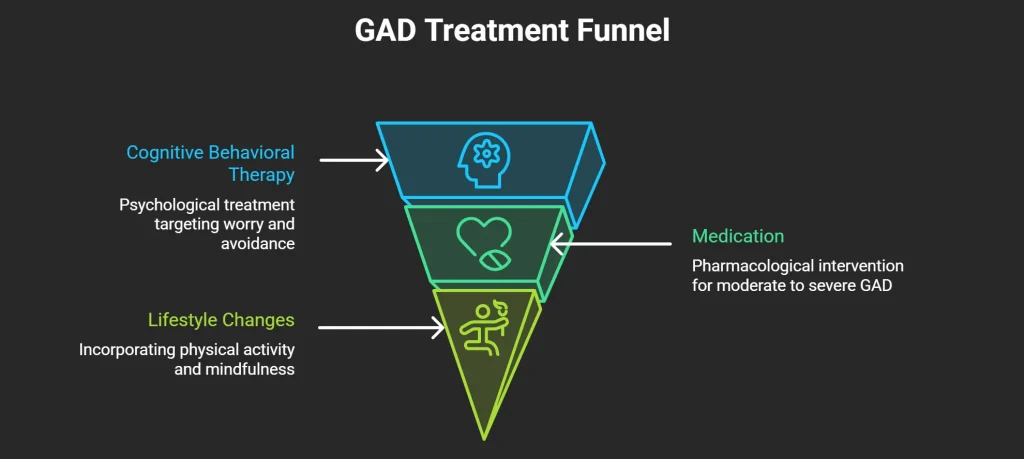
GAD is a treatable condition. Two approaches have the strongest evidence base.

Cognitive Behavioural Therapy for GAD

Cognitive Behavioural Therapy adapted for GAD is the most extensively researched psychological treatment for the condition. A comprehensive meta-analysis published in Psychological Medicine confirmed CBT’s efficacy across multiple outcome measures, with response rates comparable to pharmacological treatment and superior durability at follow-up.
CBT for GAD typically targets three processes: the tendency to perceive threats as more likely and more catastrophic than they are; the intolerance of uncertainty that drives the worry; and the behavioural avoidance and reassurance-seeking that maintain the condition by preventing the person from discovering that uncertainty can be tolerated.
treatments of gad
A practical technique drawn from CBT is scheduled worry time. Rather than attempting to suppress worry (which is largely ineffective and often counterproductive), the person designates a specific 20-minute period each day for worry. When intrusive worries arise outside this time, they are noted briefly and deferred. This does not eliminate worry but interrupts the constant background hum, and gradually weakens the association between any trigger and an immediate spiral.

Medication

For moderate to severe GAD, medication is often used alongside therapy. The first-line pharmacological treatments, according to NICE (the UK’s National Institute for Health and Care Excellence) guidelines, are selective serotonin reuptake inhibitors (SSRIs) such as sertraline, and serotonin-norepinephrine reuptake inhibitors (SNRIs) such as venlafaxine. These are not sedatives or tranquillisers — they work on the neurochemical systems that regulate threat and emotional response, and typically take several weeks to produce full effect.
Benzodiazepines, while effective for short-term anxiety relief, are not recommended as a primary treatment for GAD due to the risk of dependence. This is worth knowing because benzodiazepines are still prescribed relatively readily in parts of South Asia and the Gulf, and their long-term use can worsen anxiety outcomes.

Lifestyle and Adjunctive Approaches

Physical activity has a well-evidenced effect on anxiety, operating through multiple mechanisms including the reduction of cortisol, the release of endorphins, and the improvement of sleep architecture. A review published in JAMA Psychiatry found that exercise produced significant reductions in anxiety symptoms across clinical populations.
Mindfulness-Based Stress Reduction (MBSR) and mindfulness-based cognitive therapy are also effective adjuncts for GAD, particularly for reducing the cognitive fusion with anxious thoughts that drives the worry cycle. These approaches do not require eliminating anxiety but change the person’s relationship with anxious thought content.

When to Seek Professional Help

Many people with GAD spend years managing their symptoms alone, assuming that worry is simply part of who they are. The following signs indicate that professional support would be appropriate and beneficial.
Seek professional help if worry is present on most days and has been for six months or longer. If anxiety is causing you to avoid situations, decisions, or opportunities that matter to you, that is a clinically significant level of impairment. If sleep disruption, physical tension, or fatigue are persistent and have no identified medical cause, anxiety is worth assessing. If you are using alcohol, cannabis, or other substances to manage anxious feelings, the anxiety needs to be addressed directly. If family members or colleagues have noticed that you seem constantly stressed or unable to relax, their observation is worth taking seriously.
There is also a particular pattern worth naming for South Asian readers: if you have spent years being told by doctors that your physical symptoms (headaches, IBS, fatigue, palpitations) have no clear medical explanation, and you have never had a structured assessment for anxiety, that gap in your care is worth closing.
Oppam’s therapists work in Malayalam, Tamil, and English, and are trained in evidence-based treatments including CBT for anxiety disorders. You can access support from wherever you are. Book your first session →

Frequently Asked Questions

What are the main symptoms of Generalised Anxiety Disorder?

The core symptom is excessive, persistent worry about multiple areas of life — health, finances, family, work — that is difficult to control and present on most days for at least six months. This is accompanied by at least three physical or psychological symptoms, which may include restlessness, fatigue, difficulty concentrating, irritability, muscle tension, and disturbed sleep. Many people with GAD also experience physical complaints such as headaches, digestive problems, and palpitations, which are direct effects of chronic physiological arousal.

How do I know if I have GAD or just normal anxiety?

The key differences are duration, intensity, and controllability. Normal anxiety is proportionate to a real threat and eases when the situation resolves. In GAD, the worry is excessive relative to the actual risk, spans multiple topics simultaneously, is present on most days for months or years, and feels very difficult to stop even when you want to. If your worry is interfering with your sleep, your work, or your relationships consistently, it warrants a proper assessment rather than continued self-management.

Can GAD go away on its own without treatment?

For some people, GAD symptoms fluctuate — they may reduce during stable periods and worsen under stress. However, without treatment, the underlying patterns that drive GAD (particularly intolerance of uncertainty and cognitive avoidance) tend to persist. Research consistently shows that structured treatment, particularly CBT, produces more sustained improvement than the condition resolving untreated. Waiting for it to pass on its own often means years of unnecessary suffering, and the condition can worsen if left unaddressed.

Is GAD common in South Asian or Keralite communities?

Anxiety disorders are common globally, and South Asian communities face specific risk factors that increase vulnerability: intergenerational transmission of anxious coping patterns, migration and acculturation stress, family pressures around performance and reputation, and significant stigma around seeking psychological help. Research published in Transcultural Psychiatry has found elevated rates of anxiety among South Asian diaspora populations in Western countries. Within India, NIMHANS data suggests anxiety disorders are significantly underdiagnosed due to the predominance of physical symptom presentation.

Can I get therapy for GAD in Malayalam or Tamil?

Yes. Oppam offers online counselling in Malayalam, Tamil, and English, with therapists who are trained in evidence-based approaches for anxiety disorders. Being able to work in your first language matters clinically — it allows for more precise expression of emotional experience and reduces the effort of self-monitoring in a second language. Sessions are conducted online, making them accessible regardless of where you are located.

How long does treatment for GAD take?

This varies depending on severity and the approach used. A standard course of CBT for GAD typically involves 12 to 20 sessions, with many people experiencing significant improvement within the first six to eight sessions. Medication, if used, generally requires four to six weeks before full effects are felt. Some people benefit from a shorter course of therapy focused on specific skills, while others find ongoing support more useful. Your therapist will work with you to set a realistic plan based on your individual presentation.

Is GAD linked to depression?

Yes, there is a strong association. According to the APA, a significant proportion of people diagnosed with GAD also meet the criteria for a depressive disorder at some point. The two conditions share some neurobiological features and tend to worsen each other: chronic anxiety is exhausting and demoralising, which can tip into depression, while depression reduces the cognitive and emotional resources needed to manage anxiety. When both are present, treatment needs to address both, which is why accurate diagnosis matters.

External Resources

Struggling?
Talk to an Oppam Therapist

Get the Support You Deserve Online & Confidential

Mental health isn’t a luxury It’s your right

Feeling tired, stuck, overwhelmed or just not like yourself lately?
Take a pause. Talk to someone who gets it.

There’s more like that

Scroll to Top