
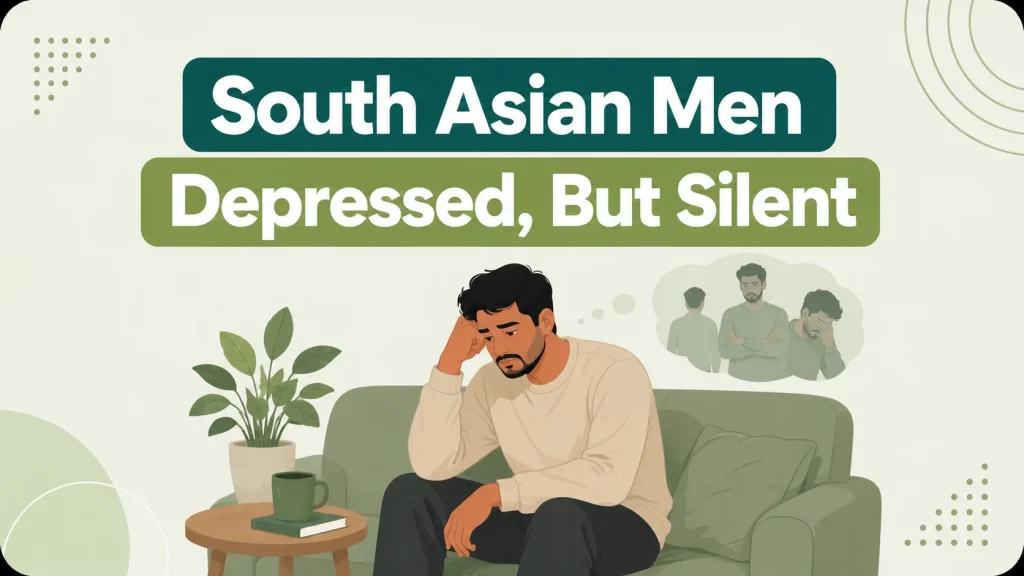
Depression in South Asian Men? He has been drinking more than usual. Not dramatically — no one has said anything yet — but more than before, and at different times. He is short with his wife in ways he was not a year ago. He has stopped calling his parents back in Kerala as often, and when he does call, he keeps the conversation brief. At work he is still performing, still reliable, still the person others depend on. But something behind the eyes has gone out.
Nobody asks. His wife attributes the irritability to work pressure. His friends, the handful he still sees, do not have the vocabulary or the relationship structure for this kind of conversation. His parents, if they knew anything was wrong, would worry in ways that would make everything harder. And he himself does not have a word for what he is experiencing, because the word he knows — depression — belongs to other people. People who cannot function. People who are visibly unwell. Not him.
Need to Talk to Someone?
Book a private online session with a licensed therapist
This is the specific shape that depression takes in South Asian men — Keralite men, Tamil men, NRI men in the Gulf and the diaspora. It does not look like the clinical picture in the textbooks. It looks like irritability, alcohol, withdrawal, and performance maintained at a cost no one can see.
According to the World Health Organisation, men are significantly less likely than women to seek help for depression globally — and in South Asian communities, the gap is wider still. This article explains why, what the condition actually looks like in this population, and what it takes to change the pattern.
The Scale of the Problem
Depression does not spare men. According to the WHO, depression affects more than 280 million people globally, and while diagnosed rates in men are lower than in women, this reflects differential help-seeking rather than differential prevalence. Research published in JAMA Psychiatry by Marcus and colleagues found that when diagnostic criteria are adjusted to include the male-typical presentation of depression — irritability, aggression, alcohol use, risk-taking — rather than the female-typical presentation that dominates clinical research, gender differences in prevalence largely disappear.
The clinical reality is that men and women experience depression at roughly similar rates. What differs is how it presents, how it is recognised, and whether it reaches professional attention.
In India, the suicide rate among men is approximately twice that among women, according to data published by the National Crime Records Bureau. This disparity is consistent with international patterns and reflects the downstream consequence of untreated depression in men: not that men suffer less, but that they suffer more silently and for longer, until the accumulated weight becomes crisis. The WHO has identified this treatment gap as a global public health concern, and in South Asian communities, it is significantly more pronounced than global averages.
For Keralite and Tamil communities, both in India and in diaspora contexts, the specific cultural, economic, and relational pressures on men create a mental health risk profile that is large, well-documented in clinical experience, and almost entirely unaddressed by existing services.
What Depression Looks Like in South Asian Men
The most important clinical point about male depression in South Asian contexts is that it does not typically present as sadness. Understanding how it actually presents is the foundation for recognising it.
Irritability as the Presenting Emotion
The depressed South Asian man is often not described as sad. He is described as difficult, short-tempered, easily frustrated, or “not himself.” The irritability is real — it is a core feature of the male depression presentation, now formally recognised in clinical literature as male-type depression or irritable depression.
Research published in JAMA Psychiatry by Fava and colleagues identified irritable depression as a clinically distinct subtype associated with greater severity, higher rates of comorbid anxiety, and worse outcomes when the irritability dimension is not specifically addressed in treatment. In Keralite families, this irritability is almost universally attributed to work stress, financial pressure, or personality — rarely to depression. The man himself shares this attribution and does not connect his short temper to an underlying depressive condition.
Alcohol Use
Alcohol is the most common self-medication for depression in men across cultures, and in Keralite and South Asian communities it is no different. The specific neurochemical mechanism is clear: alcohol temporarily suppresses the pain of depression, reduces the hypervigilance and rumination that accompanies it, and lowers the inhibitions that ordinarily prevent emotional expression. It works, briefly, and so it is repeated.
The longer-term consequence is that alcohol is a central nervous system depressant that worsens depressive neurochemistry with sustained use, disrupts sleep architecture, impairs the prefrontal cortical function needed for decision-making and emotional regulation, and creates a secondary dependency problem that compounds the original condition. According to the American Psychological Association, comorbid depression and alcohol use disorder is one of the most common clinical presentations in men, with each condition reliably worsening the other.
In communities where male alcohol use is normalised or even socially facilitated — as it is in many Keralite male social environments — the drinking that accompanies depression is less likely to be read as a symptom and more likely to be read as an unremarkable social habit that has perhaps gotten slightly heavier lately.
Workaholism and Behavioural Escape
South Asian men with depression frequently increase rather than decrease their work hours. The busyness is functional in multiple ways: it is socially legitimate (he is working hard for the family), it provides distraction from the internal experience, and it maintains the external performance that is the man’s primary source of identity and worth.
This is behavioural avoidance operating at a culturally sanctioned level. The Gulf NRI who works twelve-hour days, the Kerala professional who is always busy, the father who is physically present but completely disengaged: these are recognisable patterns that are rarely connected to depression by the people around them because the work is valued and the busyness looks like dedication.
Social Withdrawal
Depression produces a progressive withdrawal from relationships and social activities. In South Asian men, this withdrawal is often less visible than it might be in other contexts because male social connection in these communities already tends to be structured around activity — work events, cricket, gatherings with specific social purposes — rather than the kind of intimate, emotionally open friendships that would provide a context for disclosure.
The Keralite man who stops initiating contact with friends, who declines social invitations, who has shorter conversations with his family: these changes are noticed but rarely acted upon because the social norms do not provide a mechanism for asking “are you okay?” in a way that expects an honest answer.
Why South Asian Men Don't Seek Help
Understanding the barriers is the only way to address them. They are multiple, mutually reinforcing, and deeply embedded in cultural frameworks that have genuine value in other respects.
The Definition of Strength
In Keralite and South Asian male culture, strength is defined substantially by what a man does not need. He does not need help. He does not burden others with his problems. He manages. This definition of strength has produced generations of men who sacrificed enormously, managed genuinely difficult circumstances, and supported families and communities through real hardship. It is not a hollow value.
But it becomes a clinical barrier when applied to psychological health, because it frames seeking professional help for depression as the antithesis of strength rather than as an expression of it. The man who acknowledges he is struggling and books a therapy session is, in this framework, failing. The man who endures silently for years is succeeding. This inversion of adaptive and maladaptive coping is one of the most consistent drivers of the male depression treatment gap in South Asian communities.
Research published in Social Science and Medicine examining help-seeking patterns among South Asian men found that the internalisation of traditional masculine norms was the single strongest predictor of not seeking mental health support, above stigma, above cost, and above practical access barriers.
For Gulf NRI men particularly, and for South Asian men in general, identity is heavily invested in the provider role. Being the person the family depends on financially is not just a responsibility — it is who they are. Depression threatens this identity in two directions: first by making the work harder (through cognitive impairment, fatigue, and reduced motivation), and second by making the disclosure of the depression feel like a threat to the family’s confidence in their provider.
A depressed father who acknowledges his depression to his wife and children is, in his own internal framework, potentially undermining the sense of security his family relies on. This is not a rational calculation — it is an emotional one, driven by the identification of his worth with his functioning. But it is a very powerful barrier to help-seeking, and it is almost entirely invisible to the clinicians who wonder why men do not come.
Stigma and the Community Gaze
The dense social networks that characterise Keralite communities — in Kerala and in diaspora settings — are sources of genuine support and connection. They are also, in the context of mental health, sources of significant social risk. Being known to be seeing a psychologist or psychiatrist carries potential consequences for a man’s professional reputation, his marriage prospects (for unmarried men), and the family’s standing in the community.
This is not paranoia. In closely networked communities, information does travel, and the association between mental illness and incompetence, weakness, or instability is real enough that the fear of exposure is clinically rational. Online therapy, which removes the visibility of clinic attendance, addresses this specific barrier in a way that in-person services cannot.
The Absence of a Vocabulary
Many South Asian men do not seek help for depression simply because they do not recognise what they are experiencing as depression. The word belongs, in their mental framework, to a category of obvious, visible, dramatic suffering that does not match what they are experiencing. The irritability, the alcohol, the withdrawal, the private hopelessness — these have other names in their vocabulary, and none of them is depression.
This is a clinical education problem as much as a stigma problem. Providing accurate information about what male depression actually looks like is a prerequisite for the recognition that would prompt help-seeking.
What It Takes for South Asian Men to Seek Help
In clinical practice, South Asian men who eventually reach therapy tend to describe a specific set of circumstances that made the difference. Understanding these circumstances helps both individuals and their families create conditions in which help-seeking becomes possible.
A Precipitating Event That Breaks the Performance
For many men, help-seeking follows a moment when the maintained functioning breaks down: a panic attack at work, a significant relationship rupture, a medical event that forces attention onto the internal state. The crisis that precipitates help-seeking is often not the depression itself but its consequences — the relationship damage done by years of irritability, the alcohol use that has become impossible to manage, the physical symptoms that finally require attention.
This pattern is a clinical argument for earlier intervention — for recognising the depression before the crisis, addressing it before it produces consequences that extend the suffering and complicate the recovery.
A Non-Judgemental First Contact
The quality of the first interaction with a professional matters enormously for men who have overcome significant internal resistance to seeking help at all. A first session that feels clinical, impersonal, or judgmental sends men back out of the door and reinforces the belief that therapy is not for them. A first session that is warm, normalising, and specific — that names what the man is experiencing without making him feel pathologised for it — can be the beginning of genuine change.
This is one of the reasons working with a therapist who understands South Asian male cultural context is clinically significant: the man does not have to spend the early sessions explaining why his situation is different from the Western male depression cases the therapist may have been trained on.
The Framing of Therapy as Practical, Not Emotional
South Asian men often engage more readily with therapy when it is framed in practical terms rather than emotional ones. Not “let’s talk about how you feel” but “let’s understand what is happening and develop a specific plan to change it.” CBT’s structured, goal-oriented, skills-based approach is often more accessible to South Asian men than more exploratory therapeutic modalities, precisely because it maps onto the problem-solving framework that many men find culturally familiar and comfortable.
When to Seek Professional Help
If the patterns described in this article — the irritability, the alcohol use, the withdrawal, the private hopelessness, the maintained performance at a cost no one can see — have been present for two months or more, professional support is warranted.
Seek help if sleep has been significantly disturbed. If alcohol use has increased as a coping mechanism, particularly if it is being used to manage the way you feel rather than for social reasons. If the relationship with your partner, your children, or your parents has deteriorated noticeably and you cannot fully account for why. If the sense that things will not improve has settled in and has been present for some time without lifting.
For Keralite and South Asian men in Kerala and across the diaspora, online counselling in Kerala through Oppam removes the most concrete barriers to access: the privacy concern, the community visibility, the difficulty of finding a therapist who understands your cultural context without requiring you to explain it first. Sessions are in Malayalam, Tamil, and English, accessible from home via secure video call. Book your first session →
Frequently Asked Questions
What does depression look like in South Asian men?
Depression in South Asian men typically presents as irritability, increased alcohol use, social withdrawal, workaholism, and maintained external functioning that conceals significant internal suffering. Overt sadness or tearfulness, the presentation most commonly associated with depression, is less typical in men and particularly uncommon in South Asian cultural contexts where emotional expression is constrained by gender role expectations. Recognising the male-typical presentation — the short temper, the drinking, the withdrawal, the private sense that nothing will improve — is the first step towards getting appropriate help.
Why don't South Asian men seek help for depression?
Multiple converging barriers maintain the treatment gap. The internalisation of traditional masculine norms that define strength as not needing help. The breadwinner identity that makes disclosing vulnerability feel like a threat to the family’s confidence in the provider. Stigma in closely networked communities where being known to see a psychologist carries real social risk. The absence of a vocabulary for the male-typical presentation, which means many men do not recognise what they are experiencing as depression. Research published in Social Science and Medicine found that internalised masculine norms were the single strongest predictor of not seeking mental health support among South Asian men.
Is depression in men different from depression in women?
The underlying condition shares the same biological and psychological mechanisms, but the presentation differs significantly. Women are more likely to present with overt sadness, tearfulness, and self-directed distress. Men are more likely to present with irritability, externalising behaviours (alcohol use, risk-taking), social withdrawal, and maintained functioning that conceals the internal suffering. Research published in JAMA Psychiatry found that when diagnostic criteria are adjusted to include the male-typical presentation, gender differences in depression prevalence largely disappear — indicating that men are not less depressed, but that their depression looks different and is less often recognised.
How can I help a South Asian man who I think is depressed?
Name what you have noticed specifically and privately, without an audience: “You have not seemed yourself lately, and I am concerned about you.” Avoid framing it as a performance failure or expressing disappointment. Do not make the conversation contingent on immediate help-seeking — plant the seed and allow time. If he dismisses the concern, acknowledge that and keep the door open rather than arguing. Provide specific, low-barrier information about options — including online therapy, which removes the visibility concern. If there is any indication of suicidal thinking, treat this as urgent.
Can online therapy Kerala work for men who have never tried therapy before?
Yes, and online delivery specifically addresses several of the barriers that prevent South Asian men from accessing in-person therapy. It removes the community visibility of clinic attendance. It can be done from home, privately, without anyone else knowing. It fits around work schedules. And it removes the logistical barrier of finding a culturally competent therapist in a local area. Oppam offers online therapy in Kerala and the diaspora in Malayalam, Tamil, and English, with therapists who understand South Asian male cultural contexts without requiring extended explanation.
Does therapy for men look different from therapy for women?
Good therapy is adapted to the individual, which includes their gender socialisation and cultural context. For South Asian men, effective therapy typically begins with a practical, structured framing rather than an immediate focus on emotional disclosure. CBT’s goal-oriented, skills-based approach is often well-matched to the problem-solving orientation that many South Asian men bring. Effective therapists working with South Asian male depression also understand the specific role of the breadwinner identity, the masculine norm barriers to disclosure, and the cultural meanings attached to the symptoms the man is presenting with.
Is it normal for men to feel depressed but not know why?
Yes, and this is one of the features of depression that is most difficult for South Asian men to accept as legitimate. The expectation, in many families and communities, is that suffering should have an identifiable cause — a loss, a failure, a specific difficulty. Depression often does not. It can develop without an obvious precipitating event, driven by a combination of biological vulnerability, accumulated stress, and the slow depletion of psychological resources. The absence of a clear external cause is not evidence that the depression is not real or not serious. It is a feature of how the condition operates.
Depression in South Asian men is real, it is common, and it does not get better through continued endurance — it deepens, damages relationships, and in the most serious cases, becomes life-threatening. If you have recognised yourself in this article, or if someone in your life has, the right step is not more waiting. Oppam offers online counselling in Kerala and across the South Asian diaspora in Malayalam, Tamil, and English, with therapists who understand what male depression looks like in our communities and who will not require you to explain your cultural context from scratch. The first session requires nothing more than showing up. Book your first session →
External Resources
- World Health Organisation — Global depression prevalence (280 million); male suicide rates and treatment gap; men less likely to seek help for depression
- JAMA Psychiatry (Marcus et al.; Fava et al.) — Male-type depression presentation; adjusted diagnostic criteria and gender prevalence; irritable depression as distinct subtype
- Social Science and Medicine — Internalised masculine norms as strongest predictor of not seeking mental health support among South Asian men
- American Psychological Association — Comorbid depression and alcohol use disorder in men; bidirectional worsening mechanisms
- National Crime Records Bureau (India) — Male suicide rate approximately twice female rate in India; downstream consequence of untreated male depression
Struggling?
Talk to an Oppam Therapist
Get the Support You Deserve Online & Confidential