

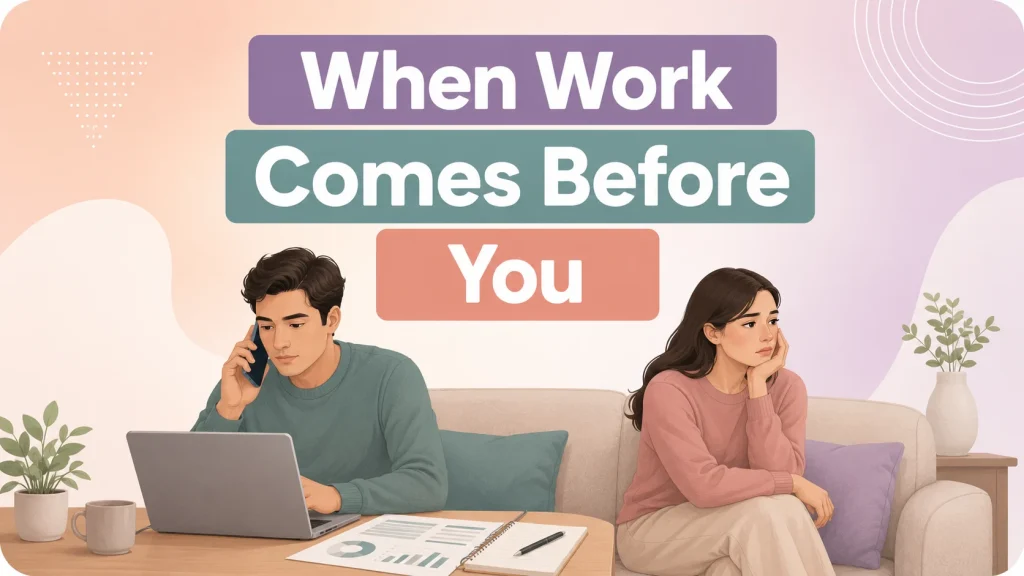
My Partner Prioritizes Work Over Me? Feeling ignored? There is a particular kind of loneliness that comes from sitting in the same room as someone and still feeling far away from them. Your partner is home, but their mind is on a deadline. They are next to you on the couch, but their eyes are on a laptop screen. You want to talk about your day, but they are already thinking about tomorrow’s meeting.
Work pressure is real. Careers matter, bills need to be paid, and ambition is not a flaw. But when work consistently becomes the reason there is no time left for you — no conversation, no affection, no shared moments — it is worth asking whether the relationship still has room for connection. This is not about blaming your partner or being “needy.” It is about recognising that emotional neglect in a relationship is a real issue, and one that relationship counselling and online counselling can genuinely help with. If the pattern feels bigger than the two of you can untangle alone, online therapy Kerala services exist for exactly this kind of quiet, ongoing ache.
Need to Talk to Someone?
Book a private online session with a licensed therapist
So, what can you do when your partner prioritizes work over you? Start by naming the feeling clearly, not as an accusation, but as an invitation to reconnect. Instead of saying, “You never have time for me,” try saying, “I miss feeling close to you, and I want us to spend more intentional time together.” Sometimes, couples get stuck not because love is absent, but because routines, stress, and unspoken disappointments slowly create distance. A calm conversation, clear boundaries around work time, and small daily moments of attention can help rebuild connection. But if every conversation turns into defensiveness, guilt, or silence, seeking support through relationship counselling or online therapy can help both partners understand what is really happening beneath the surface.
Is It Normal for Work to Affect a Relationship?
Yes, to some extent. Deadlines, financial pressure, career transitions, and long working hours will naturally affect anyone’s energy and availability. It is normal for a partner to be distracted during a demanding project, or to need a quiet evening to decompress after a difficult day.
The difference lies in whether this is a temporary phase or a permanent pattern. A relationship can absorb a busy month. It struggles when “I’m busy with work” becomes the standing explanation for every missed conversation, every cancelled plan, and every moment of emotional distance — for months or years on end. When work stops being a phase and starts being an excuse, the relationship can begin to feel one-sided, even if that was never anyone’s intention.
Signs Your Partner Is Prioritizing Work Over the Relationship
It can be hard to name what’s wrong when nothing dramatic is happening — no one is shouting, no one is lying. The neglect is quieter than that. Some common signs include:
- They cancel plans often because of work, even ones that were made in advance
- They rarely ask how you are feeling, or the question feels like a formality
- Conversations feel rushed, transactional, or purely practical — logistics, not connection
- You feel like you are constantly waiting for their free time, rather than being part of their day
- They become defensive or dismissive when you try to express your needs
- Emotional and physical intimacy has quietly reduced over time
- You feel lonely even while technically being in a relationship
If several of these feel familiar, you are not imagining things. This pattern is one form of signs of unhealthy patterns in a relationship, and recognising it early makes it far easier to address before resentment sets in.
Are You Being Too Demanding, or Are Your Needs Valid?
Many people in this situation spend more energy wondering if they’re overreacting than actually addressing the issue. If you’ve asked yourself “am I being too clingy?” or “is it unfair to expect more?” — pause there for a moment.
Wanting time, attention, emotional safety, and honest conversation from your partner is not excessive. It is a basic, reasonable expectation in a committed relationship. The real question isn’t whether your partner has work — of course they do. The real question is whether the relationship still has space for care, respect, and connection alongside that work. A psychologist in Kerala or an online psychologist can help you get clarity here, especially if you’ve been going back and forth on this for a while and want an outside, non-judgemental perspective.
How to Talk to Your Partner Without Starting a Fight
Bringing this up can feel risky — you may worry it will turn into an argument, or that your partner will feel attacked. A calm, structured approach makes a real difference:
- Choose a calm time — not right after a stressful workday or in the middle of another disagreement.
- Use “I feel” statements instead of accusations. This keeps the conversation about your experience, not their character.
- Be specific about what you miss — a evening walk, a proper conversation at dinner, a weekend without laptops.
- Avoid blaming language. The goal is connection, not a debate about who’s right.
- Ask for realistic changes, not a complete overhaul of their work life.
- Listen to their work pressure too. This isn’t a one-way complaint — understanding their side builds goodwill.
- Decide one small relationship ritual together, such as dinner without phones, a weekly check-in, or a screen-free hour before bed.
For example, instead of saying, “You only care about work,” try saying, “I feel lonely when we don’t get time to talk properly during the week.” The second version invites a conversation. The first invites a defense.
If these conversations tend to end with your partner going quiet or walking away entirely, it may help to read about when your partner shuts down during conflict — this is a common and specific pattern with its own approach
What If Your Partner Keeps Dismissing Your Feelings?
Sometimes you have this conversation once, twice, several times — and nothing changes. The same promises are made and the same patterns return within a week. This is where things can start to feel genuinely discouraging. Repeated dismissal, even if unintentional, can lead to resentment, growing emotional distance, and eventually a kind of relationship burnout where you stop bringing things up at all because it feels pointless.
This is exactly the situation Online couple therapy is designed for. Couple counselling gives both partners a structured, guided space to understand the pattern together — not as an argument, but as something to work through with a neutral third person present. online Relationship counselling doesn’t take sides; it helps both people see what’s actually happening and why. If you’re at this stage, couple therapy with qualified therapists can help you move from repeating the same conversation to actually resolving it.
Can Online Counselling Help Relationship Issues?
Yes, and for many couples, it’s often more accessible than in-person therapy. Online counselling can help both partners understand communication gaps, unmet emotional needs, recurring conflict patterns, and mismatched expectations, all with the guidance of a trained professional.
Online therapy is particularly useful when:
- Partners have busy or mismatched schedules and struggle to find a common time for in-person sessions
- One or both partners travel often or live in different cities
- Privacy matters, and a familiar, private space feels safer than a clinic waiting room
- You want to start with individual sessions before bringing your partner in
Through online counselling Kerala and online therapy Kerala services, couples across the state can access support without the added stress of travel. For many Malayali couples, being able to speak in their own language matters too — online counselling Malayalam, online therapy Malayalam, and Malayalam counselling online options make it easier to express nuanced emotions in the language you think and feel in, rather than translating them into English mid-session. Online psychologist consultation Kerala services also make it simple to book a session discreetly, at a time that actually works for both partners.
If you’re exploring your options, it may help to look at:
- Individual therapy for emotional support — useful if you want to process your own feelings first
- Online couple counselling — for working through the pattern together
- Find a qualified psychologist online — to see therapist profiles and specialisations
- Online counselling in Malayalam — if you’d prefer to work with a Malayalam-speaking therapist
Benefits of Individual Therapy and Couple Therapy
When you’re dealing with a partner who prioritizes work over the relationship, it’s worth understanding what each type of therapy actually offers — they serve different purposes, and many people benefit from one before the other, or both together.
Benefits of individual therapy:
- Gives you a private space to process feelings of loneliness, resentment, or self-doubt without worrying about your partner’s reaction
- Helps you figure out what you actually need from the relationship, separate from what you think you “should” need
- Builds clarity and confidence before you raise the issue with your partner, so the conversation comes from a grounded place rather than pent-up frustration
- Supports you in managing anxiety or low self-worth that can build up from feeling consistently unseen
- Useful even if your partner isn’t ready to join sessions yet — you don’t need their participation to start working on yourself
Individual therapy for emotional support is often the right starting point when you’re still trying to understand your own feelings before deciding how to approach the relationship.
Benefits of couple therapy:
- Creates a structured, neutral space where both partners can speak without the conversation turning into a fight
- Helps identify the actual pattern behind the conflict — often it’s less about work itself and more about unspoken expectations on both sides
- Gives your partner a chance to explain their pressures and blind spots without feeling attacked, which usually makes them more open to change
- Builds shared tools and language — like the “I feel” approach — that the two of you can keep using long after sessions end
- Addresses recurring resentment before it hardens into permanent emotional distance
Couple therapy works best when both partners are willing to show up, even if one is more hesitant at first. Many couples find that online couple counselling lowers that initial resistance — it can feel less intimidating than walking into a clinic together, and sessions can be scheduled around even the busiest work calendars.
When Should You Seek Professional Help?
Not every busy phase needs therapy. But it’s worth considering professional support if:
- You feel emotionally neglected most of the time, not just occasionally
- Every conversation about this topic turns into an argument
- Your partner consistently avoids serious discussions about the relationship
- You are constantly anxious or unsettled about where things stand
- You feel invisible or unimportant in your own relationship
- You both genuinely want to improve things but don’t know where to start
If any of this sounds familiar, searching for a therapist near me or psychologist near me is a reasonable next step — though for many couples, an online option turns out to be just as effective and considerably more convenient. A psychologist Kerala online can offer the same depth of support as an in-person session, without the added logistics.
Frequently Asked Questions
Is it normal to feel neglected when my partner is busy with work?
Yes. Feeling neglected doesn’t mean you’re being unreasonable — it means an emotional need isn’t being met. Occasional busy weeks are normal, but if the feeling of neglect is constant, it’s worth addressing rather than dismissing.
How do I tell my partner I need more time without starting a fight?
Choose a calm moment, use “I feel” statements instead of accusations, and be specific about what you’re missing — a conversation at dinner, a walk together, an hour without screens. Naming one small, realistic change is usually more effective than a broad complaint.
Is this a sign my relationship is failing, or is it just a phase?
It depends on whether the pattern changes over time. A busy project or a demanding quarter at work is a phase. A partner who consistently avoids connection, dismisses your feelings, and never adjusts, even after you’ve spoken about it, is a pattern worth taking seriously — ideally with the help of relationship counselling.
Can online counselling really help with relationship problems?
Yes. Online counselling helps couples and individuals identify communication gaps, unmet needs, and recurring conflict patterns with a trained therapist’s guidance. It’s especially useful when schedules are tight, partners are in different locations, or privacy is a priority.
Should we go for couple therapy or individual therapy first?
There’s no fixed order. Some people prefer starting with individual therapy to process their own feelings before bringing their partner in; others go straight to couple therapy together. A therapist can help you decide what fits your situation during an initial session.
How do I know if my partner is emotionally unavailable vs. just genuinely busy?
Genuinely busy partners still make an effort to check in, apologise for missed time, and reconnect when the busy period ends. Emotional unavailability looks different — conversations stay surface-level even during quieter periods, and attempts to talk about the relationship are consistently brushed off.
Is online counselling in Malayalam available for couples in Kerala?
Yes. Many couples in Kerala prefer speaking about emotional topics in Malayalam rather than English. Online counselling Malayalam and Malayalam counselling online options make it easier to express nuanced feelings in the language you’re most comfortable in, with therapists who understand the local context.
Is online counselling in Malayalam available for couples in Kerala? Yes. Many couples in Kerala prefer speaking about emotional topics in Malayalam rather than English. Online counselling Malayalam and Malayalam counselling online options make it easier to express nuanced feelings in the language you’re most comfortable in, with therapists who understand the local context.
Final Thoughts
Work will always demand a certain amount of time and energy — that’s not something you’re trying to compete with. What matters is whether your relationship still has room for presence, care, and connection alongside a busy career. A healthy partnership isn’t one where work disappears; it’s one where both people make a conscious effort to protect the relationship even when things get busy.
If you feel stuck in this pattern, talking to a qualified therapist can help you understand what is happening and what to do next. Oppam offers online counselling with professional therapists in Malayalam, English, Kannada, and Tamil — so you can talk about what you’re going through in whichever language feels most natural to you.
External Resources
- BYU ScholarsArchive — Work-family conflict and couple relationship quality; supports the point that work pressure can negatively affect relationship satisfaction and emotional closeness.
- American Psychological Association — Stress effects on the body; useful for explaining how chronic stress can affect mood, patience, energy, and emotional availability.
- The Gottman Institute — Bids for connection; supports the idea that small daily moments of attention, listening, and response are important for relationship connection.
- PMC / Family Process — Couple therapy in the 2020s; supports the statement that couple therapy is a recognised, evidence-based support for relationship distress.
- PubMed — Couple therapy in the 2020s; an academic reference for the role of relationship counselling and couple therapy in improving relationship concerns.
Struggling?
Talk to an Oppam Therapist
Get the Support You Deserve Online & Confidential