
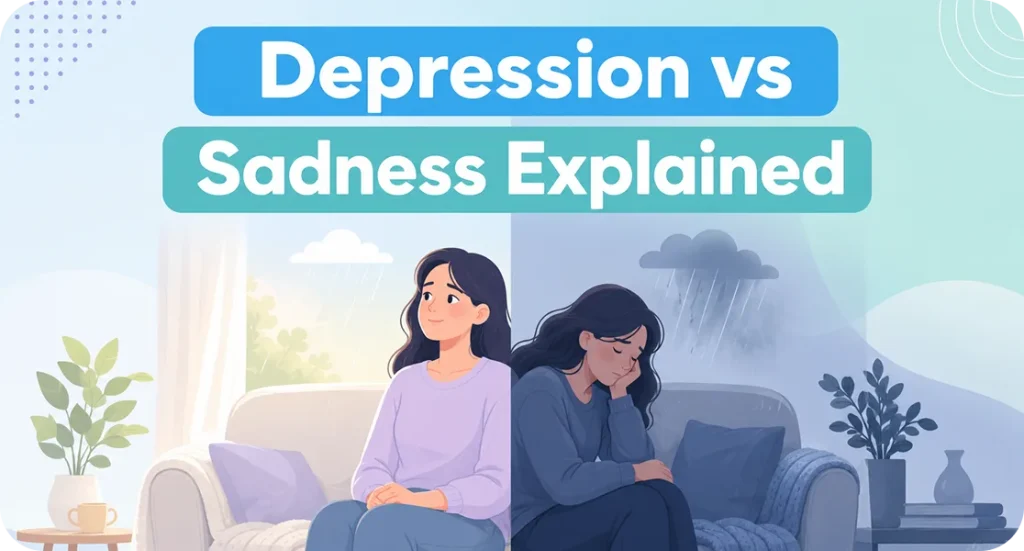
Depression vs sadness? “Manasu konjam heavy-a iruku.” That is how most Tamil people describe it — not depression, not a clinical condition, just a heaviness. Something is off. You are not yourself. Maybe a bad week, maybe exam results, maybe a fight with amma. You tell yourself it will pass. You have been telling yourself that for three months now.
In Tamil households, there is an unspoken rule that sits above most conversations: handle panniko. Manage it yourself. Do not make it a big thing. Crying is weakness. Talking about feelings to strangers — a tamil therapist, a counsellor — is something people do in movies, not in real life. So the heaviness gets filed under tiredness, under stress, under “I’ll be fine after the weekend.”
Need to Talk to Someone?
Book a private online session with a licensed therapist
This article explains the real difference between sadness and depression, what manasolaivu (மனச்சோர்வு) actually looks like when it is clinical rather than situational, why Tamil cultural frameworks so consistently miss the distinction, and what to do if you recognise the clinical picture in yourself or someone you care about.
What Sadness Is — and Why It Is Not the Problem
Sadness is one of the most fundamental human emotions. It is appropriate, functional, and in many ways necessary. It arises in response to real losses — a relationship that has ended, a result that disappointed, a person who is no longer here, a plan that did not work out. It tells you that something mattered, and that mattering has cost you something.
Sadness has a texture and a trajectory. It is usually possible to identify the cause. It is proportionate — the depth of the feeling roughly corresponds to the significance of the loss. And crucially, it moves. Not quickly, not always comfortably, but it shifts. A Tamil college student in Chennai who fails a semester paper will feel genuinely bad — possibly very bad — for some time. But the feeling has a context, a cause, and eventually a resolution. When results come in, when a plan is made, when time passes, the sadness does what sadness does: it changes.
This movement is the key clinical feature that distinguishes sadness from depression. Sadness is responsive. Depression is not. Or rather, depression responds very slowly, very little, and not reliably to the things that would ordinarily help.
What Depression Actually Is: More Than Just "Very Sad"
Depression, clinically called Major Depressive Disorder, is not an intensified version of sadness. It is a different condition with a different neurobiological basis, a different cognitive profile, and a different course. Understanding this distinction is the foundation for seeking the right kind of help.
The DSM-5 diagnostic criteria require five or more of the following symptoms to be present during the same two-week period, with at least one being either depressed mood or loss of interest:
- Depressed mood most of the day, nearly every day
- Markedly diminished interest or pleasure in activities previously enjoyed
- Significant weight change or appetite disturbance
- Insomnia or sleeping too much
- Psychomotor agitation or slowing observable by others
- Fatigue or loss of energy nearly every day
- Feelings of worthlessness or excessive or inappropriate guilt
- Difficulty concentrating, thinking, or making decisions
- Recurrent thoughts of death or suicidal ideation
The two core symptoms are depressed mood and anhedonia — the loss of the capacity for pleasure. That second one is the one that most Tamil people do not know to look for. You can have depression without crying every day. You can have depression while still going to college, still showing up at the office, still responding to WhatsApp messages with a thumbs up. What changes is that nothing produces the feeling it used to. Oru vacant feeling — a blankness where enjoyment used to be.
According to the World Health Organisation, depression affects more than 280 million people globally and is the leading cause of disability worldwide. In India, NIMHANS has estimated that approximately 57 million people live with depressive disorders — a figure that almost certainly underrepresents the true prevalence given the degree to which depression goes unrecognised and unreported in Tamil Nadu and across South India.
The Tamil Picture: How Depression Hides in Our Culture
Depression in Tamil communities does not typically look like the clinical picture in the textbook. It adapts to the culture it lives in — and in Tamil Nadu, that means it hides very effectively.
"Yellarum Happy-a Irukaanga, Naan Maatum..."
One of the most consistent features of depression in Tamil young adults is the comparison trap. Everyone around you seems to be managing — college, career, relationships, family pressure — and you alone feel like you are falling behind something you cannot name. Social media makes this worse. The friend in Coimbatore who just got a campus placement. The cousin in the UK who got married last year. Yellarum set-a iruku, naan maatum enna pannuveno — everyone else has figured it out, only I haven’t.
This experience — the isolation within apparent collective functioning — is not unique to Tamil people, but the specific cultural context gives it a particular intensity. Tamil family culture carries a strong achievement orientation, a dense social comparison network, and very limited permission for admitting to struggle. The depressed Tamil person is not simply sad. They are performing normality — attending functions, smiling at family events, producing results — while the internal experience is entirely different.
The Body as the Only Legitimate Channel
In Tamil households where psychological distress has no comfortable vocabulary, the body becomes the available language. Research published in the Indian Journal of Psychiatry has documented the high prevalence of somatisation in South Indian clinical populations — the expression of psychological suffering through physical symptoms. The Tamil patient with depression typically presents to a doctor with persistent headaches, chronic fatigue, stomach problems, or a general malaise they cannot explain. The GP treats the body. The depression continues.
This is not fabrication. The physical symptoms of depression are real — produced by measurable changes in cortisol levels, inflammatory markers, and the neurochemical systems that regulate both mood and physical function. But treating only the symptoms without the source provides only temporary relief at best.
The Kollywood Gap
Tamil cinema has occasionally touched the territory of genuine mental health — the grief and dissociation in films like 96, the romantic melancholy that runs through Vinnaithaandi Varuvaayaa. But the cultural framework for these emotional states in cinema is almost never clinical. It is poetic, it is relational, it is resolved by love or music or time. The idea that what a character is experiencing might be a treatable neurobiological condition — one that responds to therapy and medication, not to the right song or the right person — is rarely the film’s conclusion.
This creates a cultural template that is beautiful but clinically incomplete. Tamil audiences learn to recognise emotional suffering as meaningful and romantic rather than as a health problem with a practical solution.
The Key Differences: A Clinical Comparison
Understanding the differences concretely helps both self-identification and the process of deciding whether professional support is warranted.
Duration
Sadness typically resolves within days to weeks, proportionate to the significance of the loss. Depression, by DSM-5 definition, requires symptoms to be present for at least two weeks — but in clinical practice, most people presenting for depression treatment have been experiencing symptoms for months or years before seeking help. If low mood, emptiness, or loss of pleasure has been present consistently for more than a month, the threshold for a clinical assessment has been crossed.
Trigger
Sadness usually has an identifiable cause — something happened. Depression may begin with a trigger, but it persists and deepens beyond what the original cause would warrant, and often becomes disconnected from any external event. A Tamil engineering student who fails one paper might understandably feel bad for a few weeks. If the low mood, emptiness, and inability to engage with studies persists through the semester regardless of subsequent results or circumstances, that disconnection from external reality is a clinical marker.
The Presence of Anhedonia
This is the single most distinguishing clinical feature. Sadness does not typically destroy the capacity for pleasure in all domains. A person who is sad about one thing can still enjoy food, a film, a conversation, a moment of genuine laughter. In depression, anhedonia flattens the entire emotional landscape. The things that used to work — a good film, a meal at the right restaurant in Madurai, a late-night call with a best friend — stop producing any notable feeling. Ennaku enna achu nu theriyala — I don’t know what’s happened to me.
Physical Symptoms
Depression almost always produces physical symptoms: persistent fatigue that sleep does not resolve, disrupted sleep patterns (either insomnia or sleeping significantly more than usual), changes in appetite, physical heaviness, slowed movement and speech. Sadness may produce some physical effects — a heaviness, tearfulness, disrupted sleep around the event — but these are typically temporary and resolve as the emotional response processes.
Cognitive Distortion
Depression produces a specific cognitive profile — what Aaron Beck, the originator of CBT, identified as the negative cognitive triad: pervasively negative beliefs about oneself, the world, and the future. These beliefs feel like facts. The depressed Tamil student who believes he will never succeed, that the family’s investment in his education was wasted, that things will not improve, is not engaging in realistic appraisal. He is experiencing a cognitive distortion produced by the depression — one that responds to structured psychological treatment.
A Practical Self-Check
This is not a diagnostic tool — only a qualified clinician can diagnose depression — but it is a useful self-check for deciding whether professional assessment is warranted.
Ask yourself honestly: how long has the low mood, emptiness, or flatness been present? If the answer is more than four weeks with no meaningful lifting, that duration is significant.
Then ask: is there anything that genuinely helps, even briefly? If food, rest, connection, or distraction produce no change in the feeling, that unresponsiveness is a clinical marker.
Then ask: is the low mood affecting your functioning — your ability to study, work, maintain relationships, or manage daily tasks? Functional impairment is the clinical threshold across all depression diagnoses.
If your honest answers to these questions point toward duration, unresponsiveness, and impairment — that is the clinical picture of depression rather than sadness, and professional support is the appropriate next step.
When to Seek Professional Help
There is a specific belief in Tamil culture — handle panniko — that makes this the hardest step. The idea that seeing a therapist is for people with serious problems, not for someone who is “just sad.” The fear of family judgement. The worry that your parents in Trichy or Salem will find out. The sense that talking to a stranger about your feelings is something foreigners do, not us.
These barriers are real. They are also the reason depression in Tamil Nadu goes untreated for an average of years before anyone seeks help — and untreated depression deepens, compounds, and in some cases becomes a genuine crisis.
Seek professional help if low mood, emptiness, or loss of pleasure has been present on most days for more than four weeks. If sleep, appetite, concentration, or daily functioning are significantly affected. If you are feeling hopeless about the future — ennakku future-e illai nu feel aaguthu — in a way that does not lift. If physical symptoms have been investigated medically without explanation. If thoughts of self-harm or not wanting to be here have occurred, please contact iCall (9152987821) immediately.
Online therapy in Tamil Nadu through Oppam means you do not have to manage the privacy concern of attending a local clinic, explain your Tamil cultural context from scratch to a therapist who does not understand it, or wait for an appointment that is weeks away. Tamil-speaking therapist support is available online, in Tamil and English, from wherever you are — Chennai, Coimbatore, Madurai, Trichy, or anywhere in the Tamil diaspora. Book your first session →
Frequently Asked Questions
Sad feel aaguthu — depression-a illaya just sadness-a?
The key difference is duration, unresponsiveness, and functional impact. If the sad feeling has been present most days for more than four weeks, if nothing genuinely helps even briefly, and if it is affecting your ability to study, work, or engage with daily life, that picture is clinically closer to depression than to ordinary sadness. Sadness is responsive — it shifts when circumstances change or when time passes. Depression is not. It persists, flattens the capacity for pleasure, and often has physical symptoms alongside the emotional ones. If you recognise this pattern, a clinical assessment is warranted rather than continued waiting.
What are the symptoms of manasolaivu (depression) in Tamil?
Manasolaivu symptoms include persistent low mood present most of the day on most days, loss of interest or pleasure in things that previously brought enjoyment, significant fatigue, disturbed sleep (either too little or too much), changes in appetite, difficulty concentrating or making decisions, feelings of worthlessness or excessive guilt, and in more severe presentations, thoughts of death or suicide. Physical symptoms — headaches, stomach problems, general malaise — are also very common in Indian clinical populations. The minimum duration for a clinical diagnosis is two weeks, but most people experiencing depression will have had symptoms for significantly longer before seeking help.
Why do I feel sad for no reason?
Feeling persistently low without a clear external cause is one of the hallmarks of clinical depression. Unlike sadness, which is proportionate to a real loss or difficulty, depression can arise without an obvious trigger — driven by neurobiological factors including dysregulation in serotonergic and dopaminergic systems, genetic predisposition, cumulative stress, and the depletion of psychological resources over time. In Tamil culture, the absence of an obvious reason can make the experience harder to name and validate — there is a sense that you have no right to feel this way if nothing has happened. That invalidation compounds the suffering without addressing the cause.
Is depression common among Tamil youth in Tamil Nadu?
Yes. According to NIMHANS data, depression is significantly prevalent across Indian youth populations, with the combination of academic pressure, career expectations, family obligation, and limited emotional vocabulary creating specific vulnerability in Tamil Nadu. The NEET pressure culture, joint family dynamics, the fear of disappointing parents, and the absence of culturally appropriate mental health support all contribute. Tamil Nadu also has one of the highest student suicide rates in India, which reflects the downstream consequence of untreated depression in young people who receive no professional support before reaching a crisis point.
Where can I find an online therapist in Tamil Nadu who speaks Tamil?
Oppam offers online therapy in Tamil and English, accessible from anywhere in Tamil Nadu — Chennai, Coimbatore, Madurai, Trichy, Salem, Erode, Tirunelveli, and across the Tamil diaspora. Sessions are conducted via secure video call, with no GP referral required, no waiting room, and no community visibility. For Tamil-speaking patients who want to work in their first language with a therapist who genuinely understands the cultural context of Tamil family life, Oppam’s Tamil-language support is directly accessible through oppam.com.
Can online counselling in Tamil Nadu help with depression?
Yes. Multiple randomised controlled trials, reviewed in World Psychiatry, have confirmed that online CBT produces outcomes equivalent to in-person therapy for depression. For Tamil Nadu patients, online delivery has specific advantages: privacy from community networks, access to Tamil-speaking therapists without geographic constraint, scheduling flexibility around college or work hours, and the ability to begin treatment without the significant step of attending a mental health clinic in person. Depression treatment Tamil Nadu through Oppam is available in Tamil and English, from any device with an internet connection.
My family thinks therapy is only for "serious" mental problems. How do I handle this?
This is one of the most common barriers Tamil patients describe. A few approaches that help: frame the conversation in physical terms if that is more acceptable in your family context — “I have not been sleeping, I am exhausted, I want to speak to someone about it” is often easier than “I think I am depressed.” If direct conversation feels impossible, accessing therapy independently first is entirely appropriate — many Tamil patients begin therapy privately and raise it with family later, once they have a clearer understanding of their own experience. You do not need your family’s permission or approval to access professional support.
External Resources
- World Health Organisation (WHO) — Global prevalence data: anxiety disorders affect 301 million people (2022 Mental Health Atlas)
- World Health Organisation — Global prevalence of postpartum depression (10–15%); definition and clinical recognition
- The Lancet Psychiatry — Meta-analysis of psychological therapy for PPD; CBT and IPT effect sizes compared to medication
- JAMA Psychiatry — Paternal postnatal depression prevalence (approximately 10%); onset timing and presentation
- Archives of Women’s Mental Health — Social isolation as a predictor of postpartum depression; strength of association comparable to prior depression history
- NICE (UK) — Clinical guidelines for the treatment of postnatal depression; SSRI safety in breastfeeding; first-line recommendations for CBT .
- NIMHANS — Prevalence of depressive disorders in India (approximately 57 million); Tamil Nadu student mental health; somatisation in South Indian clinical populations
Struggling?
Talk to an Oppam Therapist
Get the Support You Deserve Online & Confidential