
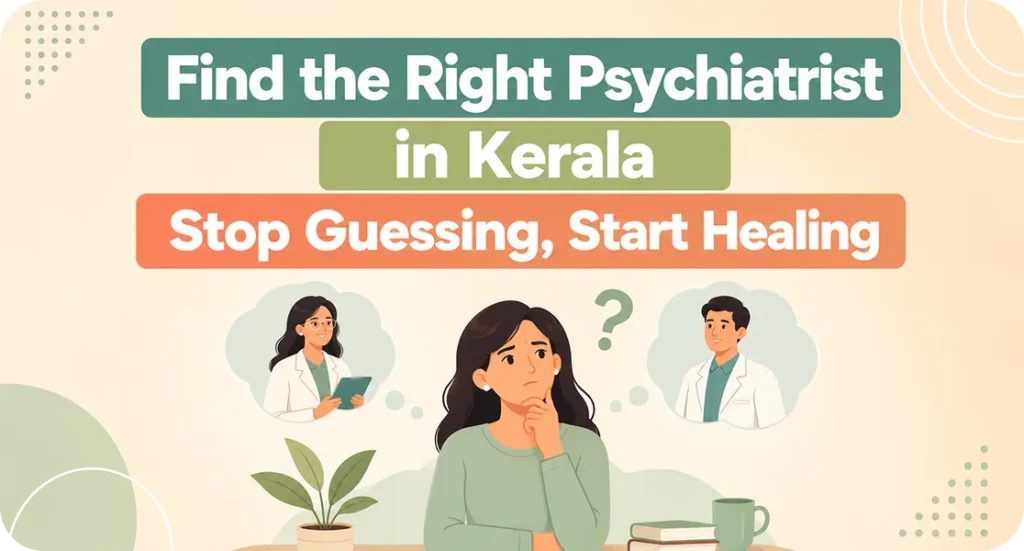
How to find a good psychiatrist in kerala? confused? You have decided you need to speak to someone. Maybe anxiety has been keeping you up for months. Maybe a relationship is breaking down and you cannot see clearly anymore. Maybe the low mood has lasted long enough that you have stopped pretending it will pass on its own. The decision to seek help is made. And then comes the part nobody tells you about: actually finding the right person.
In Kerala, this is more complicated than it should be. Type “psychiatrist in Kerala” into Google and you get a long, varied list — clinics, platforms, hospital departments, private practitioners — with no clear way to evaluate them from the outside. The credentials look similar. The websites look professional. Some charge ₹500, some charge ₹3,000, and there is nothing obvious explaining why. You do not know whether you need a psychiatrist or a psychologist, whether online therapy is as good as going in person, or what questions you are even supposed to ask.
Need to Talk to Someone?
Book a private online session with a licensed therapist
This article removes the confusion. It explains what the different credentials mean and who treats what, the difference between a psychologist and a psychiatrist, what to look for in a good therapist in Kerala, the red flags that should make you walk away, and how to access quality online counselling in Kerala without having to figure it all out from scratch.
By the end, you will know exactly what to look for — and what questions to ask before you commit.
First: Psychologist or Psychiatrist? Getting This Right Matters
The most common confusion Keralites have when seeking mental health support is not knowing the difference between a psychologist and a psychiatrist. They are distinct professions, they treat different things, and going to the wrong one can mean months of delay before you get the right help.
What a Psychiatrist Does
A psychiatrist is a medical doctor — MBBS plus postgraduate specialisation in psychiatry (MD Psychiatry or DPM). Psychiatrists are medically trained to diagnose mental health conditions and prescribe medication. They manage conditions that require pharmacological intervention — severe depression, bipolar disorder, schizophrenia, psychosis, addiction requiring detoxification, and moderate to severe anxiety where medication alongside therapy is indicated.
If your GP has told you that medication may be appropriate, if you are experiencing symptoms that are severe or significantly impairing daily functioning, or if you have had a previous diagnosis requiring medical management, a psychiatrist is the right first point of contact.
One important note for Keralite patients: a psychiatrist is not a therapist. A psychiatric appointment typically involves assessment, diagnosis, and medication management. It does not typically involve the structured psychological therapy — CBT, interpersonal therapy, ACT — that addresses the cognitive and behavioural patterns maintaining conditions like anxiety, depression, and relationship difficulties. Many patients need both. Some need only one.
What a Psychologist Does
A clinical psychologist in India holds an M.Phil. in Clinical Psychology from a Rehabilitation Council of India (RCI) accredited institution, or an equivalent doctoral-level qualification. This is the highest level of psychological training in India and qualifies the practitioner to assess, diagnose, and treat the full range of mental health conditions using evidence-based psychological therapies.
A Online counselling psychologist typically holds an M.Sc. or M.A. in Counselling Psychology. A consultant psychologist has advanced postgraduate training and specialist clinical experience. A counsellor may hold anything from a diploma to a master’s degree, with significant variation in clinical scope and training depth.
For most presentations of anxiety, depression, relationship difficulties, work stress, grief, and adjustment problems, a clinical or counselling psychologist is the appropriate first professional to see. They do not prescribe but can refer to a psychiatrist if medication is also indicated — and the best clinical outcomes for many conditions come from both working together.
Online counselling in kerala
Kerala has a high density of mental health practitioners relative to most Indian states, partly because of its healthcare infrastructure and partly because of the significant demand created by Gulf migration stress, academic pressure, and a growing awareness of mental health needs. But not all practitioners are equally qualified, and the public-facing markers of quality are not always clear.
The RCI Registration
For clinical psychologists and rehabilitation psychologists in India, RCI registration (Rehabilitation Council of India) is the regulatory standard. A registered clinical psychologist has completed their M.Phil. from an accredited institution and meets the professional standards required for independent practice.
Asking a potential psychologist for their RCI registration number is entirely appropriate — the equivalent of asking a doctor for their MCI registration. A qualified practitioner will provide it without hesitation. If a therapist is evasive about this, that is a significant red flag.
Degrees That Mean Something
When evaluating credentials on a website or clinic profile, the following qualifications are meaningful for psychological practice in Kerala:
M.Phil. in Clinical Psychology (RCI accredited) is the primary qualification for a clinical psychologist. M.Sc. in Clinical Psychology or Counselling Psychology from a recognised university indicates a counselling psychologist or counsellor. Ph.D. in Psychology from an accredited institution indicates doctoral-level training. MBBS plus MD Psychiatry or DPM indicates a psychiatrist.
Qualifications that require more scrutiny include short-term diplomas in counselling, certifications from unaccredited online providers, and generic “life coaching” or “wellness coaching” credentials that carry no regulatory oversight. These practitioners may be helpful for adjustment difficulties and life transitions, but they are not appropriate for clinical presentations of anxiety disorders, depression, trauma, or complex mental health conditions.
The Specialisation (clinical psychology)
A general practitioner in any field treats a wider range of conditions less deeply than a specialist. The same is true in psychology. A psychologist who lists “anxiety, depression, relationships, trauma, OCD, eating disorders, addiction, and career counselling” as areas of practice may genuinely cover all of these — or may have superficial familiarity with most of them. Asking specifically about experience with your presenting concern, and how many clients with similar presentations the therapist currently works with, gives you more useful information than a credential list.
Five Qualities That Separate Good Psychologists From Average Ones
Beyond credentials, the quality of the therapeutic relationship is the single strongest predictor of therapy outcomes. A comprehensive meta-analysis published in Psychotherapy by Horvath and colleagues found that the therapeutic alliance — the quality of the collaboration between therapist and patient — accounts for a significant proportion of positive outcomes, independent of the specific technique used.
This means that finding the right person is as clinically important as finding the right credential. Here is what to look for.
They Use Evidence-Based Approaches
A good psychologist in Kerala should be able to name the specific therapeutic approach they use and explain why it is appropriate for your presenting concern. Cognitive Behavioural Therapy (CBT) is the most extensively evidenced treatment for anxiety disorders and depression. Interpersonal Therapy (IPT) is specifically evidenced for depression and relationship difficulties. EMDR and trauma-focused CBT are appropriate for trauma. DBT is used for emotional dysregulation and borderline presentations.
According to a comprehensive meta-analysis published in Psychological Medicine, CBT produces large effect sizes across all major anxiety disorder categories with effects durable at long-term follow-up. A therapist who cannot name a specific evidenced approach, who speaks only in vague terms about “holistic” or “integrated” practice, may simply be a less trained practitioner using the language of sophistication to obscure the absence of structured clinical training.
They Can Formulate Your Specific Problem
A good psychologist does not apply a generic framework to everyone. In early sessions, they should be developing a personalised formulation — a specific model of how your particular anxiety, depression, or relationship difficulty is maintained, and what the treatment plan will target. This formulation should be shared with you and refined collaboratively. If a therapist begins treatment without ever developing a clear shared understanding of what is driving your difficulty, that is a sign of limited clinical training.
They Are Clear About Structure and Duration
Evidence-based therapy is time-limited and goal-oriented. A standard course of CBT for an anxiety disorder typically involves 12 to 20 sessions. A good psychologist should be able to give you a realistic estimate of duration, explain what sessions will involve, and set measurable goals. Indefinitely open-ended therapy with no clear structure or endpoint is less aligned with the evidence base and should prompt questions.
They Maintain Appropriate Boundaries
This should go without saying, but it is worth stating: a good therapist maintains clear professional boundaries. They do not share personal information beyond what serves the therapeutic work. They do not contact you outside sessions without clinical reason. They do not develop social relationships with clients. Any boundary violation is grounds for ending the therapeutic relationship immediately.
They Welcome Questions
A confident, qualified psychiatrist welcomes questions about their training, approach, and experience. Defensiveness about credentials or approach is a red flag. You are entitled to understand who you are working with and why they are recommending the treatment they are recommending.
Red Flags: When to Walk Away
Kerala’s mental health landscape, like that of any rapidly growing sector, includes practitioners whose training is insufficient for the clinical work they are offering. The following are clear signals that a different practitioner is needed.
A therapist who diagnoses you definitively in the first session without a thorough assessment is problematic. Diagnosis requires careful, structured evaluation — not a rapid judgement based on a brief conversation.
A therapist who guarantees outcomes — “I can cure your anxiety in five sessions” — is making a claim that no responsible clinician makes. Outcomes in psychological therapy depend on multiple factors, including the nature and duration of the presenting problem, the quality of the therapeutic relationship, and the patient’s engagement between sessions.
A therapist who discourages you from seeking a second opinion, or who responds to your questions about their approach with irritation rather than openness, is not operating within professional norms.
A therapist who relies heavily on advice-giving rather than structured therapeutic work — who primarily tells you what to do rather than working with you to understand and change the patterns that maintain your difficulty — may be offering support rather than treatment. Support is valuable; it is not the same as evidence-based clinical therapy.
A therapist who does not take a proper history in early sessions, who does not ask about medical background, previous mental health treatment, medications, or family history, is missing the clinical foundation of good psychological practice.
Online vs In-Person Psychiatrist in Kerala: The Evidence
One of the most practically important questions for Keralites seeking psychological support is whether online therapy is as good as in-person. The answer, based on the current evidence, is yes for most presentations.
A systematic review published in World Psychiatry confirmed that online CBT produces outcomes equivalent to face-to-face delivery for anxiety disorders, depression, and relationship difficulties. The therapeutic relationship — the primary driver of outcomes — transfers fully to the video call format. Research published in Psychotherapy Research has also confirmed that patients working in their first language, whether in person or online, produce richer and more effective therapeutic material.
For Keralites, online therapy has specific practical advantages that are worth naming. In Kerala’s dense community networks, being seen attending a mental health clinic carries social risk that deters many people from seeking help they need. Online therapy from home removes this entirely. For those in smaller towns, rural areas, or districts far from major cities, online counselling in Kerala removes the practical barrier of travel. For Gulf NRIs managing the balance of work shifts and the time difference with India, online scheduling flexibility is practically significant.
The main clinical argument for in-person therapy is for presentations requiring close physical observation — some trauma work, assessments where behavioural observation is clinically important, or for individuals who specifically find face-to-face contact more therapeutic. For the majority of common mental health presentations, online is equally effective.
A Practical Checklist Before You Book
Before committing to a psychologist in Kerala, ask these questions either in an initial consultation or directly through the booking platform:
What is your specific qualification and are you RCI-registered? What therapeutic approach do you use and why is it appropriate for my presenting concern? How many clients with similar presentations do you currently work with? How many sessions do you typically recommend for a case like mine? Can we conduct sessions in Malayalam? What is your confidentiality policy? What happens if I feel we are not a good fit?
A qualified, confident practitioner will answer all of these. If any of these questions produce evasion, irritation, or vague non-answers, take that as useful information and look elsewhere.
When to Seek Professional Help
If you are reading this article, you have likely already passed the point of wondering whether you need professional support. But for clarity: seek a psychologist if anxiety has been present most days for six weeks or more. If depression or low mood has not lifted after a month. If relationship difficulties have not improved with your own efforts. If sleep, concentration, appetite, or daily functioning are significantly affected. If you are relying on alcohol or other substances to manage the way you feel.
Seek a psychiatrist if a GP or previous mental health professional has indicated that medication may be appropriate. If symptoms are severe or significantly impairing — difficulty maintaining basic self-care, inability to work or study, significant functional collapse. If there is any history of psychosis, bipolar disorder, or presentations requiring medical management.
For Keralites across Kerala and the diaspora, online counselling in Kerala through Oppam gives you direct access to clinically trained Malayalam-speaking therapists without having to navigate clinic directories, manage privacy concerns, or explain your cultural background from scratch. You can access an online therapist in Kerala from home, in Malayalam or English, with no GP referral required. Book your first session →
Frequently Asked Questions
Is there a Malayalam-speaking psychologist in kerala?
For psychiatric assessment and medication management, look for a practitioner with MBBS and MD Psychiatry or DPM from a recognised medical institution, and MCI (Medical Council of India) registration. Government medical colleges in Kerala — Medical College Thiruvananthapuram, Kozhikode Medical College, Government Medical College Thrissur — have psychiatry departments with qualified practitioners. Private psychiatric clinics in Kochi, Kozhikode, and Thiruvananthapuram are also available. If your presenting concern is primarily psychological rather than requiring medication, starting with a psychologist who can refer to a psychiatrist if needed is often more efficient. Oppam’s clinical team can advise on the right first step based on your specific presentation.
How do I find a good psychologist in Kerala?
Start by clarifying what you need: a psychiatrist for medication management, a clinical psychologist for structured therapy, or a counsellor for adjustment difficulties. Ask specifically about RCI registration, therapeutic approach, and experience with your presenting concern. Request an initial consultation before committing to a full course. Check whether Malayalam-language sessions are available if that is clinically important to you. For direct access to qualified, culturally competent therapists, online counselling Kerala through Oppam removes the need to research and vet practitioners individually.
How do I find a good psychiatrist in Kerala?
For psychiatric assessment and medication management, look for a practitioner with MBBS and MD Psychiatry or DPM from a recognised medical institution, and MCI (Medical Council of India) registration. Government medical colleges in Kerala — Medical College Thiruvananthapuram, Kozhikode Medical College, Government Medical College Thrissur — have psychiatry departments with qualified practitioners. Private psychiatric clinics in Kochi, Kozhikode, and Thiruvananthapuram are also available. If your presenting concern is primarily psychological rather than requiring medication, starting with a psychologist who can refer to a psychiatrist if needed is often more efficient. Oppam’s clinical team can advise on the right first step based on your specific presentation.
How much does a psychologist cost in Kerala?
Private psychologist fees in Kerala typically range from ₹1000 to ₹2,500 per session, depending on qualifications, experience, and location. Government hospital services are available at lower cost but with significant waiting times and variable cultural competence. Online psychologist consultation Kerala through Oppam is priced accessibly for Keralite clients, with transparent fees visible before booking. No GP referral is required. For Gulf NRIs accessing Kerala-based online counselling, session fees are comparable to the cost of a single private GP visit.
Can I get therapy in Malayalam online?
Yes. Oppam offers online therapy Kerala in Malayalam and English, via secure video call, from anywhere in Kerala or the South Asian diaspora. Working in Malayalam is a clinical advantage — research published in Psychotherapy Research has confirmed that patients working in their first language produce richer, more emotionally connected therapeutic material. For Keralites whose emotional experiences, family relationships, and core reference points are in Malayalam, finding a psychologist Kerala online who works in the language makes a real clinical difference
What should I ask a psychologist before my first session?
The most important questions are: What is your specific qualification and RCI registration number? What therapeutic approach do you use and why is it appropriate for my presenting concern? How many sessions do you typically recommend? Can we work in Malayalam? What is your confidentiality policy? A qualified, confident psychologist will answer all of these clearly. Vagueness or defensiveness about any of these questions is a signal to look for a different practitioner.
How do I find malayalam counselling near me in Kerala?
If you are in kerala and looking for Malayalam counselling near you, Oppam’s calicut centre is the direct answer. You can book an in-person appointment if you are in or 3rd Floor, Multi Arcade, Mini Bypass Rd, Karaparamba, Kozhikode, Kerala 673010, or access online sessions from anywhere in the city. Visit oppam.com to book directly, or search for “Oppam Mental Health Centre Calicut” on Google Maps for directions to the calicut location.
If you are a Keralite looking for a psychologist who speaks your language, understands your community, and can work with you in Malayalam — Oppam’s mental health centre in Calicut is built for exactly that. In-person appointments are available at the Calicut centre, and online therapy Calicut is accessible from anywhere in the city via secure video call in Malayalam and English. Sessions are ₹1,500, with no referral required. Book your first session →
External Resources
- Psychotherapy Research (Aragno and Schlachet) — Working in first vs second language in therapy; richer emotional material produced when working in native language
- World Psychiatry — Systematic review confirming equivalence of online and in-person therapy outcomes across major mental health conditions
- Social Psychiatry and Psychiatric Epidemiology — Internal migration and mental health risk; adjustment stress, social isolation, and erosion of support networks in migrant populations
- American Psychiatric Association / DSM-5 — Diagnostic criteria for anxiety disorders, depressive disorders, and substance use disorders treated at Oppam Bengaluru
- NICE (UK) — Evidence-based treatment guidelines for anxiety and depression; CBT as first-line recommendation
Struggling?
Talk to an Oppam Therapist
Get the Support You Deserve Online & Confidential