Perfectionism in Kerala culture has become a defining trait, shaping relationships, careers, and daily life. From the expectation of a perfect wife or mother to the demand for top exam scores and flawless work performance, Malayalis often live under intense social pressure to meet high standards. Does perfectionism prevail among Malayalis?
There have been numerous studies and discussions about the culture and characteristics of Malayalis. Is there a culture of perfectionism that has taken shape among Malayalis? What is Perfectionism?
Malayali society lives with high expectations. For example, the expectation of a perfect wife, a perfect mother, perfect employees, children who score high marks in exams, and the constant effort to maintain a high standard of living are all prevalent among Malayalis. This could be a social construct.
- However, as Malayalis increasingly conform to this culture of perfectionism, it significantly impacts their mental health.
- The pressure to achieve high expectations, self-criticism for not meeting these expectations, and fear of failure are all prevalent among Malayalis who strive for perfection. As a result, stress, depression, and burnout are increasingly common among Malayalis.
- Prioritizing mental health is key. By cultivating self-love and self-compassion, individuals can mitigate the adverse effects of perfectionism.
- While a moderate level of perfectionism can be beneficial in promoting diligence and attention to detail, excessive perfectionism can lead to significant mental strain.
Seeking professional help, such as therapy for perfectionism in Malayalam or counseling, can be an effective way to manage perfectionism and achieve better mental health.
Need to Talk to Someone?
Book a private online session with a licensed therapist
Learn more about overcoming the perfectionist culture among Malayalis and its associated challenges…
Why Perfectionism is Common in Kerala Society?
Perfectionism is a complex and multifaceted personality trait characterized by a persistent and relentless striving for flawlessness and perfection in various aspects of life. It involves setting extremely high standards for oneself or others, often accompanied by overly critical evaluations and a fear of failure or making mistakes.
- High standards: Perfectionists set unrealistically high standards for themselves or others, often based on an idealized or unrealistic expectation of what is achievable.
- Self-criticism: Perfectionists are often overly critical of themselves when they fail to meet their high standards, which can lead to feelings of inadequacy, guilt, and shame.
- Fear of failure: Perfectionists often fear failure or making mistakes, which can lead to anxiety, stress, and avoidance behaviors.
- Need for control: Perfectionists often strive for control and order in their lives, which can manifest as a need to micromanage or dictate how things should be done.
- All-or-nothing thinking: Perfectionists often engage in all-or-nothing thinking, where they view themselves or others as either perfect or completely flawed.
- Anxiety and stress: The pressure to meet high standards can lead to increased anxiety and stress levels.
- Depression: The fear of failure and self-criticism can contribute to feelings of sadness and hopelessness.
- Burnout: The constant striving for perfection can lead to physical, emotional, and mental exhaustion.
- Low self-esteem: The constant self-criticism and fear of failure can lead to low self-esteem and self-doubt.
- Difficulty in relationships: Perfectionism can lead to unrealistic expectations and criticism of others, which can strain relationships
While perfectionism and high achieving may seem similar, they are distinct. High achieving individuals set high standards for themselves, but they are also able to accept and learn from mistakes. Perfectionists, on the other hand, often struggle with self-criticism and an excessive fear of failure.
The cultural emphasis on perfectionism among Malayalis is also influenced by societal factors. Malayalis place great importance on their society and culture, which leads to a complex interplay of cultural expectations, social pressures, parental expectations, and personal factors that contribute to this pressure to be perfect.
1. Societal pressures
- Kerala is a highly competitive society, and achieving good education and jobs requires significant effort.
- This competitive culture is growing rapidly in Kerala. However, the mental pressure that comes with it is often not discussed openly.
- The influence of media also plays a significant role in shaping societal expectations. With the promotion of luxurious lifestyles and the spread of unrealistic expectations through social media and other platforms, Malayalis often feel pressured to achieve perfection in their lives.
- The unrealistic expectations created by social media platforms lead to significant mental stress as individuals strive to shape their lives and culture accordingly.
In the process, mental health is often neglected. In such cases, seek professional help, counseling, and therapy. This is essential to address the mental health implications of perfectionism and societal pressures.
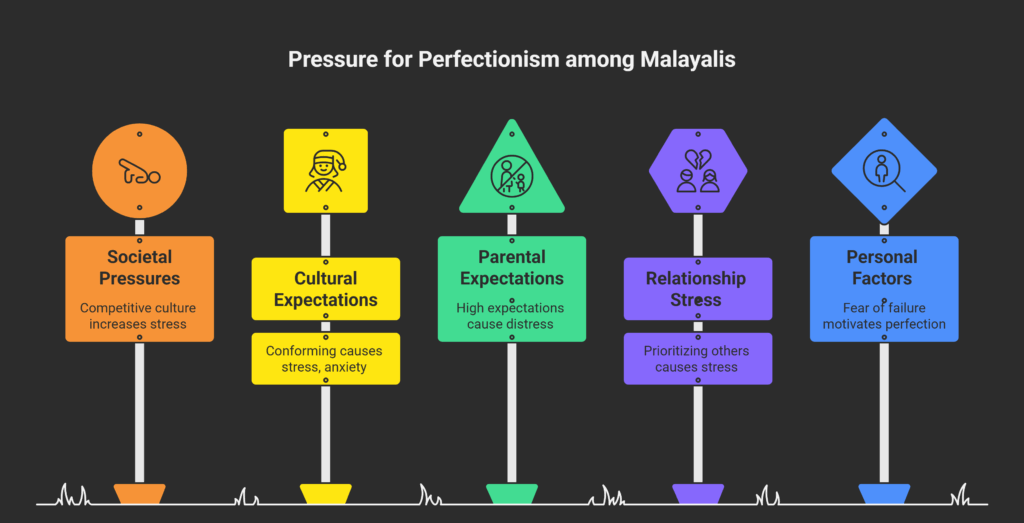
2. Cultural expectations
- In Malayali culture, society, and its norms play a significant role in shaping individual behavior. This can lead to significant mental stress, which is often not addressed.
- The pressure to conform to traditional norms and standards can cause stress, anxiety, and depression.
- In Malayali culture, education is highly valued, which can be positive. However, the emphasis on academic achievement can lead to pressure to score high marks, secure top ranks, and achieve academic success.
- This can lead to significant mental distress in children and even suicidal tendencies. Additionally, family is highly valued in Malayali culture, and individuals often live with their families.
- The responsibility to maintain family reputation and prestige can create significant pressure on individuals, leading to a culture of perfectionism.
In such cases, individuals may experience significant mental stress. Seeking therapy and counseling for perfectionism can help address these issues.
3. Parental expectations
- In Malayali culture, respecting and following parents’ instructions is a common trend. This can lead to significant mental stress as individuals prioritize their parents’ expectations over their desires.
- Malayali parents often have high expectations for their children, pushing them to excel academically and in other areas. This can lead to a competitive mindset, where parents enroll their children in various coaching centers and activities without considering their interests.
- This pressure can lead to significant mental distress, anxiety disorders, depression, and even suicidal tendencies.
- The effort to be perfect in the eyes of parents and society can ultimately take a toll on a child’s mental health.
- Additionally, Malayali parents often prioritize discipline, which can lead to significant pressure on children.
Seeking counseling and therapy can help individuals recover their mental health. Parental counseling and therapy for perfectionism in malayalam can be beneficial in addressing these issues.
4. Relationship stress
- Malayalis often prioritize what others think, which can lead to significant stress in relationships.
- In family relationships, social relationships, romantic relationships, marital relationships, and friendships, Malayalis struggle to maintain perfectionism.
- Many Malayalis endure difficulties, both big and small, and live with the pressure of what others might think. This can lead to significant mental stress and even domestic violence.
In such cases, cultural therapy, therapy for perfectionism in Malayalam, and relationship stress therapy can be helpful. Online relationship counseling in Malayalam can also be beneficial in improving relationships, making them more harmonious and healthy, and increasing overall life satisfaction.
5. Personal factors
- The reasons for perfectionism can also be personal, beyond societal, cultural, parental, and relational pressures.
- Fear of failure is a significant motivator for Malayalis to strive for perfection. The emphasis on winning and succeeding can lead to an unhealthy attitude towards failure.
- Children often learn this behavior from their parents, who may prioritize winning and achievement over other aspects of life. This can create significant internal conflict and self-criticism.
- Additionally, Malayalis often strive for success and achievement, which can lead to perfectionism.
- Self-criticism and negative self-talk can also contribute to perfectionism, as individuals may feel the need to be perfect to compensate for perceived shortcomings. This can lead to anxiety, stress, and burnout.
Seeking counseling and therapy can be an effective solution, and perfectionism therapy can help individuals find happiness and achieve mental well-being.
Perfectionism can have a significant impact on both relationships and work, leading to challenges and difficulties in various areas. Here’s a detailed explanation of how perfectionism can affect relationships and work:
Impact on Relationships:
- Unrealistic expectations: Perfectionists often have high expectations for themselves and others, which can lead to disappointment and frustration in relationships.
- Criticism and judgment: Perfectionists may be overly critical and judgmental of others, which can lead to feelings of resentment and hurt.
- Difficulty with intimacy: Perfectionists may struggle with intimacy and vulnerability in relationships, as they may feel the need to present a perfect image.
- Conflict and arguments: Perfectionists may be more prone to conflict and arguments in relationships, as they may have high expectations for others and become frustrated when these expectations are not met.
- Difficulty with forgiveness: Perfectionists may struggle with forgiveness, as they may feel that others should be perfect and not make mistakes.
Impact on Work:
- Overemphasis on details: Perfectionists may become overly focused on details, which can lead to inefficiency and decreased productivity.
- Analysis paralysis: Perfectionists may struggle with decision-making, as they may feel the need to consider every possible option and outcome.
- Burnout and exhaustion: The constant striving for perfection can lead to physical, emotional, and mental exhaustion.
- Difficulty with delegation: Perfectionists may struggle with delegating tasks, as they may feel that others will not do the task to their standards.
- Impaired creativity: Perfectionism can stifle creativity, as individuals may feel the need to conform to certain standards or expectations.
- Strained relationships: Perfectionism can lead to strained relationships, as others may feel criticized, judged, or unappreciated.
- Decreased productivity: Perfectionism can lead to decreased productivity, as individuals may become overly focused on details or struggle with decision-making.
- Increased stress: Perfectionism can lead to increased stress, as individuals may feel the pressure to meet high expectations.
- Decreased job satisfaction: Perfectionism can lead to decreased job satisfaction, as individuals may feel overwhelmed or unfulfilled.
The Anxiety Behind the Perfectionist
Perfectionism and anxiety are closely linked, with many perfectionists experiencing high levels of anxiety as a result of their perfectionistic tendencies. The anxiety behind the perfectionist can be attributed to several factors, including:
Fear of Failure
- Fear of not meeting expectations: Perfectionists often fear that they will not meet their own or others’ expectations, leading to feelings of anxiety and self-doubt.
- Fear of making mistakes: Perfectionists often fear making mistakes, which can lead to anxiety and a reluctance to take risks.
Need for Control
- Desire for control: Perfectionists often have a strong desire for control over their environment, which can lead to anxiety when things are outside of their control.
- Fear of uncertainty: Perfectionists often fear uncertainty and unpredictability, which can lead to anxiety and a need for control.
Self-Criticism
- Self-criticism: Perfectionists often engage in self-criticism, which can lead to anxiety and low self-esteem.
- Fear of being judged: Perfectionists often fear being judged or criticized by others, which can lead to anxiety and a need for perfection.
High Expectations
- High expectations: Perfectionists often have high expectations for themselves and others, which can lead to anxiety and stress.
- Pressure to perform: Perfectionists often feel pressure to perform at a high level, which can lead to anxiety and burnout.
Consequences of Perfectionistic Anxiety
The anxiety behind the perfectionist can have significant consequences, including:
-
- Burnout: The constant striving for perfection can lead to physical, emotional, and mental exhaustion.
- Low self-esteem: The self-criticism and fear of failure can lead to low self-esteem and self-doubt.
- Impaired relationships: The need for control and perfection can lead to impaired relationships and difficulty with intimacy.
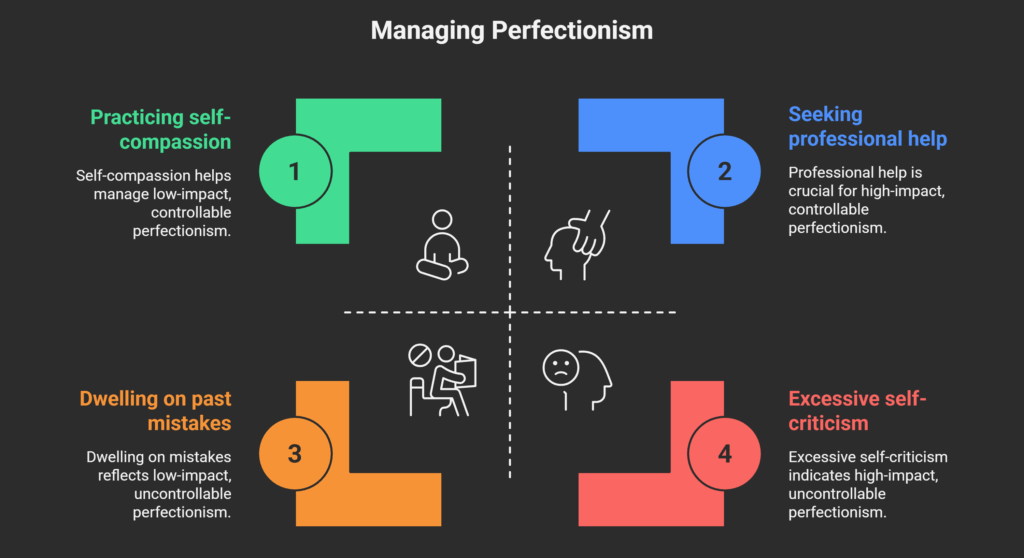
Perfectionism can be a positive personality trait, enabling individuals to be goal-oriented and driven to succeed through focused behavior. However, when perfectionistic behaviors become uncontrollable, they can negatively impact daily life and routines.
Manageable perfectionist behaviors and within one’s control, allowing individuals to strive for excellence without succumbing to debilitating obsessive thoughts or compulsive actions.
1. Practicing self-compassion
-
- Perfectionists tend to be overly critical of themselves, dwelling on mistakes and imperfections, even in minor matters.
- When we can acknowledge and accept our flaws, perfectionism ceases to negatively impact our lives.
- Moreover, when we understand our emotions, desires, and goals accurately and achieve them in a healthy manner, we can maintain mental well-being. This, in turn, enhances our social relationships.
- In some cases, achieving this may require mental health practices. If you’re seeking affordable perfectionism counseling online, consider online therapy for OCD and perfectionism
2. Reducing Self-Criticism
Self-criticism can be beneficial up to a point. It helps us recognize our flaws and negative aspects, allowing us to correct and improve. However, perfectionism often involves excessive self-criticism, dwelling on mistakes and flaws.
To overcome this:
- Recognize that mistakes and failures are an inevitable part of life and opportunities for growth.
- Learn to appreciate small moments and pleasures.
- Seeking professional help can be beneficial when these issues impact daily life, decision-making processes, and overall well-being.
- Online therapy for perfectionism or affordable online counseling can be effective options.
3. Embracing Change
Change is inevitable, and perfectionism often involves dwelling on past mistakes and flaws. This creates significant mental hurdles.
To overcome this:
- Recognize that mistakes and failures are an inherent part of life.
- Acknowledge that growth comes from learning from these experiences.
- Cultivate the ability to appreciate small moments and pleasures.
If these issues impact daily life, routines, and decision-making processes, seeking professional help is the better option. Consider online therapy for OCD and perfectionism or affordable OCD online counseling.
Feeling Overwhelmed?
You’re Not Alone. Get Support from an
Oppam Therapist Wherever You Are
Oppam Therapist Wherever You Are
Book a therapy session for perfectionism and take the first step towards a healthier mindset.
Maintaining a flawless exterior can put your mental health and physical well-being at risk in pursuit of a perfect life (Thomson, 2009).
While perfectionism can be beneficial up to a point, positively influencing life, unhealthy perfectionism can sometimes make life more difficult. Recognizing the difference between healthy and unhealthy perfectionism is crucial to overcoming its negative effects.
Let’s explore how to deal with perfectionism in daily life:
1.Modify Expectations:
Perfectionism often operates with numerous expectations and high standards. To overcome this, try to move beyond your comfort zone and aim for smaller, achievable expressions. By doing so, you can gradually adjust your expectations and develop a more realistic approach to life.
2. Practice Self-Compassion:
Unhealthy perfectionism negatively impacts psychological well-being, self-esteem, and mental health. Mindfulness practices and self-compassion exercises can help improve these areas.
Through these practices, you can:
- Reduce the fear of failure
- Regulate emotions related to perfectionism
3. Reduce Self-Criticism:
Self-criticism can be a positive trait, helping you recognize and correct mistakes and flaws. However, excessive self-criticism can lead to significant mental distress, feelings of unworthiness, and self-blame.
Reducing self-criticism can help boost confidence and manage stress. If stress caused by perfectionism becomes uncontrollable, consider seeking:
can be beneficial. Perfectionists often exhibit goal-directed behaviors, which can be advantageous. However, setting unrealistically high goals can lead to fear of failure.
5. By setting achievable goals
you can reduce this fear. Perfectionists often spend excessive time on tasks, which can be optimized by setting realistic goals.
If you struggle to set such goals, consider:
Both options can help you develop a healthier approach to goal-setting and perfectionism.
6. Avoid Procrastination:
Perfectionists often exhibit significant procrastination, driven by the fear of failure. This involves delaying tasks due to the anxiety of not meeting expectations.
To overcome perfectionism, it’s essential to avoid procrastination. By doing so, you can:
- Build confidence in your abilities
- Develop a more realistic approach to tasks
- Reduce stress and anxiety
7. Instead of dwelling on your mistakes and failures, learn to accept them and move forward.
Recognize that mistakes are an inevitable part of life. This mindset shift can be an effective way to overcome perfectionism.
By understanding perfectionism accurately and seeking professional help, you can make your life more beautiful.
Oppam is with you to make your life more wonderful.
What’s important to remember is that being healthy is better than being perfect. Therefore, it’s essential to seek out online counseling and therapy to improve mental health and well-being. With Oppam’s support, you can improve your mental health and well-being. Join hands with Oppam to embark on a journey towards a more fulfilling and meaningful life.
Struggling?
Talk to an Oppam Therapist
Get the Support You Deserve Online & Confidential