
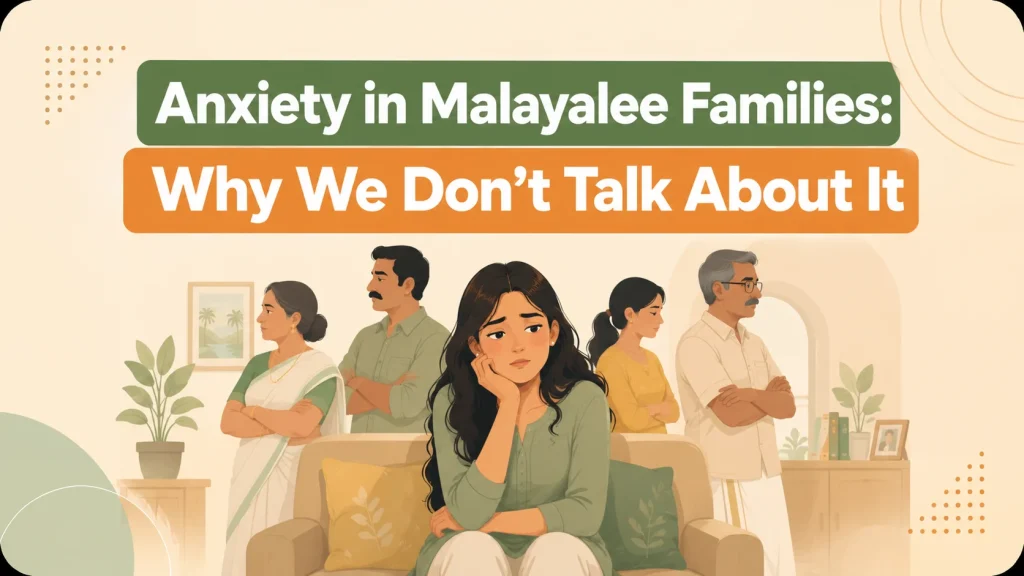
Anxiety in Malayalam Families — Why We Don’t Talk About It ??There is a word in Malayalam — veruppu — that roughly translates as disgust or aversion, but carries a social weight that the English word does not. When a family’s reputation is threatened, or when someone does something that causes collective shame, it is veruppu that the community feels. It is a powerful regulatory force, and it works in large part because everyone knows it exists and nobody wants to be its subject.
It is also, quietly, one of the reasons anxiety goes unnamed in Keralite families for so long.
When psychological distress is disclosed, it risks the family’s standing. When someone sees a psychologist, the question becomes: what did the family do wrong? Mental illness — and anxiety, in the popular imagination, is a form of mental illness — implies fragility, dysfunction, a failure of the collective to produce a strong, capable person. So the anxiety gets another name. Overthinking. Tension. Stress from studies. A physical complaint the body has produced for reasons that are not psychological. It gets managed, carried, endured. What it does not get is treated.
This article is an honest examination of why anxiety in Malayalam families so rarely gets named, the specific cultural mechanisms that keep it hidden, and why understanding those mechanisms is the first step towards changing them. It is written for Keralites — in Kerala, in the Gulf, and across the diaspora — who have spent years managing something that had a name they were never given.
The Language We Use (and Don’t Use)
Language shapes what is possible to experience, and in Malayalam, the vocabulary for psychological distress is thin.
There are words for grief — saadhanam, for sorrow. There are words for worry — parakkam, the anxious fluttering feeling. There are words for tension and pressure. But there is no common vernacular Malayalam equivalent for anxiety as a clinical concept — no phrase that captures the sustained, physiological, cognitively specific experience of an anxiety disorder in the way that the English term does when properly explained.
This is not unique to Malayalam. Research published in Transcultural Psychiatry has consistently documented that in many South Asian languages, the vocabulary for psychological distress maps imprecisely onto Western clinical categories — not because the experiences do not exist, but because the conceptual frameworks used to organise and communicate them are different. In a culture where the body is the primary legitimate channel for distress, the chest that tightens is heart trouble, not anxiety. The stomach that churns before a family event is digestive problems, not social anxiety.
This linguistic gap has a practical consequence: if there is no word for something, it is very difficult to seek help for it. A person can go to a GP with chest tightness. They cannot easily go to the same GP and say “I have an anxiety disorder” if that category does not exist in their mental framework. The clinical condition remains inaccessible, even when the suffering is entirely real.
What Keralite Culture Does With Emotional Distress
To understand why anxiety is so rarely talked about in Malayalam families, it is necessary to understand what Keralite culture does — and does not do — with difficult emotions more broadly.
The Priority of Endurance
Kerala has a cultural heritage that valorises sacrifice, endurance, and the subordination of individual need to collective wellbeing. The parent who works themselves to exhaustion for their children’s education. The wife who manages the household and her own distress without troubling her husband. The NRI worker who sends every spare dirham home and does not mention how depleted he feels. These figures are admired, not pitied, because in the Keralite cultural frame, the capacity to carry difficulty without complaint is a mark of character.
This value is not wrong. It reflects a real and honourable tradition of resilience that has served generations of Keralite families through genuine hardship. But it creates a specific problem for mental health: it makes the disclosure of psychological distress feel not just unnecessary but morally suspect. To say “I am struggling” is, in this framework, to announce that you are not strong enough — a failure, not a health disclosure.
The Collective Over the Individual
In most Western psychological frameworks, the individual is the primary unit of concern. Their wellbeing, their autonomy, their internal experience — these are the relevant metrics. In Keralite family culture, the relevant unit is the family. The individual’s distress is meaningful primarily in terms of what it means for the collective — whether it reflects badly on the family, whether it creates burden, whether it interferes with the person’s capacity to fulfil their family role.
This orientation produces a specific barrier to seeking help. A young woman who is struggling with anxiety may not ask “what do I need?” She asks “what will happen to my family if I do?” If the answer involves shame, cost, disruption to the family’s plans, or the implicit suggestion that the family environment contributed to the problem, the incentive to seek help is powerfully suppressed.
Research published in the International Journal of Social Psychiatry examining help-seeking patterns in South Asian communities found that shame about being identified as mentally ill — and the perceived impact of that identification on the family rather than the individual — was the single most commonly cited barrier to seeking professional help. The data confirm what anyone who has grown up in a Keralite family already knows from lived experience.
Somatisation as the Available Language
Because psychological distress lacks a legitimate vocabulary in Keralite family culture, it finds its expression through the body. This is somatisation — the conversion of psychological suffering into physical symptoms — and it is not a choice or a manipulation. It is what happens when the emotional channel is unavailable and the physical channel is the only legitimate one.
The Keralite person with anxiety does not typically say “I am anxious.” They say their chest is heavy, that they have been getting frequent headaches, that their stomach has been troublesome, that they have not been sleeping. These are true statements — the physical symptoms of anxiety are real and measurable — but they describe the expression of the problem rather than its source. The GP investigates the chest and the stomach. The source remains untouched.
According to research published in the Indian Journal of Psychiatry, somatisation is more prevalent in South Asian clinical populations than in Western comparison groups, and significantly delays the identification and treatment of underlying psychological conditions. The average time between symptom onset and psychological referral, in cases where somatisation is the primary presentation, is several years.
The Specific Barriers in Keralite Communities
The Reputation Economy
Keralite communities — whether in Thrissur or Sharjah, in London or in Sydney — operate within a dense reputation economy. Information travels. Families are known quantities. The choice of school, the results of an exam, the timing of a marriage, the career of a child: all of these are community-level events as much as family ones.
In this environment, seeking mental health support carries risks that go beyond personal stigma. If it becomes known that someone in the family is seeing a psychologist, the questions begin. Is there instability in the family? Is the marriage in trouble? Are the children not coping? The person seeking help is not just making a personal health decision — they are potentially introducing a variable into the community’s assessment of their family that they cannot control once it is known.
Online therapy is particularly significant in this context because it removes the visibility that makes help-seeking socially risky. A Keralite woman in Kochi who accesses online counselling in Kerala through Oppam does not have to pass through a waiting room where she might be seen, does not have to explain an appointment to her family, and does not create a legible social event that enters the community’s information flow. The same therapy, delivered privately and accessibly, removes one of the most concrete barriers to seeking it.
The Role of Religion and Fate
For many Keralite families — across Christian, Muslim, and Hindu communities — there is a framework of divine will and fate that shapes how suffering is understood. Difficulty is something to be accepted, offered up, or prayed through. The idea of paying a psychologist to help manage what God has given you can feel, in some families, like a failure of faith or a category error.
This is not a simple barrier to dismiss. It is a deeply held framework that provides genuine meaning and comfort for many people, and it deserves respectful engagement rather than clinical dismissal. What is worth naming is that psychological treatment and spiritual practice are not in competition. Anxiety is a neurobiological and psychological condition, not a spiritual deficiency. Managing it through therapy does not preclude prayer, community, or faith — it addresses a different level of the same suffering.
The Model of Strength in Men
In Keralite culture, the expectation that men will not disclose psychological distress is particularly acute. The Gulf NRI worker, the family’s breadwinner, the person on whom multiple people depend: acknowledging anxiety is, in this framework, a threat to the role identity that structures his entire relationship to his family and his sense of purpose.
The consequence is that anxiety in Keralite men is particularly likely to be expressed through behavioural channels rather than disclosed: irritability, alcohol use, workaholism, withdrawal, physical complaints that are invested in repeatedly rather than the psychological source being acknowledged. These presentations reach clinical services, if at all, significantly later than the anxiety that produced them.
Research published in Social Science and Medicine examining South Asian male help-seeking patterns found that internalisation of distress, stigma about mental health treatment, and gender role conflict were the primary barriers to care among South Asian men — with the interaction between these factors creating a particularly robust resistance to disclosure.
What Is Changing — and Why It Matters
The silence around anxiety in Malayalam families is not permanent. It is a cultural pattern, and cultural patterns shift — slowly, unevenly, but measurably.
The generation of Keralites who grew up with smartphones and social media has access to mental health information that was not available to their parents. The diaspora experience, for all its stresses, creates exposure to cultural frameworks in which therapy is normalised. The COVID-19 pandemic produced a global increase in mental health awareness that reached Kerala and the Gulf as much as anywhere else. And the growth of Malayalam-language mental health content — articles, podcasts, social media accounts — means that the vocabulary is gradually developing, even if the clinical terminology has not yet fully arrived.
What remains to be bridged is the gap between awareness and action. Many Keralites now know, in the abstract, that therapy exists and that anxiety is a treatable condition. The barriers that prevent them from actually booking a session are more specific: the privacy concern, the cost, the difficulty of finding a therapist who speaks Malayalam and understands the cultural context, and the residual weight of the belief that seeking help means admitting failure.
Oppam exists precisely to address this gap. The ability to access a Malayalam-speaking psychologist online, from home, without creating a visible appointment in the community, removes the most concrete of these barriers. The remaining work — of changing how families talk about distress, of building the vocabulary, of shifting the association between help-seeking and weakness — is a longer process. But it begins with one person deciding that their anxiety deserves proper attention.
When to Seek Professional Help
If you have read this article and recognised your own family in it — the silence, the alternative names, the endurance, the physical symptoms that have never been adequately explained — that recognition matters and is worth acting on.
Seek professional support if anxiety has been present most days for six weeks or more. If it is affecting your sleep, your work, your relationships, or your capacity to do what matters to you. If physical symptoms have been repeatedly investigated without a clear medical explanation. If you have been managing alone for years and the management is no longer sufficient.
For Keralites in Kerala and across the diaspora, online counselling in Kerala through Oppam is accessible, private, and available in Malayalam — which means you can speak about your experience in the language in which you actually experience it, without translating or simplifying. The first session does not require you to have everything figured out. It requires only that you decide the current situation is worth changing. Book your first session →
Frequently Asked Questions
Why don’t Keralites talk about mental health?
Several interlocking cultural factors create this silence. Endurance and the subordination of individual need to family welfare are deeply valued, making psychological disclosure feel like weakness. Mental health stigma in Keralite communities is tied to family reputation — seeking help risks not just personal exposure but the family’s standing in a tightly networked community. The vocabulary for psychological distress in Malayalam is limited, making it difficult to name what is being experienced. And a strong tradition of somatisation means psychological distress is expressed physically rather than emotionally, delaying recognition. These factors are cultural patterns, not fixed facts — and they are beginning to shift.
Is anxiety common in Kerala?
Yes, though it is significantly underdiagnosed. According to the World Health Organisation, anxiety disorders affect approximately 7 per cent of the global population — there is no evidence that Keralites are less susceptible, and several cultural factors (academic pressure, Gulf migration stress, social comparison, family obligation) create specific vulnerabilities. What is different in Kerala is not the prevalence but the recognition and treatment rate. Somatisation, stigma, and limited mental health vocabulary mean that many Keralites with clinical anxiety are seen by GPs and cardiologists for years before a psychological explanation is considered.
How do I talk to my Keralite family about my anxiety?
This is one of the most common practical challenges people raise, and there is no single formula. A few principles that help: frame the conversation around the practical impact rather than the emotional experience — “I have not been sleeping and it is affecting my work” is more likely to be received than “I feel anxious.” Choose a calm, private moment rather than raising it during a conflict. Avoid framing that implies the family caused the problem, even if family dynamics are a factor. If direct conversation feels too exposing initially, accessing therapy independently and raising the topic with family once you have a clearer understanding of your own experience is a legitimate approach.
Does seeking therapy mean I am not strong enough?
No — and it is worth examining where this belief comes from and whether it is accurate. Strength is not the absence of difficulty; it is the capacity to address difficulty effectively. Spending years managing an untreated anxiety disorder through sheer endurance is not a demonstration of strength — it is a demonstration that professional support was unavailable or inaccessible. The person who seeks treatment earlier recovers more completely, with less disruption to their life and relationships, than the person who waits until the anxiety has entrenched. By any practical measure, seeking help when it is needed is the more effective choice.
Where can I find online therapy in Kerala in Malayalam?
Oppam offers online therapy Kerala in Malayalam, Tamil, and English, with psychologists trained in evidence-based approaches for anxiety disorders. Sessions are conducted via secure video call and are accessible from anywhere in Kerala or the South Asian diaspora. There is no need for a GP referral or a clinic visit, and the privacy of online delivery means the session does not create a visible social event in your community. You can book directly through oppam.com.
Is online counselling as effective as seeing a psychologist in person?
Yes. Multiple randomised controlled trials have confirmed that online therapy produces outcomes equivalent to face-to-face therapy for anxiety disorders, including GAD, social anxiety, panic disorder, and health anxiety. For Keralite patients specifically, online delivery has additional advantages: it removes the privacy concern of attending a local clinic, makes a Malayalam-speaking therapist accessible regardless of location, and allows sessions to be scheduled around work and family obligations. The therapeutic relationship, which is the core of effective therapy, translates fully to the online format.
Can anxiety be treated without my family knowing?
Yes. Therapy is confidential, and Oppam’s online sessions are private by design — there is no clinic waiting room, no visible appointment, and no disclosure required to anyone in your family or community. Many people begin therapy independently, develop a clearer understanding of their own experience, and then make a decision later about whether and how to share this with family. That decision belongs to you. The first step does not require anyone else’s involvement or approval.
Sources
- Transcultural Psychiatry — Imprecise mapping of Western clinical categories onto South Asian languages; vocabulary gaps in psychological distress terminology
- International Journal of Social Psychiatry — Shame about family impact of mental illness as primary barrier to help-seeking in South Asian communities
- Indian Journal of Psychiatry — Prevalence of somatisation in South Asian clinical populations; delay between symptom onset and psychological referral
- Social Science and Medicine — South Asian male help-seeking barriers: internalisation of distress, stigma, gender role conflict
- World Health Organisation — Global prevalence of anxiety disorders; treatment gap in low- and middle-income countries