Take that first step - Use "NEW15" to get 15% off on your first session!

Take that first step  Use "NEW15" to get 15% off on your first session! Take that first step  Use "NEW15" to get 15% off on your first session! Take that first step  Use "NEW15" to get 15% off on your first session!

14 min read

Breathing Techniques and Grounding Exercises for Anxiety

[post_author_reviewer]
what is anxiety?
What is anxiety? You know the feeling. It is 11 pm and you are lying in bed, replaying a conversation from earlier that day — what you should have said, what they might have meant, whether you made a mistake at work. Your chest feels tight. You cannot quite settle. Sleep should come, but your mind keeps pulling you back.
For many people in Kerala, Tamil Nadu, and across the South Asian diaspora, this kind of relentless mental churning is so familiar it barely registers as unusual. It gets filed away as overthinking, a character flaw, a by-product of ambition, or simply the cost of living far from home. The idea that it might be anxiety — a recognised psychological condition with a name, clear symptoms, and effective treatments — often comes as a surprise.

Need to Talk to Someone?

Book a private online session with a licensed therapist
This is partly cultural. In many South Asian families, there is no easy vocabulary for psychological distress. You were raised to manage, to perform, to not burden others. The Gulf parent working 12-hour shifts to send money home, the student in Canada swallowing homesickness to not worry their family, the daughter-in-law in a joint household who cannot afford to seem weak — these are real contexts, and they shape how anxiety develops, hides, and grows.

What Anxiety Actually Is ? (and What It Isn't)

Anxiety is not weakness, and it is not simply worrying too much. Clinically, it refers to a state of persistent, excessive apprehension or fear that is disproportionate to the actual threat — and that interferes with daily functioning.
The word comes from the Latin anxietas, meaning distress or trouble of mind, but the experience is far older than any diagnostic label. It is rooted in a biological system that humans share with every other mammal: the threat response system, sometimes called the fight-or-flight response.
When your brain perceives danger — whether it is a physical threat like a dog running towards you, or a psychological one like an impending performance review — the amygdala, the brain’s alarm centre, sends a signal. Adrenaline floods the bloodstream. Your heart rate increases. Muscles tense. Breathing quickens. You are ready to act.
This is useful. The problem arises when the alarm fires too often, too intensely, or in response to situations that are not actually dangerous. When your nervous system treats a difficult phone call, a social gathering, or an unanswered message as a life-threatening event, the physical and emotional toll accumulates. That accumulation is anxiety as a clinical condition.
It is worth distinguishing anxiety from ordinary stress. Stress is typically tied to a specific external cause — a deadline, a conflict, a difficult period — and eases when the cause resolves. Anxiety persists beyond the triggering situation. It can exist even when there is nothing visibly wrong, which is one of the reasons people find it so difficult to explain to their families.

The Different Types of Anxiety Disorder

Anxiety is not a single condition. The Diagnostic and Statistical Manual of Mental Disorders (DSM-5), published by the American Psychiatric Association, classifies several distinct anxiety disorders, each with its own pattern of symptoms.

Generalised Anxiety Disorder (GAD)

This is the most common presentation. Generalised Anxiety Disorder involves chronic, pervasive worry about multiple areas of life — health, finances, relationships, work, family — for more days than not, over a period of at least six months. It is accompanied by physical symptoms such as fatigue, muscle tension, difficulty concentrating, and disturbed sleep. Many people with GAD describe themselves as lifelong worriers who assumed it was simply their personality.

Social Anxiety Disorder

Social anxiety disorder involves intense fear of social situations — not shyness, but a deep, often debilitating apprehension about being judged, embarrassed, or scrutinised by others. It can prevent people from attending weddings, speaking up at work, making phone calls, or eating in public. In South Asian contexts, where family reputation, social standing, and appearances carry significant weight, social anxiety can be especially difficult to separate from culturally normal behaviour.

Panic Disorder

Panic disorder is characterised by recurrent, unexpected panic attacks — sudden surges of intense fear accompanied by physical symptoms so severe that many people end up in emergency departments, convinced they are having a heart attack. Racing heart, chest pain, shortness of breath, dizziness, and a terrifying sense of impending doom can all occur within minutes. After a first panic attack, the fear of having another often becomes its own source of anxiety.

Health Anxiety

Formerly called hypochondria, health anxiety involves excessive preoccupation with the belief that you have, or will develop, a serious illness. This has been particularly amplified by the internet, where symptoms can be matched to worst-case diagnoses in seconds. In communities where illness is often spoken about in hushed, fearful terms, health anxiety can take root and persist for years.

Specific Phobias and Separation Anxiety

These are also formally categorised anxiety disorders. Specific phobias involve intense, irrational fear of a particular object or situation — flying, blood, spiders. Separation anxiety, more commonly associated with children but also present in adults, involves excessive fear about being separated from attachment figures.

How Anxiety Feels: Symptoms Beyond Worry

One of the reasons anxiety goes undiagnosed for so long — particularly in South Asian communities — is that its symptoms are often physical rather than obviously psychological.

Physical Symptoms

According to the World Health Organisation, anxiety disorders affect approximately 301 million people globally, making them the most prevalent mental health conditions worldwide. Yet a significant proportion of those affected present to doctors with physical complaints rather than emotional ones.
Common physical symptoms of anxiety include:
  • Persistent headaches or migraines
  • Digestive problems: nausea, irritable bowel, loss of appetite
  • Muscle tension, particularly in the neck, shoulders, and jaw
  • Fatigue that does not improve with rest
  • Heart palpitations or a racing pulse
  • Tingling or numbness in the hands and feet
  • Frequent urination
  • Dizziness or feeling lightheaded
In Kerala specifically, and across South Asian cultures more broadly, there is a well-documented tendency to somatise psychological distress — that is, to experience and express emotional difficulties through the body. Research published in the Indian Journal of Psychiatry has documented this pattern extensively: patients report physical symptoms to their GP for months or years before a psychological cause is identified. This is not fabrication. The body genuinely experiences the physiological effects of chronic anxiety. But it means that anxiety often goes untreated while physical symptoms are investigated instead.

Emotional and Cognitive Symptoms

The psychological dimension of anxiety includes:
  • Persistent, intrusive worry that is difficult to control
  • Difficulty concentrating or making decisions
  • Irritability or a low threshold for frustration
  • A sense of dread that something bad is about to happen
  • Racing thoughts, particularly at night
  • Avoidance of situations that trigger anxiety, even when avoidance causes practical problems

Behavioural Patterns

Anxiety shapes behaviour in ways that are often invisible to others. People with anxiety may over-prepare for everything as a way of managing uncertainty. They may seek constant reassurance from family members. They may say no to opportunities, social events, or new experiences — not because they lack ambition, but because the anticipated anxiety feels unmanageable.

Why South Asians and NRIs Are Particularly Vulnerable

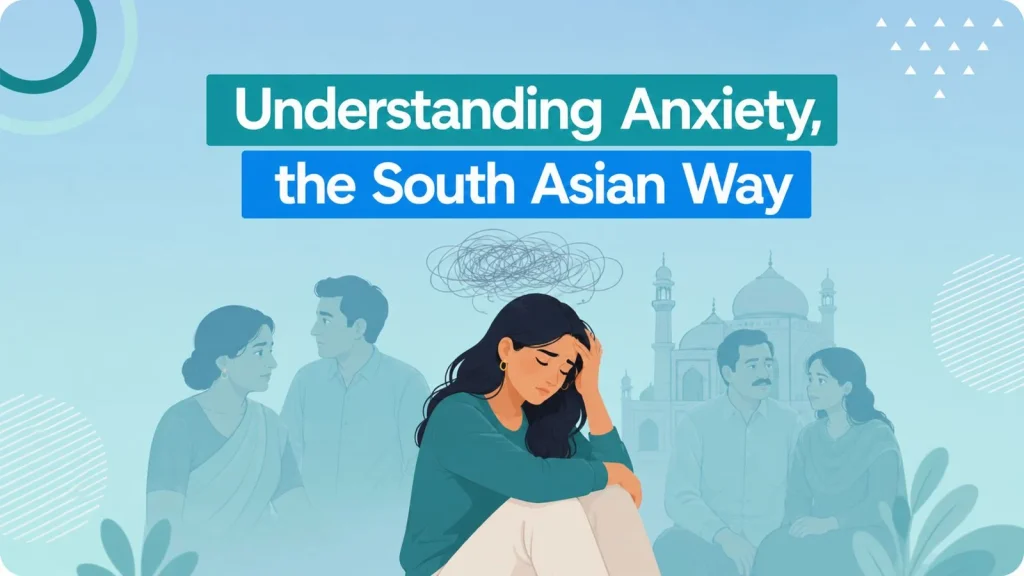
Anxiety does not develop in a vacuum. Cultural context, migration stress, family dynamics, and the specific pressures of South Asian life all shape both the likelihood of developing anxiety and the form it takes.

The Achievement-Validation Cycle

Many South Asian children grow up in households where academic and professional success is closely tied to parental approval and family honour. The pressure to achieve — to get into a good college, to earn well, to make the family proud — creates a baseline of performance anxiety that can persist well into adulthood. When the external validation falters — if the job is lost, the marriage is delayed, the children are not performing as expected — the anxiety that was always present beneath the surface can intensify sharply.

The Diaspora Experience

For NRIs and diaspora communities in the Gulf, UK, Canada, Australia, and Southeast Asia, anxiety often carries an additional layer. There is the practical stress of building a life in a foreign country, navigating systems in a second language, managing immigration paperwork, and maintaining transnational family obligations. There is also the subtler stress of cultural in-between-ness: not fully fitting the culture left behind, and never quite fitting the culture arrived in. Research from the International Journal of Social Psychiatry has consistently identified this acculturation stress as a significant risk factor for anxiety and depression among South Asian diaspora populations.

Stigma and Silence

Mental health stigma in South Asian communities is real and persistent. Seeking psychological support is still, in many families, associated with being “mad”, being weak, or bringing shame. A Keralite woman asking for therapy may worry about what the neighbours will say. An NRI professional may fear that disclosing mental health struggles will be seen as incompetence. This stigma does not cause anxiety, but it prevents treatment — and untreated anxiety compounds over time.

Intergenerational Patterns

Anxiety is also partly heritable. According to research cited by the APA, first-degree relatives of people with anxiety disorders are significantly more likely to develop one themselves. In families where parents modelled anxious responses to uncertainty — where every minor risk was catastrophised, where the world was presented as fundamentally dangerous — children absorb those patterns. In a cultural context where expressing fear or worry is normalised as an expression of care (“I worry about you because I love you”), the line between love and anxiety transmission can be difficult to draw.

Evidence-Based Approaches to Managing Anxiety

Understanding that anxiety is real, that it is biological as well as psychological, and that it responds to treatment is the foundation. The question is: what actually helps?

Cognitive Behavioural Therapy (CBT)

Cognitive Behavioural Therapy is the most extensively researched psychological treatment for anxiety disorders. A review published in JAMA Psychiatry found CBT to be effective for Generalised Anxiety Disorder, panic disorder, social anxiety, and specific phobias — with effects comparable to medication in many cases, and more durable over time.
The core principle of CBT is that our thoughts, feelings, and behaviours are interconnected, and that changing the way we interpret situations can shift how we feel and act. For anxiety, this typically involves identifying cognitive distortions — patterns of thought such as catastrophising (“if I make a mistake, everything will fall apart”), mind-reading (“they think I am incompetent”), and probability overestimation (“something terrible is definitely going to happen”) — and systematically testing whether they are accurate.
A simple CBT technique you can try is the worry record. When anxiety spikes, write down:
  1.  the situation or trigger,
  2. the automatic thought, 
  3. the evidence for and against that thought, 
  4. a more balanced alternative thought.
The process of externalising and examining the thought interrupts the rumination cycle.

Acceptance and Commitment Therapy (ACT)

Acceptance and Commitment Therapy takes a different approach. Rather than challenging anxious thoughts, ACT works on changing your relationship to them. The goal is not to eliminate anxiety but to reduce the degree to which it controls your behaviour. This is particularly relevant in a cultural context: for many South Asians, the very expectation that anxiety should be suppressed or hidden adds a second layer of distress on top of the first.

Breathing and Physiological Regulation

Because anxiety is a physiological state, physiological interventions are effective. Diaphragmatic breathing — slow, deep breaths that engage the belly rather than the chest — activates the parasympathetic nervous system and directly counters the fight-or-flight response. A well-evidenced technique is the 4-7-8 method: inhale for 4 counts, hold for 7, exhale for 8. Practiced consistently, this builds the body’s capacity to down-regulate anxiety responses.

When to Seek Professional Help

There is a range between everyday worry and clinical anxiety disorder, and not everyone who experiences anxiety needs therapy. But there are clear signs that professional support is warranted, and recognising them early matters.
Consider seeking professional help if:
  • Anxiety has been present most days for six weeks or more
  • It is interfering with work, relationships, or daily activities — not just making them harder, but causing you to avoid or fail at them
  • Physical symptoms (headaches, palpitations, insomnia) have not been explained by a physical cause
  • You are relying on alcohol, cannabis, or other substances to manage anxiety
  • You are having panic attacks
  • The anxiety feels out of proportion to anything happening in your life and you cannot trace a cause
  • You have thoughts of self-harm or hopelessness alongside the anxiety
If you see yourself in any of these, that is not weakness — it is information. Anxiety disorders respond well to treatment. The earlier you access support, the less the condition typically entrenches.
Oppam offers online counselling in Malayalam, Tamil, and English, with therapists who understand South Asian family dynamics, diaspora pressures, and the specific cultural contexts that shape your experience. You do not need to explain yourself from scratch. Book your first session →

Frequently Asked Questions

What is the difference between anxiety and normal worry?

Normal worry is typically triggered by a specific situation and resolves when it passes. Clinical anxiety is more persistent, harder to control, and often disproportionate to the actual situation. If worry is affecting your sleep, your concentration, your relationships, or your ability to do your job most days, it has likely moved beyond normal. The key clinical marker is functional impairment — whether anxiety is getting in the way of the life you want to live.

Can anxiety cause physical symptoms?

Yes, and this is one of the most commonly misunderstood aspects of the condition. Anxiety activates the body’s stress response, which produces very real physical effects: increased heart rate, muscle tension, digestive disruption, headaches, fatigue, and more. Many people seek repeated medical investigations for these symptoms before anxiety is identified as the underlying cause. If physical symptoms have no clear medical explanation, psychological causes are worth exploring.

Is anxiety more common among South Asians or NRIs?

Research suggests that South Asian diaspora communities carry elevated risk for anxiety, linked to acculturation stress, intergenerational pressure, migration-related uncertainty, and reduced access to culturally competent mental health support. A study published in the International Journal of Social Psychiatry found significantly higher rates of anxiety and depression among South Asians in the UK compared to the white British population, particularly among first-generation migrants. Cultural stigma also means that anxiety often goes undiagnosed and untreated in these communities.

I feel anxious but my family says I have nothing to worry about — am I overreacting?

This is one of the most common experiences people describe, and no, you are not overreacting. Anxiety does not require an objectively difficult situation to be real. The brain’s threat response can fire in environments that others experience as safe. Feeling invalidated by family — however well-intentioned — is itself a significant barrier to getting help. What you are experiencing is physiologically and psychologically real, and it deserves proper attention regardless of whether others can see a reason for it.

Can online therapy help with anxiety?

Yes. Multiple randomised controlled trials, including a major review published in JAMA Psychiatry, have found that online CBT for anxiety disorders produces outcomes equivalent to in-person therapy for most people. Online therapy also removes practical barriers that disproportionately affect South Asians: the privacy concern of being seen entering a clinic, the difficulty of accessing a Malayalam or Tamil-speaking therapist locally, and the time and cost pressures of in-person attendance.

How much does online therapy cost in India or the Gulf?

Session fees vary depending on the platform, the therapist’s experience, and the country. At Oppam, sessions are priced to be accessible to clients in India, the Gulf, and diaspora markets including the UK, Canada, and Australia. Contact us directly or visit the booking page for current session rates. For many people, the cost of one or two sessions is comparable to a single GP visit or specialist consultation.

What is the best way to support a family member with anxiety?
Avoid minimising phrases like “just relax”, “stop overthinking”, or “you have nothing to worry about” — even if well-intentioned, these reinforce the sense that the person is failing at something they should be able to control. Instead, listen without trying to immediately fix the problem, and gently encourage professional support. You can help most by communicating that anxiety is a health condition, not a character flaw, and that treatment works.

External Resources

Struggling?
Talk to an Oppam Therapist

Get the Support You Deserve Online & Confidential

Mental health isn’t a luxury It’s your right

Feeling tired, stuck, overwhelmed or just not like yourself lately?
Take a pause. Talk to someone who gets it.

There’s more like that

Scroll to Top