This article, written and reviewed by Oppam’s Chief Psychologist Mubashira Rahman, explains why financial stress in relationships does what it does, what the specific patterns look like in Malayali and South Asian couples, and — most importantly — what evidence-based steps actually help when you feel like your marriage is falling apart over money.
Money does not destroy marriages because of the numbers. It destroys them because of what the numbers represent. Research published in the *Journal of Family and Economic Issues* (Dew, 2008) found that financial disagreements were the strongest predictor of divorce among the variables studied — more predictive than disagreements about sex, household chores, or in-law relationships. The reason is not that money matters more than intimacy. It is that financial conflict uniquely activates the deepest relationship wounds.
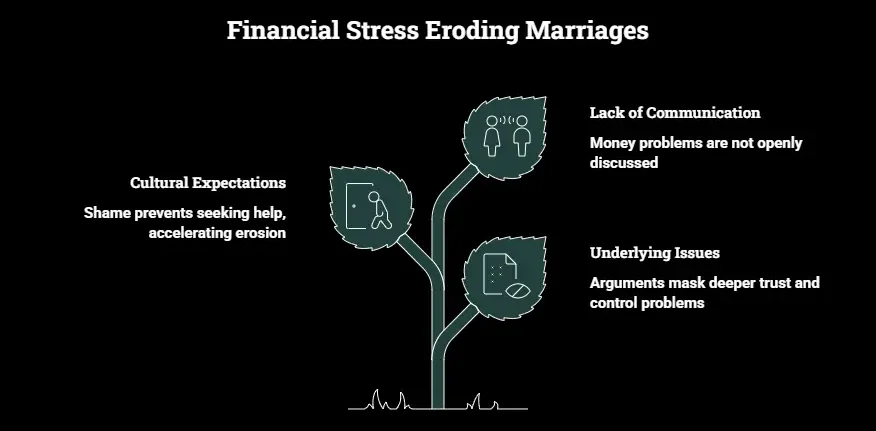
For most couples, money is not just money. It is safety. It is freedom. It is proof of worth. It is evidence of effort. When your partner spends money without telling you, it does not just feel like a financial issue — it feels like a betrayal of trust. When there is not enough money, it does not just feel like a practical problem — it feels like failure. These emotional meanings attach themselves to financial conversations before either person has said a word, which is why communication problems in marriage over money escalate so quickly and feel so personal.
Chronic financial stress in relationships maintains the nervous system in a state of background threat activation. When the brain perceives threat — even a financial one — it prioritises survival over connection. The neurological systems responsible for empathy, emotional regulation, and collaborative problem-solving are literally suppressed. This is why couples in financial stress are more likely to misread each other’s intentions, respond to neutral comments with defensiveness, and find conversations that should be practical become explosive.
For Malayali and South Asian couples, financial stress carries a specific cultural weight that generic relationship advice rarely addresses. The pressure on men to provide — and the shame of failing to — is acute. For Gulf NRI couples, the husband’s income often carries the entire family’s financial infrastructure: the EMI on the house back home, the children’s school fees, the parents’ medical expenses, the remittances. When that income is under threat, the consequences are not just personal — they are felt by an extended network of people who are financially dependent. This scale of responsibility, without adequate emotional support, is a setup for both marriage problems and clinical depression.
For women in traditional South Asian marriages, a different but equally significant issue arises: financial exclusion. When one partner controls all financial decisions and information, the other partner is economically dependent in a way that fundamentally undermines trust in a relationship and creates the conditions for what researchers now call financial infidelity.
Financial infidelity is the deliberate concealment of financial information, spending, debt, or assets from a partner. It ranges from hiding a small purchase to concealing an entire loan, a secret savings account, or significant debt accumulated without the partner’s knowledge. A 2018 survey by the National Endowment for Financial Education found that 41% of American adults admitted to committing financial infidelity against a partner. The rate in South Asian marriages — where financial transparency between spouses is not culturally mandated and where financial shame is high — is likely comparable or higher.
The psychological damage of financial infidelity is equivalent in many ways to sexual infidelity. Research by Britt and Huston (2012) in the *Journal of Financial Therapy* found that financial infidelity significantly reduced trust in a relationship, increased conflict, and was associated with higher rates of divorce when discovered. The betrayal is not about the money spent — it is about the dishonesty, the secrecy, and what the secrecy implies about the partner’s respect for the relationship.
One of the most consistent findings in relationship research is the link between financial stress and no intimacy in marriage. The pathway is direct. Chronic stress elevates cortisol, which suppresses the hormones responsible for sexual desire and emotional bonding (testosterone, oxytocin). At the same time, the psychological states created by financial stress — anxiety, shame, resentment, exhaustion — are the emotional opposites of the states required for intimacy and connection.
When couples are arguing about money regularly, they move into adversarial positions with each other — each defending their own spending, their own priorities, their own choices. Adversarial positioning is incompatible with emotional intimacy in marriage. You cannot be connected with someone you are fighting. And when the fighting becomes chronic, the emotional distance it creates can calcify into the marriage without intimacy that many couples describe when they first contact Oppam: still living together, still functional in practical terms, but emotionally and physically disconnected.
Not all couples experiencing financial stress end up in crisis. The factor that most determines whether financial stress in relationships is survived or becomes fatal is not the amount of money involved — it is the communication patterns the couple uses when discussing it. Research by John Gottman at the Gottman Institute identified four communication patterns that are reliably toxic in marriage and relationship conflict, and all four are particularly activated by financial stress.
Contempt is the most damaging of Gottman’s Four Horsemen — a predictor of divorce in longitudinal research. In husband and wife relationship conflicts about money, contempt communicates not just disagreement but superiority: that one partner is fundamentally less capable, intelligent, or responsible than the other. Financial contempt is particularly common in marriages where there is a significant income disparity, and it is lethal to emotional connection in marriage.
Defensiveness is a counter-attack that refuses accountability. In financial conflict, it prevents any genuine problem-solving from occurring because both partners are protecting themselves rather than addressing the actual issue. Defensiveness is often the automatic response to criticism — which is why breaking the criticism-defensiveness cycle is the first priority in couples counselling for financial conflict.
When the conversation becomes too dysregulating, one partner (usually, research suggests, more often the male partner in heterosexual couples) shuts down completely — giving monosyllabic answers, leaving the room, or simply going silent. Stonewalling is not calm. It is a physiological flooding response — the heart rate is elevated, the nervous system is overwhelmed, and the brain has essentially gone offline for productive communication. No communication in marriage following a financial argument is almost always stonewalling rather than reflection.
For Gulf Malayali couples, the financial architecture of the marriage is often built around remittance. The husband in Dubai or Qatar is sending money home to Kerala — for the house EMI, for the children’s education, for ageing parents. The wife managing the household in Kerala, or the wife who has also migrated, is managing both the financial reality and the emotional weight of family expectation. When the remittance slows — because of job loss, health issues, or business failure — the shame is enormous and the conversation about it is almost never had directly. The communication problems in marriage that follow are not about communication skills. They are about shame avoidance.
In many traditional Malayali households, the wife has limited visibility into family finances. She may not know the full extent of debts, may not have her own bank account, or may have her personal income absorbed into family expenses without transparency. This financial exclusion is not experienced as control by most men who practice it — it is experienced as “handling things.” But it creates a profound power imbalance that affects every dimension of husband wife relationship quality. When financial problems surface, the partner who has been excluded from financial information has no context to understand the situation and no agency to help address it.
South Asian marriages are frequently not just marriages between two people — they are financial entanglements between two extended families. Money borrowed from parents without the partner’s full knowledge. Financial obligations to siblings. The expectation that the successful child in the family will subsidise the others. These cross-family financial dynamics create conflict that is structurally different from the individual financial disagreements that most Western couples counselling models are designed to address. Making marriage work when money flows in and out of the marriage through extended family channels requires a different conversation.
The following strategies are drawn from couples therapy research and clinical practice. They are not platitudes. They are specific, evidence-based approaches that address the actual mechanisms through which financial stress damages marriage relationships.
The most common mistake couples make when trying to address financial stress in relationships is attempting to solve the practical problem (the debt, the budget, the spending behaviour) while still in emotional activation. When either partner is physiologically flooded — heart rate above approximately 100 bpm — the brain’s capacity for collaborative problem-solving is significantly impaired. Gottman’s research is unambiguous on this: productive financial conversation requires physiological calm first. Have the emotional conversation (how we each feel about what is happening with money) separately from and before the practical conversation (what are we going to do about it).
For couples where financial exclusion or secrecy has been a pattern, establishing full transparency is a foundational repair step. This means shared access to all account information, regular scheduled financial conversations (monthly “money meetings” that are calm and structured, not crisis-driven), and explicit agreement about what level of spending requires prior discussion. For Malayali couples where one partner has controlled finances, this shift requires the controlling partner to voluntarily surrender financial power — which may need to be explicitly framed as an act of respect for the marriage rather than a critique of past behaviour.
Money scripts — a term from financial therapy — are the unconscious beliefs about money formed in childhood that determine adult financial behaviour. Common money scripts include: “Money is the root of all evil” (leading to avoidance of financial conversations), “There will never be enough” (leading to hoarding or anxiety about any spending), “Rich people are greedy” (leading to discomfort with financial success), and “Money equals love” (leading to spending as emotional expression). Most financial conflict in married couple relationships is between two incompatible money scripts that have never been made explicit. Identifying yours — and your partner’s — is one of the most productive single steps in couples work around money.
Budgeting for couples that works is built collaboratively, gives both partners visibility and agency, and includes explicit allocations for each partner’s personal spending without accountability — what financial therapists call “fun money” or “freedom accounts.” When budgeting is imposed by one partner on the other, it functions as control rather than planning, and the partner subject to it will typically either comply resentfully or subvert it covertly. Both outcomes worsen financial infidelity risk.
Financial stress frequently has anxiety as its engine rather than an actual shortage of money. A couple earning adequately but managed by one partner’s health anxiety about financial catastrophe will experience the same relationship problems as a couple with actual financial shortage — because the anxiety drives the same conflict patterns. If financial conversations are consistently explosive despite relative financial stability, the issue is anxiety management rather than financial planning, and it requires therapeutic rather than financial intervention.
A psychologist in Kerala online through Oppam can provide couples counselling in Malayalam, Tamil, or English — addressing both the communication patterns and the underlying emotional dynamics that financial stress has created. Online counselling in Kerala for couples through Oppam is available without a referral, without a waiting list, and at times that work for both partners, including Gulf time zones.
Discovering that a partner has been financially dishonest is a genuine relationship rupture. Rebuilding trust in marriage after financial infidelity follows a process similar to rebuilding after any betrayal — and it requires the same conditions: genuine accountability from the partner who concealed, genuine commitment to transparency going forward, and a therapeutic space in which the injured partner’s pain is fully acknowledged rather than minimised.
Yes. Financial stress is consistently identified in research as one of the leading predictors of divorce. A 2008 study by Dew published in the Journal of Family and Economic Issues found financial disagreements to be more predictive of divorce than disagreements about sex, household tasks, or in-law relationships. The reason is not that money matters more than other issues — it is that financial conflict uniquely activates trust, respect, and power dynamics in ways that erode the emotional foundation of the relationship. Financial stress is rarely just about money.
Financial infidelity is the deliberate concealment of financial information, spending, debt, or assets from a partner. This includes hiding credit cards, concealing debt, making significant purchases without disclosure, maintaining secret savings accounts, or taking loans without the partner’s knowledge. Research by Britt and Huston (2012) in the Journal of Financial Therapy found financial infidelity significantly damages trust and is associated with higher divorce rates. In South Asian marriages, financial concealment is common and often rationalised as protection or autonomy — but the impact on the partner’s trust is equivalent regardless of the intention.
The most important first step is separating the emotional conversation from the practical one. Productive financial problem-solving requires physiological calm — if either partner is emotionally activated, the conversation will escalate before it resolves anything. Have the emotional conversation first: how does each of you feel about what is happening with money? Then, in a separate, calmer conversation, address the practical questions: what are the actual numbers, and what are we going to do? If these conversations consistently escalate regardless of timing, couples counselling provides a structured facilitated environment in which the underlying dynamics can be addressed.
Yes. Financial concealment — even when motivated by the desire to protect your partner from worry — is one of the most damaging things you can do to the long-term trust in your marriage. When the financial situation surfaces (and it will), the discovery of the concealment will be more damaging than the financial situation itself. The conversation will be difficult. A couples therapist or financial counsellor can help you structure how to have it in a way that minimises the additional damage. Oppam’s therapists work with couples navigating exactly this situation regularly.
Yes. Couples counselling for financial stress addresses the communication patterns, emotional dynamics, and underlying individual psychology (money scripts, anxiety, shame) that make financial conflict so difficult to resolve through direct conversation alone. Research shows that Gottman Method couples therapy, Emotion-Focused Therapy (EFT), and Behavioural Couples Therapy all produce significant improvements in relationship satisfaction for couples experiencing financial conflict. Oppam offers couples counselling in Malayalam, Tamil, and English, online and in-person in Kozhikode, at ₹1,500 per 90-minute session.
The specific financial pressures of Gulf expat life — remittance obligations, visa-dependent employment, extended family financial entanglement, the absence of a local support network — create a distinct version of marital financial stress that standard relationship advice does not adequately address. Oppam therapists understand this context from clinical experience with Gulf Malayali couples. Online couples counselling through Oppam is accessible from the Gulf, available at times that suit Gulf time zones, and conducted in Malayalam. Starting with a joint assessment session — where both partners speak with the therapist together — is typically the most productive entry point.
Financial stress is one of the most common causes of intimacy loss in marriage, but it is rarely the only factor. The pathway is typically: financial stress → conflict → emotional withdrawal → loss of physical intimacy. But the loss of intimacy can also be driven by unaddressed depression or anxiety in either partner, by relationship resentment that predates the financial problems, or by physical health factors. A clinical assessment with a couples therapist can help identify the primary drivers and address them in the right sequence — because treating the intimacy issue before the trust and communication issues that underlie it tends to be ineffective.