

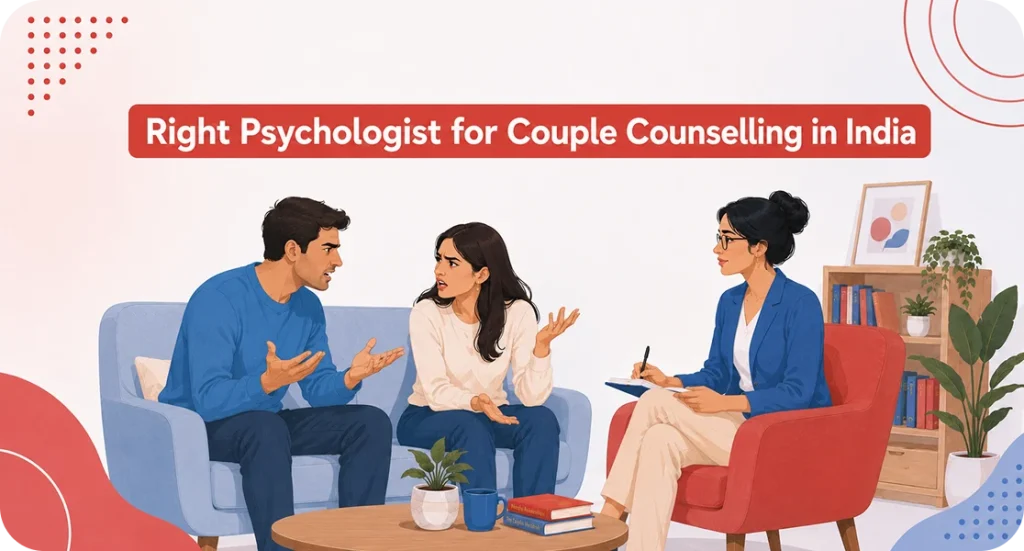
Right Psychologist for Couple Counselling in India? The two of you used to talk for hours. Now most conversations either end in the same argument about his mother, her long work hours, or nothing at all, just a quiet dinner table and two phones. Someone finally said the word “counselling” out loud last week, and there was a pause before the other person said okay. Now you’re the one searching, scrolling through psychologist profiles that all promise to help “strengthen your bond,” trying to work out which one actually knows what they’re doing with couples specifically, rather than individual therapy dressed up for two people.
This distinction matters more than most people realise going in. Couples work is a distinct clinical skill, not simply individual therapy conducted with both partners present, and choosing a psychologist without couples-specific training is one of the most common reasons couples try therapy once, feel unheard or worse, more distant, and never return. In arranged-marriage households and joint families particularly, the right psychologist also needs to understand pressures that don’t show up in Western relationship models at all.
Need to Talk to Someone?
Book a private online session with a licensed therapist
This guide walks through exactly what to look for in a couples psychologist in India, the approaches with genuine evidence behind them, and the specific questions worth asking before you and your partner commit to anyone.
Why Couples Therapy in India Looks Different
Roughly 90% of marriages in India are arranged or semi-arranged, meaning many couples build emotional intimacy and daily-life compatibility after the wedding rather than before it, on a timeline that looks nothing like the dating-then-marriage sequence most Western couples-therapy models were built around. This isn’t a flaw in the relationship; it’s a different starting point, and a psychologist unfamiliar with it may misread perfectly ordinary early-marriage adjustment as a deeper compatibility problem, or the reverse, miss a genuine compatibility problem by assuming “it will grow with time” applies universally.
Family involvement is another distinguishing factor. Where many international couples-therapy frameworks assume the couple functions as an independent unit, Indian couples, especially in joint-family arrangements, are often navigating in-law expectations, shared finances across generations, and decisions (having children, where to live, how to raise them) that involve parents as active stakeholders rather than distant observers. A psychologist who treats this as dysfunction to be corrected, rather than a cultural reality to be worked within, will struggle to build trust with either partner.
The Approaches With Genuine Evidence Behind Them
Emotionally Focused Therapy(EFT) is among the most extensively researched couples-therapy models available, built on attachment theory, and focuses on identifying the negative interaction cycle a couple has fallen into, often a pattern where one partner pursues connection through criticism or pressure while the other withdraws to avoid conflict, and replacing it with more secure, emotionally responsive communication. Research on EFT has found that a substantial majority of couples move from significant distress to measurable improvement or recovery over the course of treatment, making it one of the strongest evidence bases in the couples-therapy field.
The Gottman Method, developed from decades of observational research on real couples, focuses on concrete, teachable skills: managing conflict without contempt, building a detailed understanding of each partner’s inner world, and increasing everyday positive interactions relative to negative ones. Unlike EFT’s attachment focus, the Gottman Method tends to be more structured and skills-based, which some couples, particularly those uncomfortable with heavily emotion-focused work early on, find easier to engage with.
A good couples psychologist should be able to name which framework they primarily use, ideally with specific training in it beyond a general psychology degree, and explain how it applies to the pattern you and your partner are describing, rather than offering generic advice about “communicating better.”
Beyond these two dominant models, some psychologists integrate elements of both, or draw on structural family therapy when a couple’s conflict is heavily entangled with wider family involvement, since a purely two-person framework can fall short when parents or in-laws are functionally part of the daily decision-making unit. This is worth asking about directly if your situation involves significant extended-family dynamics: “if my in-laws are involved in most of our disagreements, how does your approach account for that?” A thoughtful answer here often reveals more about a psychologist’s real-world experience than their theoretical training alone.
Credentials and Questions Worth Asking Directly
Look first for a clinical or counselling psychologist with postgraduate training (M.Sc. or M.Phil) and, ideally, specific additional certification in couples or family therapy, since a general individual-therapy background doesn’t automatically include couples-specific skills. Ask directly: “what percentage of your practice is couples work, and what specific training do you have in it?” A psychologist confident in this area will have a clear, specific answer, often naming EFT, Gottman, or another recognised model by name.
It’s also worth asking how the psychologist handles sessions structurally: some see both partners together for the entire course of treatment, others alternate between joint and brief individual check-ins, and neither is automatically wrong, but you should understand the approach before committing so there are no surprises about confidentiality or format partway through.
Feeling Overwhelmed?
You’re Not Alone. Get Support from an
Oppam Therapist Wherever You Are
Oppam Therapist Wherever You Are
Red Flags Worth Taking Seriously
Be cautious of a psychologist who takes an obvious side within the first session or two, since effective couples work requires holding both partners’ experiences as valid, even when they conflict, rather than declaring a winner. Be cautious, too, of anyone offering to see only one partner “on behalf of” the couple over an extended period without a clear structural reason, since this can quietly become individual therapy that one partner experiences as ganging-up. Finally, be wary of any promise of a fast, guaranteed outcome; couples therapy is genuinely difficult work, and a psychologist honest about that difficulty, rather than selling an easy fix, is usually the more trustworthy choice.
Cross-Cultural and NRI Relationships: A Specific Consideration
For couples where one or both partners are living outside India, or where the relationship spans different regional, religious, or caste backgrounds within India itself, the right psychologist needs comfort with a wider range of cultural context than a general couples-therapy background provides. A Malayali-Tamil couple navigating two sets of family expectations, or an NRI couple managing long-distance strain alongside cultural adjustment in a new country, benefits significantly from a psychologist who has actually worked with these specific dynamics before, rather than treating them as a footnote to a standard relationship-conflict framework.
This extends to language itself, which is easy to underestimate as a factor. Many couples who are entirely fluent in English still find that arguments and, more importantly, moments of vulnerability and repair, land differently in Malayalam or Tamil, the language in which they first learned to express affection, frustration, or apology as children. A psychologist who can work flexibly across languages, rather than defaulting to English for the “serious” parts of a session, often reaches a depth of communication that an English-only session structurally cannot.
Online vs In-Person Couples Counselling
Research published in the Journal of Marital and Family Therapy found no statistically significant difference in outcomes between online and in-person couples counselling, which makes online sessions a genuinely valid option rather than a compromise. For many Indian and NRI couples, particularly those juggling demanding work schedules, long-distance arrangements, or living with extended family where privacy for an in-person appointment is hard to arrange, online sessions from separate rooms or devices can actually make consistent attendance more realistic than travelling to a shared physical appointment.
Need to Talk to Someone?
Book a private online session with a licensed therapist
A Practical Exercise: The Pre-Booking Conversation
Before your first session, have a short conversation with your partner using these three questions, ideally together rather than each of you deciding separately:
- What do we each want to get out of this, specifically, rather than just “fixing things”?
- Are we both willing to hear feedback about our own part in the pattern, not only our partner’s?
- What would feel like meaningful progress to each of us after two months, realistically?
Bringing shared clarity into the first session, rather than two separate, unspoken agendas, tends to make the early sessions considerably more productive.
When to Seek Professional Help
Couples often wait years after real problems begin before seeking support, by which point patterns have become deeply entrenched and harder to shift. Consider booking a consultation if the same argument recurs without resolution, if one or both of you have started withdrawing rather than engaging, if in-law or family involvement has become a persistent source of conflict rather than occasional friction, or if either partner is considering separation and wants clarity before making that decision rather than after.
It’s worth stating plainly that couples therapy is not only for relationships in crisis. Increasingly, couples across India and the diaspora are choosing pre-marital or early-marriage counselling proactively, using the space to build shared communication tools before conflict patterns have had time to solidify, much as one might invest in financial planning before a crisis rather than only after one. If your relationship feels stable but you sense recurring friction points worth addressing early, that is a legitimate and often more effective time to begin than waiting for things to worsen. Book your first session with Oppam → to speak with a psychologist experienced in couples work who understands both evidence-based methods and the specific cultural context shaping your relationship.
Frequently Asked Questions
How is couples therapy different from individual therapy?
Couples therapy treats the relationship itself as the client, focusing on interaction patterns between partners rather than one person’s individual history or symptoms. It requires specific training beyond general individual-therapy skills, since the psychologist must hold both partners’ perspectives as valid simultaneously, often while working with real-time conflict happening in the room.
What is the most effective type of couples therapy?
Emotionally Focused Therapy (EFT) and the Gottman Method both have strong research support, though they work somewhat differently. EFT focuses on attachment and the underlying emotional cycle driving conflict, while the Gottman Method offers more structured, skills-based tools for communication and conflict management. A good psychologist will explain which approach they use and why it fits your specific relationship pattern.
How do we find a couples counsellor who understands arranged marriage and Indian family dynamics?
Ask directly, before booking, whether the psychologist has specific experience with arranged-marriage adjustment, joint-family involvement, or the particular pressures of your cultural or religious background. Platforms like Oppam are built specifically for this, with psychologists who treat family and cultural context as central to the work rather than a side issue to work around.
My in-laws are involved in every decision in our marriage. Can a psychologist actually help with that?
Yes. An experienced couples psychologist can help you and your partner build a shared, united approach to family involvement, rather than treating it as something to eliminate entirely, which is rarely realistic or desired in Indian joint-family contexts. The goal is usually a healthier boundary the couple agrees on together, not cutting family out of the picture.
Can we do couples counselling online if we're an NRI couple or living in different cities?
Yes. Research has found no significant difference in outcomes between online and in-person couples counselling, and online sessions are often more practical for NRI couples, long-distance relationships, or partners juggling demanding schedules. Oppam offers couples counselling in Malayalam, Tamil, and English for clients across India, the Gulf, UK, Canada, Australia, and Singapore.
How much does couples therapy cost in India, and how many sessions are typically needed?
Couples therapy in India generally costs between ₹1,500 and ₹5,000 per session depending on the psychologist’s experience and format, with online sessions typically at the lower end of that range. Most couples see meaningful movement over roughly eight to fifteen sessions, though this varies considerably depending on how long the current patterns have been in place before starting therapy.
Should we go to couples therapy only if we're thinking about divorce or separation?
No. Couples who seek support early, before problems become deeply entrenched, generally see better outcomes than those who wait until a crisis point. Many couples in India and abroad now also use pre-marital or early-marriage counselling proactively, to build strong communication patterns before serious conflict develops rather than only after.
External Resources
- Journal of Marital and Family Therapy (2023): findings on comparable outcomes between online and in-person couples counselling.
- International Centre for Excellence in Emotionally Focused Therapy (ICEEFT) / peer-reviewed EFT outcome research: recovery and improvement rates for couples completing EFT treatment.
- The Gottman Institute / published Gottman Method research: evidence base for skills-based couples interventions.
- Census of India / National Family Health Survey (NFHS): data on marriage patterns and prevalence of arranged marriage in India.
- Indian Journal of Psychiatry: research on marital distress, help-seeking patterns, and family involvement in Indian couples therapy.
Struggling?
Talk to an Oppam Therapist
Get the Support You Deserve Online & Confidential