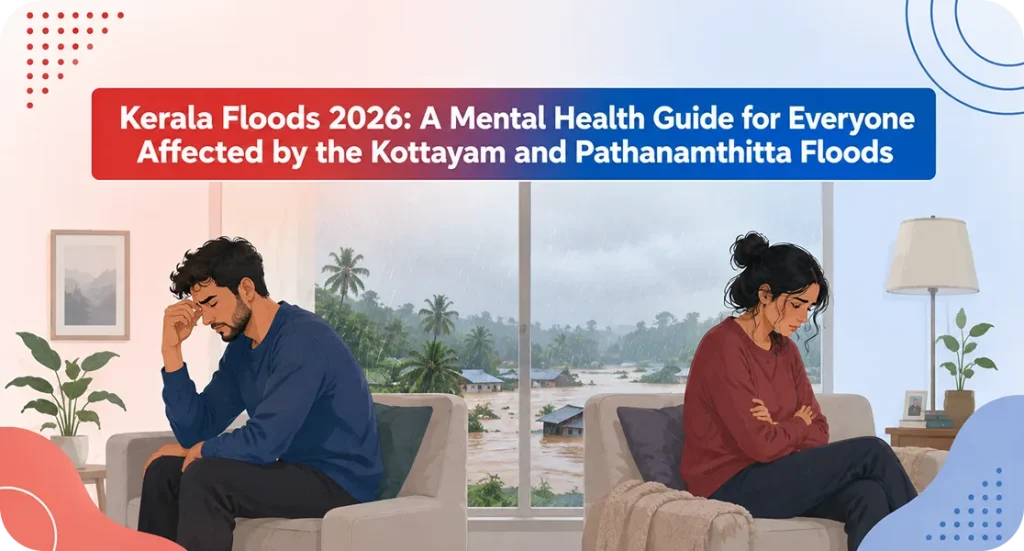
The water came faster than anyone expected. In Kottayam and Pathanamthitta, roads disappeared. Houses filled. Businesses that families had built over decades went under. People who had lived in the same place all their lives watched it become unrecognisable.
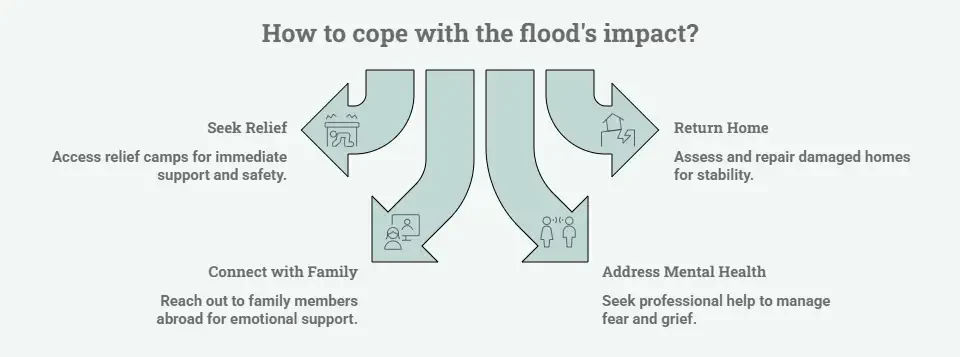
Whether you are in a relief camp right now, whether you have returned to a damaged home, whether you are watching from Dubai or London or Toronto trying to reach family members who are not answering — this article is for you.
The 2026 Kerala floods have caused immense physical destruction. What is less immediately visible, but just as real, is what they are doing to the mental health of hundreds of thousands of people. The fear, the helplessness, the grief, the exhaustion, the anger — these are not weakness. They are the normal human responses to abnormal events.
Oppam is an online counselling platform serving Malayalam-speaking communities across Kerala and the global diaspora. This guide explains what you are likely to be feeling, why, and where to find mental health support — both immediately and in the weeks ahead. Every section links to professional help that is available right now, in Malayalam, online, without a waiting list.
Flooding is not simply a physical disaster. It is among the most psychologically damaging natural events a community can experience. Unlike fires or earthquakes — which are sudden and brief — floods unfold over days and weeks. The threat does not end. The uncertainty does not resolve. You cannot return to assess the damage until the water recedes, and even then, the damage you find may be overwhelming.
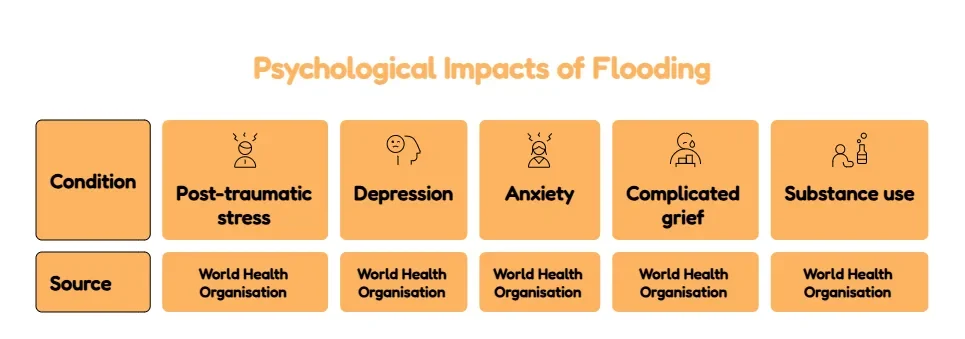
According to the World Health Organisation, natural disasters significantly increase rates of post-traumatic stress, depression, anxiety, complicated grief, and substance use in affected populations — with symptoms peaking in the weeks immediately following the event and potentially persisting for months or years without appropriate support.
Reports from Kottayam and Pathanamthitta describe floodwaters breaching new areas even as relief efforts were underway, residents returning to find homes uninhabitable, and businesses submerged with no immediate prospect of recovery. The financial dimension of this disaster compounds the psychological one: for families who have lost their homes, their savings, and their livelihood simultaneously, the mental health burden is acute.
For Keralites abroad — in the Gulf, the UK, Canada, Australia, Singapore — the experience of watching their home district underwater from thousands of kilometres away, unable to reach family members or be physically present to help, is its own distinct form of distress. Helplessness and guilt are among the most painful emotions in the human register, and diaspora Keralites are experiencing both in concentrated form right now.
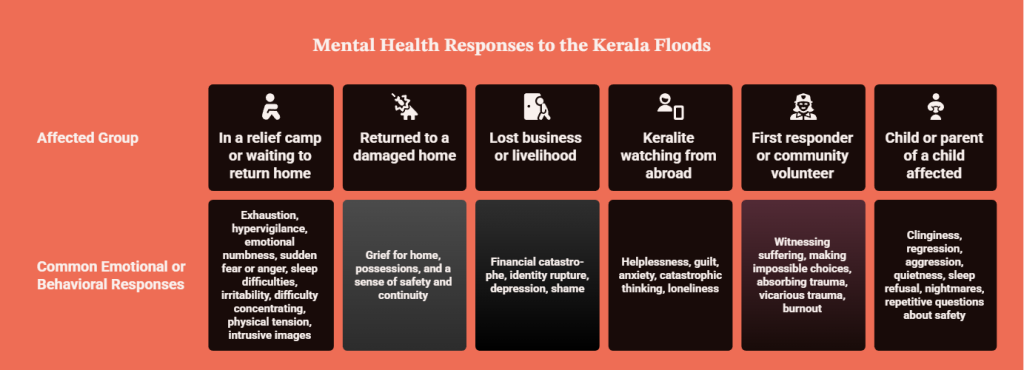
Every person affected by the Kerala floods is carrying a different version of this experience. What you feel depends on whether you are a direct survivor, a family member, a first responder, or someone watching from abroad. All of it is valid. None of it requires you to push through alone.
The immediate aftermath of displacement involves a particular combination of exhaustion, hypervigilance, and emotional numbness. You may feel physically present but emotionally disconnected — going through the motions because the alternative is feeling everything at once. You may feel sudden surges of fear or anger for no obvious reason. You may be unable to sleep even when you are exhausted.
These are all normal acute stress responses. Your nervous system has been through a genuine emergency. It does not switch off immediately. The irritability, the difficulty concentrating, the physical tension, the intrusive images of the water rising — these are not signs that something is wrong with you. They are signs that something very difficult happened to you.
Returning to a home that has been flooded is, for many survivors, more emotionally devastating than the flood itself. The smell. The waterline on the wall. Personal objects destroyed. The childhood photos gone. The realisation that what you thought would take weeks to fix will take months, if it can be fixed at all.
The businesses submerged in Kottayam and Pathanamthitta represent decades of work, family investment, and identity. For many owners and their families, the shop, the restaurant, the farm, the workshop is not just an income source — it is who they are. Losing it to floodwater is both a financial catastrophe and an identity rupture.
You are sitting in your flat in Dubai or your house in London, watching the news, trying to call home. The phone rings and rings. Or it connects and you can hear how frightened they are, and there is nothing you can do. You go to work. You try to function. But part of you is entirely in Kottayam.
Police, firefighters, NDRF personnel, boat operators, relief workers, and community volunteers are doing extraordinary work under extraordinary pressure. But they are also witnessing suffering, making impossible choices, and absorbing the trauma of others while suppressing their own responses. Vicarious trauma and burnout are not hypothetical risks for first responders — they are near-inevitable without deliberate support.
Children do not always express distress in ways adults recognise. A child who has been through a flood may become clingy, regressive (behaving younger than their age), aggressive, or unusually quiet. They may refuse to sleep, have nightmares, or ask the same questions about safety repeatedly. They may seem fine during the day and fall apart at night.
Not everyone who experiences a flood will develop Post-Traumatic Stress Disorder (PTSD) or clinical depression. Acute distress — the fear, the grief, the disrupted sleep, the intrusive memories — is a normal response to an abnormal event. For most people, these symptoms reduce naturally over weeks as safety is restored and life begins to stabilise.
However, for a significant proportion of flood survivors, symptoms do not reduce. Research published in *The Lancet* following major flood events in South Asia found PTSD rates of 15–40% among directly affected populations, with rates higher among those who experienced significant property loss, bereavement, or prolonged displacement.
The Kottayam and Pathanamthitta floods have destroyed homes, agricultural land, livestock, and businesses. For many families, the financial loss is catastrophic and immediate — no income, no shelter, and the prospect of rebuilding from nothing. This is not a peripheral mental health concern. Financial loss is one of the most powerful triggers for depression and anxiety in the clinical literature.
These are evidence-based immediate actions — not platitudes. They will not resolve trauma, but they can reduce the acute neurological stress response in the hours and days ahead.
Your nervous system cannot begin to process trauma while the threat is ongoing. If you are still in danger, in a relief camp, or awaiting evacuation, your only task is to focus on physical safety. Emotional processing comes later. Trying to “deal with your feelings” while still in an emergency is not helpful and is not necessary.
Continuously watching flood news — social media, WhatsApp forwards, news channels — maintains your nervous system in a state of acute alert. This is genuinely harmful over sustained periods. Check news once or twice daily, at specific times, and then close it. This is not avoidance; it is nervous system management. For NRI Keralites especially, the 24/7 news cycle can feel compulsive — each check provides brief reassurance followed by more anxiety. Limiting it is the most effective practical step you can take right now.
Social connection after disaster is protective. Call your family. Talk to neighbours in the relief camp. Do not isolate. At the same time, the clinical research on disaster response shows that repeatedly retelling the traumatic event in the acute phase — before safety has been fully restored — can deepen rather than process the trauma. It is fine to check in, to share practical information, and to offer comfort. It is not necessary to retell what happened in detail repeatedly in the first days.
When the nervous system is in acute stress, top-down cognitive approaches (trying to think your way to calm) are less effective than bottom-up physiological approaches. Slow breathing (four counts in, six to eight counts out) directly activates the parasympathetic nervous system. Physical movement — even walking around a relief camp — reduces cortisol. Cold water on the face activates the dive reflex and slows the heart rate. These are not small things. They are neurologically grounded interventions that work in real emergencies.
“The river got very big and it came into people’s houses. We had to leave for a while. We are safe now and we will go back when it is safe.” Children need honest, simple explanations and physical reassurance more than they need protection from reality. Telling a child “everything is fine” when the evidence around them says otherwise undermines trust and increases anxiety. Age-appropriate honesty, delivered calmly, is the most protective thing you can offer a child right now.
The mental health support you need does not require travelling to a clinic, waiting weeks for an appointment, or navigating an unfamiliar healthcare system. Oppam offers online counselling in Malayalam, accessible from anywhere — a relief camp with phone signal, a relative’s house, your apartment in the Gulf — within 24 to 48 hours of booking.
Oppam therapists use evidence-based approaches matched to specific presentations. Following a disaster, the most commonly used approaches are:
Yes. Oppam offers online counselling via secure video call, accessible from any smartphone with an internet connection. If you have phone signal in the relief camp, you can book and attend a session. Sessions are ₹1,000 per 60 minutes, in Malayalam. If cost is a barrier right now, please contact us directly — we will do everything possible to ensure access. You can also call iCall (9152987821) or the Kerala State Mental Health Authority helpline (1800-599-0019) for free immediate support.
Yes. Fear, grief, anger, numbness, irritability, sleep disruption, intrusive memories of the water — all of these are normal acute stress responses to a genuine emergency. Your nervous system has been through a serious threat. It does not reset immediately. Most people experience significant acute distress in the first two to four weeks after a disaster. This is not a sign of mental illness. It becomes a clinical concern — warranting professional support — if these symptoms are intense, persistent beyond three to four weeks, or if they are preventing you from functioning.
Emotional shutdown or numbness after a traumatic event is a recognised acute stress response. Some people become very quiet and withdrawn in the immediate aftermath of trauma because the experience has temporarily overwhelmed the brain’s capacity to process it. Do not force conversation. Maintain physical presence and gentle routine. Ensure they are eating, sleeping, and not isolated. If the shutdown persists beyond a week, or is accompanied by significant behavioural changes, consult a mental health professional. Oppam can provide an urgent assessment — book at oppam.me or call our helpline.
What you are experiencing is a form of acute anxiety driven by helplessness and uncertainty. The compulsive news-checking is reassurance-seeking — each check provides brief relief, followed by more anxiety when the situation has not resolved. Limit news to two specific times per day. Identify what is actually within your control (sending money, coordinating with family, booking a flight if needed) and do those things. For what is not within your control — and much of this is not — the most effective approach is acknowledging that uncertainty rather than trying to resolve it through information. An Oppam therapist can help you manage this acute anxiety via online session.
No. Trauma is treatable. Post-traumatic stress disorder — the most serious mental health consequence of flood events — responds well to Trauma-Focused CBT and EMDR, with the majority of people who receive appropriate treatment achieving full or near-full remission. The key factor is whether treatment is accessed. Untreated PTSD can persist for years; treated PTSD typically improves significantly within 8–16 sessions. The most important thing you can do right now is not wait to see if things improve on their own. Seek support early.
Oppam therapists work with the psychological consequences of financial loss — the depression, shame, anxiety, and identity disruption that follow the loss of a business or livelihood. This is a distinct and serious clinical presentation that requires therapeutic support alongside practical rebuilding. Sessions are available in Malayalam, online, without a referral. If you are in the immediate aftermath of loss and not yet ready for structured therapy, a single session with an Oppam therapist can help you stabilise, process what has happened, and begin to identify what comes next.