

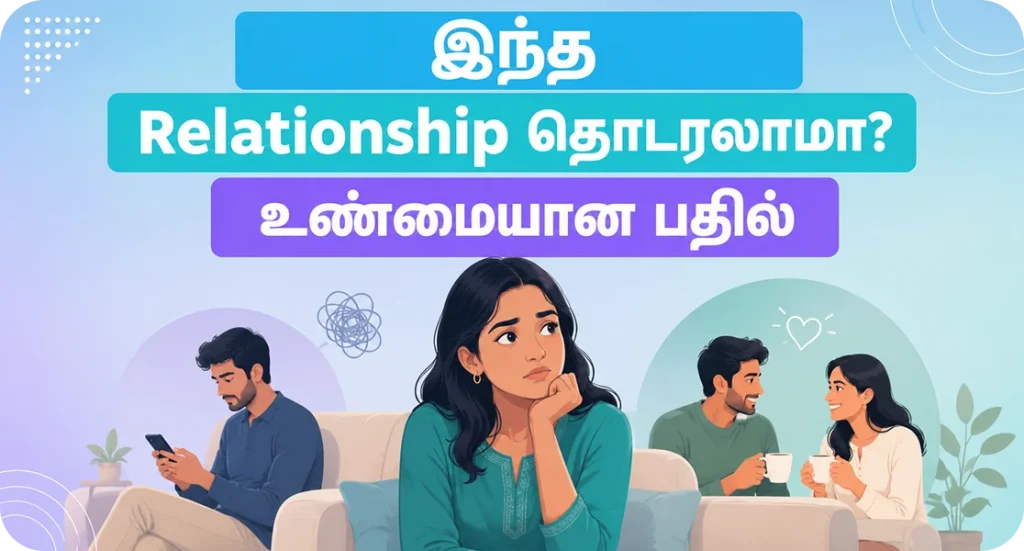
relationship continue பண்ணலாமா? அவர்/அவள் உங்களை நேசிக்கிறார்கள் — அது தெரியும். ஆனால் அந்த அன்பு போதுமானதா என்று தெரியவில்லை. சில நாட்கள் எல்லாம் சரியாக இருக்கும். சில நாட்கள் நீங்கள் அந்த உறவில் முற்றிலும் தனியாக உணர்கிறீர்கள். வெளியே சொல்ல முடியாது — family என்ன சொல்வார்கள், friends என்ன நினைப்பார்கள், society என்ன பேசும் என்ற பயம். உள்ளே சொல்லிக்கொள்ள முடியாது — ஏன் என்று சரியாக explain பண்ணவே தெரியவில்லை.
This question — இந்த relationship-ஐ தொடரலாமா — is one of the most painful a person can sit with. Not because the answer is always obvious, but because in South Asian families, the permission to even ask it rarely exists. In Kerala and Tamil Nadu, relationships carry the weight of family honour, community reputation, financial interdependence, and the deeply held belief that commitment means staying regardless of what staying costs you.
Need to Talk to Someone?
Book a private online session with a licensed therapist
This article is not going to tell you what to do. That decision belongs to you, and any professional who makes it for you is overstepping. What this article will do is give you a clear psychological framework for examining what is actually happening in your relationship, the clinical signs that indicate a relationship has become genuinely harmful, what attachment theory tells us about why leaving is so much harder than it looks from the outside, and when talking to a professional is the most useful next step.
Why This Question Is So Hard in South Asian Relationships
இந்த கேள்வி ஏன் இவ்வளவு கஷ்டமாக இருக்கிறது என்பதை clinical framework-க்கு முன்பே புரிந்துகொள்வது முக்கியம் — ஏனென்றால் இந்த கஷ்டம் weakness அல்ல. இது structural.
பெரும்பாலான South Asian குடும்பங்களில், ஒரு relationship — குறிப்பாக திருமணம் — இரண்டு நபர்களுக்கு இடையே உள்ள personal arrangement என்று பார்க்கப்படுவதில்லை. அது ஒரு family arrangement, ஒரு social contract, குடும்பத்தின் reputation-ஐயும் values-ஐயும் பிரதிபலிக்கும் ஒரு அறிக்கை. ஒரு 30 வயது Kerala பெண் தன் திருமணத்தை விட்டு வெளியேறலாமா என்று யோசிக்கும்போது, அவள் தன் சந்தோஷத்தை மட்டும் partner-இன் சந்தோஷத்துடன் ஒப்பிடவில்லை. அவள் கணக்கிடுவது — தன் பெற்றோருக்கு என்ன ஆகும், மாமியார் வீட்டினர் என்ன நினைப்பார்கள், குழந்தைகளுக்கு என்ன தாக்கம் ஏற்படும், சமூகம் என்ன பேசும், extended family-யின் social standing எப்படி பாதிக்கும், மற்றும் திருமணத்திற்குள் பொருளாதார ரீதியாக சார்ந்திருக்கும் நிலையில் தன் financial security என்னவாகும் என்று.
திருமணமாகாத couples-க்கு இந்த calculation வேறுவிதமாக இருந்தாலும், அது சமமாக கனமாகவே இருக்கிறது. Tamil குடும்பங்களில், arranged marriage timeline-இன் பயம் — இந்த relationship-ஐ விட்டால் marriage market-இல் disadvantage-ஆக நுழைய நேரும் என்ற உணர்வு — பலரை clinically evident ஆன நிலையை தாண்டியும் வேலை செய்யாத relationships-இல் தொடர வைக்கிறது.
According to research published in the International Journal of Social Psychiatry, relationship quality is one of the strongest predictors of both mental and physical health outcomes, with poor relationship quality associated with significantly elevated rates of anxiety, depression, and physical health problems. The decision to stay in or leave a relationship is therefore not merely personal — it is a health decision with measurable consequences.
What Makes a Relationship Worth Continuing: The Clinical Baseline
There is no universal definition of a perfect relationship, and no psychologist worth their training would pretend otherwise. But there is a clinical baseline — a set of conditions that research consistently identifies as necessary for a relationship to support rather than erode the wellbeing of both people in it.
Safety
Physical and emotional safety is the non-negotiable foundation. A relationship in which either person is physically afraid of the other, in which anger escalates to physical contact, or in which threats — explicit or implied — are used to manage the other’s behaviour is not a relationship that can be worked on. It is a relationship from which safety must be established first, which almost always requires professional support and often requires physical separation.
Emotional safety is more nuanced but equally important. It refers to the ability to be honest about your feelings, needs, and experiences without fearing rejection, humiliation, punishment, or prolonged withdrawal of affection. A relationship in which you have learnt never to express certain feelings because of how your partner responds is one in which emotional safety has been compromised — and its absence has a cost that accumulates quietly over time.
Respect
Mutual respect means that each person is treated as a full, capable adult whose perspective, feelings, and needs matter. It does not mean agreement on everything. It means that disagreement happens without contempt — without mockery, dismissal, eye-rolling, or the kind of low-level disdain that relationship researcher John Gottman at the University of Washington identified as one of the four strongest predictors of relationship dissolution. In his research, published across multiple studies in Journal of Family Psychology, contempt — not conflict, not disagreement, but contempt — was the single most destructive communicative pattern in long-term relationships.
In South Asian relationship contexts, contempt sometimes wears cultural clothing. The husband who dismisses his wife’s professional opinions in family settings because “she doesn’t understand these things.” The wife who criticises her husband’s family origins in front of the children. The partner who weaponises the other’s mental health history. These are contempt, whatever cultural frame they are delivered in.
Genuine Effort From Both People
A relationship worth continuing is one in which both people are genuinely trying — not identically, not perfectly, but with real effort and real investment. The absence of effort from one partner, sustained over time, is clinically significant. It indicates either that the relationship no longer holds meaning for that person, or that something else — depression, burnout, unaddressed resentment — is preventing engagement. Both warrant professional attention, but neither is a reason to wait indefinitely without change.
The Signs That a Relationship Has Become Harmful
This section requires care because the goal is not to provide a checklist that makes leaving easy — it is to name what the research identifies as genuinely harmful relational patterns, so that they can be distinguished from the ordinary difficulties that all long-term relationships involve.
The Four Horsemen
John Gottman’s research across decades at the University of Washington identified four communicative patterns — he called them the Four Horsemen — that predict relationship breakdown with significant accuracy. They are criticism (attacking the person’s character rather than the behaviour), contempt (treating the partner as inferior), defensiveness (responding to concern with counter-attack), and stonewalling (withdrawing completely from interaction).Asking a potential psychologist for their RCI registration number is entirely appropriate — the equivalent of asking a doctor for their MCI registration. A qualified practitioner will provide it without hesitation. If a therapist is evasive about this, that is a significant red flag.
The presence of one or two of these patterns in a relationship does not make it unsalvageable — Gottman’s research also identified interventions that reliably reverse them. But their habitual, entrenched presence across multiple years, in the absence of any effort to change them, is a clinical indicator that the relationship is causing harm to both people.
Consistent Minimisation of Your Reality
A particularly damaging relational pattern is the consistent minimisation or denial of your experience — what is sometimes called gaslighting. When you express a feeling and are told that you are wrong to feel it. When you describe an event and are told it did not happen that way. When your concerns are consistently attributed to your own sensitivity, instability, or irrationality rather than addressed. Over time, this pattern erodes the person’s capacity to trust their own perception, producing anxiety, self-doubt, and the characteristic uncertainty of someone who has been taught that their experience is unreliable.
In South Asian relationship contexts, minimisation is often culturally reinforced. The wife who raises a concern and is told she is being dramatic, that this is what marriage is, that her mother never complained. The husband who expresses emotional pain and is told men do not feel this way about these things. The cultural container that normalises the minimisation makes it harder to recognise as a relational pattern rather than simply the way things are.
Your Mental Health Is Declining
This is perhaps the most clinically direct indicator that a relationship warrants serious examination. If anxiety, depression, sleep disruption, physical health problems, or significant loss of self-esteem have developed or worsened since this relationship became the central context of your life, and if these symptoms improve when you are away from the relationship and worsen when you return to it, that pattern is clinical information.
Research published in Psychological Medicine has documented the bidirectional relationship between relationship quality and mental health — poor relationship quality is a significant risk factor for depression and anxiety, and these conditions in turn impair the capacity to engage constructively with the relationship. The point is not that the relationship has caused the mental health difficulty, but that the relationship environment is not supporting recovery — and that is clinically relevant data.
Why Leaving Is Harder Than It Looks: Attachment Theory
Many people who stay in relationships that are causing harm are not staying because they lack insight or because they are foolish. They are staying because of how attachment systems work — and understanding this is both clinically important and, for many people, deeply relieving.This means that finding the right person is as clinically important as finding the right credential. Here is what to look for.
Attachment theory, developed by John Bowlby and extensively extended by researchers including Mary Ainsworth, describes the deep biological and psychological bond that humans form with significant others. Once formed, this bond operates largely independently of conscious preference. The distress produced by separation from an attachment figure — even one whose behaviour is harmful — is neurologically real, not irrational. The pull back to the relationship, even after recognising its harm, is the attachment system functioning as it is designed to, not a personal failure.
For people with anxious attachment styles — more common in people who grew up in environments where care was inconsistent or conditional — the fear of abandonment can make staying in a harmful relationship feel like the only safe option. For those with disorganised attachment, developed in contexts where the caregiver was simultaneously a source of comfort and threat, harmful relationships can feel deeply familiar in ways that make them difficult to leave even when their harm is consciously recognised.
In South Asian families, attachment patterns are often reinforced by cultural structures that make separation genuinely costly — financially, socially, and in terms of family relationships. Understanding that the difficulty of leaving is not a character weakness but a predictable feature of how attachment works is the first step towards making a genuinely considered decision rather than either staying by default or leaving in crisis.
What Couples Therapy Can and Cannot Do
If you are wondering whether to continue the relationship, structured couples therapy is often the most clinically appropriate next step — not because it will make the decision for you, but because it creates a contained space in which both people can examine what is happening with a qualified professional present.
Couples therapy can help both people understand the patterns driving conflict, develop communication skills that reduce the frequency and severity of damaging exchanges, examine what each person needs and whether those needs can realistically be met within the relationship, and make a more informed decision about the relationship’s future.
One of the most practically important questions for Couples therapy cannot make a partner who is not genuinely willing to change, change. It cannot create safety in a relationship where abuse is present — couples therapy is contraindicated in situations of domestic violence, where the joint session format can be actively dangerous. And it cannot resolve a situation in which one partner has fundamentally decided the relationship is over but has not yet said so.
Individual therapy — for yourself alone, before or alongside couples work — is often the most valuable starting point, because it gives you a space to examine your own patterns, needs, and experiences without the complexity of the partner’s presence. For Keralites and South Asians who have never had a private space to think about their relationship without family or community commentary, this can be genuinely transformative.
When to Seek Professional Help
Seek professional support if you have been asking yourself whether to continue this relationship for more than three months without reaching clarity. If your mental health — anxiety, depression, sleep, self-esteem — has declined significantly within the relationship context. If there is any physical violence, any threat of violence, or any coercive control including financial control, isolation from family and friends, or monitoring of your movements or communications. If you have children who are witnessing significant conflict or emotional harm.
For Keralites and South Asians who want to speak to someone privately, without family knowing, and in a language and cultural context that does not require extensive explanation — online counselling in Tamil through Oppam is directly accessible. Sessions are available in Malayalam, Tamil, and English, from home, via secure video call. You do not need your partner’s involvement or permission to begin, and you do not need to have made a decision before speaking to someone. Book your first session →
Frequently Asked Questions
இந்த relationship-ல் continue பண்ணலாமா இல்லையா என்று எப்படி தெரியும்?
There is no single answer, but there are useful clinical markers. Ask yourself: does this relationship make you feel consistently worse about yourself over time? Is there safety — physical and emotional — for both of you? Is there genuine effort from both sides? Has your mental health declined since this relationship became the central context of your life? If the honest answers to these questions point consistently in one direction, that is clinically meaningful information worth exploring with a professional rather than alone. The decision itself belongs to you, but clarity about what is actually happening is something a therapist can help you reach.
Is it okay to leave a relationship even if there is no "big reason"?
Yes, and this is worth stating clearly because the cultural framework in South Asian families often implies that leaving is only justified by dramatic, visible harm. Clinical research does not support this framework. Chronic emotional disconnection, persistent contempt, the steady erosion of self-respect, and the consistent experience that the relationship is making your life smaller rather than larger — these are sufficient reasons to examine whether continuing serves your wellbeing, even without a dramatic incident. You do not need to wait for a crisis to justify taking your experience seriously.
How do I know if it is the relationship or my own mental health causing the problem?
This is one of the most clinically complex questions in relationship psychology, and it rarely has a clean answer. Mental health difficulties and relationship difficulties are bidirectionally linked — each worsens the other. A useful indicator is whether your mental health improves meaningfully when you are away from the relationship context — on trips, when your partner is away, during periods of distance — and worsens when you return. If that pattern is consistent, the relationship environment is a significant maintaining factor in the mental health difficulty, regardless of the original cause.
My family will not support me if I leave. What do I do?
This is one of the most common and most practically difficult situations for South Asian people contemplating leaving a relationship. Individual therapy is often the most useful first step — not to make the decision, but to develop a clearer sense of your own needs and resources, and to think through the practical realities of your situation with professional support. A therapist who understands Keralite and South Asian family dynamics can help you think through this specifically, rather than applying a generic framework that assumes family support is available.
Can couples therapy help if only one of us wants to come?
Couples therapy requires the genuine participation of both partners to be effective. If one partner is attending only under pressure and is not genuinely engaged in the process, the therapy typically produces limited benefit. However, individual therapy for the partner who is motivated can be very valuable — it provides a space to examine your own patterns, clarify your needs, and make a more informed decision about how to approach the relationship and whether couples work is realistically possible. Sometimes individual work by one partner creates enough change in the relational dynamic that the other partner becomes more willing to engage.
Online therapy available for relationship issues in Tamil and Malayalam?
Yes. Oppam offers online therapy in Tamil, Malayalam, and English for relationship difficulties — including individual sessions for people examining their relationship, couples sessions where both partners are willing, and individual work focused on attachment patterns and communication. Sessions are available via secure video call from anywhere in Kerala, Tamil Nadu, or the South Asian diaspora. An online therapist tamil through Oppam understands the specific cultural contexts — family pressure, community reputation, Gulf diaspora dynamics, and the particular weight that relationships carry in South Asian families.
Whether you are trying to decide whether to continue a relationship, trying to understand what has been happening within it, or trying to find a way to approach it differently — speaking to someone who understands both the clinical picture and the South Asian cultural context makes a real difference. Oppam offers relationship counselling in Tamil, Malayalam, and English, available online from wherever you are. If you are in tamil nadu and prefer the privacy of online access, online counselling in tamil through Oppam means no clinic visit, no community visibility, and no requirement to have made a decision before your first session. Book your first session →Sessions are ₹1,500, with no referral required. Book your first session →
External Resources
- Gottman, J. (Journal of Family Psychology) — The Four Horsemen of relationship breakdown; contempt as the single most predictive communicative pattern; research on relationship dissolution predictors
- International Journal of Social Psychiatry — Relationship quality as predictor of mental and physical health outcomes; poor relationship quality and elevated anxiety and depression rates
- Psychological Medicine — Bidirectional relationship between relationship quality and mental health; poor relationship quality as risk factor for depression
- Bowlby, J. / Ainsworth, M. (Attachment Theory) — Foundational attachment theory; anxious and disorganised attachment styles; neurological basis of attachment bonds and separation distress
- World Health Organisation — Mental health and relationship wellbeing; domestic violence as a global health concern; intimate partner violence prevalence data
Struggling?
Talk to an Oppam Therapist
Get the Support You Deserve Online & Confidential