Take that first step - Use "NEW15" to get 15% off on your first session!

Take that first step  Use "NEW15" to get 15% off on your first session! Take that first step  Use "NEW15" to get 15% off on your first session! Take that first step  Use "NEW15" to get 15% off on your first session!

India's Trusted Online Stress Counselling Platform

Online Stress Counselling in Tamil

online counselling in kerala

Online stress counselling in Tamil is now available through Oppam, connecting you with certified Tamil-speaking psychologists who understand that stress in the Tamil community is not simply about pressure at work or difficulty at home. Stress therapy in Tamil Nadu and across the Tamil diaspora has long been inadequately served by English-language services that cannot hold this cultural specificity.

1200+

clients helped

4.8

Google rating

24/7

Available now

online counselling in kerala

Tamil Counselling for Stress

No matter where you live, connect with experienced Tamil-speaking psychologists for confidential online stress counselling. Get personalised support in your preferred language from the comfort of your home.

Khushi Jain A

Khushi Jain A

Consultant Psychologist

Next slot:
Book now
Akshaya V

Akshaya V

Consultant Psychologist

Next slot:
Book now
Sneha Radhakrishnan

Sneha Radhakrishnan

Consultant Psychologist

Next slot:
Book now
Subhashree

Subhashree

Consultant Psychologist

Next slot:
Book now
Keerthika B

Keerthika B

Consultant Psychologist

Next slot:
Book now
Janet Priya Samuel

Janet Priya Samuel

Consultant Psychologist

Next slot:
Book now
Pratyusha Ramsundar

Pratyusha Ramsundar

Consultant Psychologist

Next slot:
Book now
Thamina begum

Thamina begum

Consultant Psychologist

Next slot:
Book now

What is Stress counselling?

Stress counselling in Tamil is structured psychological support delivered by a certified Tamil-speaking therapist, specifically designed to help you understand, manage, and recover from the effects of chronic or acute stress. Stress — defined clinically as the physiological and psychological response to perceived demands that exceed available coping resources — is one of the most common and most undertreated mental health concerns in the Tamil-speaking community.

Specific types of Stress we treat:

😰 chronic stress

🧠 traumatic stress

❤️Stress & Heart Disease Risk

Signs That Stress is Affecting Your Health and Life

 Many Tamil adults carry significant stress for years without ever connecting their physical symptoms, relationship difficulties, or declining work performance to the underlying chronic stress. The following signs indicate that stress has reached a level that warrants professional support.

Tension headaches, neck and shoulder pain, stomach problems, and general fatigue that do not resolve with rest.

Racing mind at bedtime, difficulty falling asleep, waking at night with worrying thoughts.

You find yourself snapping at family members or colleagues over small things, and then feeling guilty about it afterwards.

Brain fog, difficulty focusing on tasks, making errors you would not normally make

Pulling away from friends, family gatherings, religious and community events — not because of preference but because the energy required for social engagement

When things that used to feel satisfying — family time, creative work, exercise, spiritual practice — feel like obligations or are no longer enjoyable

Persistent forward-oriented worry — about finances, about children, about career, about what will happen if things get worse.

Chronic stress suppresses immune function — Tamil adults under sustained stress report getting sick more often, taking longer to recover, and experiencing the cumulative health

A sense that the demands are fixed and unavoidable but the capacity to manage them is depleting. This trapped feeling is particularly common among Tamil professionals

The irritability, the withdrawal, the reduced availability — stress does not stay inside the person experiencing it. It affects the partner, the children

Many Tamil adults under chronic stress describe a gradual erosion of the self they used to know — the interests, the energy, the enthusiasm, the ability to be present

Stress counselling addresses this loss of self as directly as it addresses the symptoms.

Malayalam & Tamil-speaking · Certified · Sessions from ₹1000 · Book in minutes

What Is stresss Counselling?

Stress is not a weakness. It is not a character failure. It is the predictable, measurable physiological and psychological response to demands that exceed available resources — and when chronic, it damages your health, your relationships, your sleep, and your capacity to function. For millions of Tamil adults, stress has been carried so long and so silently that it has become the background condition of daily life — normalised, unaddressed, and gradually eroding every domain of wellbeing.

Stress counselling is not about telling you to relax or to worry less. It is about systematically understanding what is generating your stress, what cognitive and behavioural patterns are amplifying it, and what changes — both internal and practical — will produce durable relief. For Tamil adults carrying the specific combination of achievement pressure, family obligation, and the cultural prohibition on acknowledging difficulty, stress counselling provides the first space in which the actual weight can be put down and examined without shame.

In the Tamil context, stress carries particular cultural amplifiers that generic English-language stress management programmes cannot address. The pressure of Tamil academic culture — where educational excellence is both a personal achievement and a family investment — generates stress from childhood. The financial obligation structure of Tamil families, particularly in the diaspora, creates a specific form of adult stress that is relational, economic, and deeply tied to identity. And the cultural expectation that Tamil adults — and Tamil women in particular — should silently absorb difficulty means that stress accumulates far beyond what any individual should be expected to manage alone.

Oppam’s certified Tamil-speaking stress specialists use CBT, Mindfulness-Based Stress Reduction (MBSR), and ACT to help you understand what is driving your stress, build sustainable coping capacity, and recover the quality of life that chronic stress has been costing you. Sessions start from Rs.1,000 and are available 24/7.

STRESS TYPES

  • Financial Stress
  • Work Stress
  • Relationship Stress
  • Environmental Stress

What Causes Stress in the Tamil Community?

Stress is caused by the sustained mismatch between what is demanded and what is available — in time, in energy, in financial resources, and in emotional capacity. For Tamil adults, several factors create a particularly intense and culturally specific stress landscape.

1. Tamil Achievement Culture and the Pressure of Academic Excellence

From childhood, Tamil families invest heavily in academic achievement — and the stakes are high. A good education is not merely a personal aspiration; it is the mechanism of family advancement, the repayment of parental sacrifice, and the foundation of community standing. This creates a lifelong achievement orientation that does not end with graduation: it continues in the career, in the income, in the status of one’s position and one’s children’s education. For Tamil adults, the pressure to perform is not external; it has been internalised so completely that it operates as a constant internal evaluation. This relentless self-assessment generates a specific form of chronic stress that is invisible to others and rarely acknowledged even to oneself.

2. Gulf and Singapore Diaspora Financial Remittance Obligation

For Tamil adults working in Dubai, Abu Dhabi, Singapore, Kuala Lumpur, or elsewhere in the diaspora, the financial obligation to support family in Tamil Nadu is both a source of pride and a primary stress source. Managing the cost of living abroad while sending significant portions of income home — financing parents’ healthcare, siblings’ education, family land or housing — creates a financial pressure that has no equivalent in the clinical literature outside South Asian diaspora research. The stress of insufficient income to meet both household and remittance obligations generates a specific trapped feeling that cannot be resolved by generic stress management advice.

3. Gendered Stress Norms — Tamil Women Expected to Absorb Difficulty Silently

Tamil women are subjected to a specific set of cultural expectations that make stress both more likely and harder to acknowledge. The expectation of the capable Tamil woman — managing the household, supporting the children’s education, contributing to the family income, maintaining social obligations, supporting extended family, and doing all of this without complaint — generates a stress load that is among the highest of any identifiable population. And the cultural norm of silence — the woman who does not burden others with her difficulties — prevents the acknowledgment that would be the first step towards relief.

4. Workplace Pressure — IT, Healthcare, and Manufacturing Sectors in Tamil Nadu

Tamil Nadu’s concentration of IT, healthcare, automotive, and manufacturing industries creates specific occupational stress conditions. Long hours, performance pressure, competitive environments, and the particular stress of managing careers in industries undergoing rapid change — AI transformation in IT, staffing crises in healthcare — generate occupational stress that significantly affects Tamil professionals both in Tamil Nadu and in diaspora technology hubs in Singapore, the UK, and Canada.

5. Life in Two Cultures — Identity Stress for Tamil Diaspora Adults

Tamil adults living outside Tamil Nadu navigate the cognitive and emotional cost of managing two cultural identities — Tamil at home, whatever the dominant culture is in the country of work. The work of cultural code-switching, the management of the gap between community expectations and lived reality, and the particular stress of raising Tamil children who are growing up as Singaporean or British or Emirati — creates an ongoing identity management burden that contributes to chronic stress in ways rarely recognised or addressed.

6. Stress Without Community Support — Social Isolation in Diaspora

Tamil community life in Tamil Nadu provides a dense social and spiritual support network — temple, extended family, neighbours, community events — that provides natural stress regulation. In Dubai, Singapore, London, or Toronto, this support network is either absent or exists in a diluted form that cannot provide the same containment. Tamil adults in the diaspora are managing comparable or greater stress loads with significantly less community support than they would have had at home.

Types of Stress?

Understanding the type of stress you are experiencing helps your therapist design the most effective approach from the start. Below are the most common presentations among Oppam’s tamil clients.

Work Stress

Work stress occurs when the demands of your job consistently exceed your capacity to cope. It is one of the most common reasons tamil adults — particularly those working in the Gulf or in high-pressure sectors in the UK and India — seek counselling. Left unaddressed, work stress significantly increases the risk of burnout and depression.

  • Feeling unable to switch off after work hours
  • Dreading the start of the work week or specific interactions
  • Physical symptoms such as headaches or insomnia tied to work periods
  • Reduced productivity despite working longer hours

Treatment approach: CBT to restructure work-related thought patterns, Behavioural Activation to restore balance and meaning outside work.

Financial Stress

Financial stress is the persistent psychological burden caused by financial difficulty or insecurity — real or perceived. For many Tamil, this is compounded by the responsibility of supporting family while managing personal expenses abroad. Financial stress rarely presents in isolation; it typically overlaps with anxiety, sleep disruption, and relationship strain.

  • Constant preoccupation with money and bills
  • Avoiding bank statements, calls, or financial conversations
  • Feeling ashamed or embarrassed about financial circumstances
  • Conflict with partner or family over money management

Treatment approach: IPT to address the relational dimension of financial stress; CBT to target shame-based avoidance patterns.

Stress-Linked Depression

When stress becomes prolonged and unrelenting, it can trigger or worsen depression. This is not a character weakness — it is a well-established clinical pathway. Stress-linked depression in the tamil community often presents as a sustained loss of motivation, withdrawal from family life, and a pervasive sense of emptiness or hopelessness.

  • Persistent low mood lasting more than two weeks
  • Loss of interest in activities that previously brought joy
  • Feelings of worthlessness or excessive guilt
  • Difficulty imagining the future or making decisions

Treatment approach: Combined CBT and Behavioural Activation — the evidence base for stress-linked depression is strong for both approaches.

Stress and Digestive Problems

The gut-brain connection is physiologically real. Chronic stress directly affects the digestive system through the vagus nerve, leading to symptoms including IBS-type cramping, nausea, diarrhoea, or appetite suppression. For many people, this is the first physical sign that their stress has crossed a clinical threshold.

  • Frequent stomach cramps, nausea, or bloating with no medical cause
  • Significant changes in appetite — eating far more or far less than usual
  • Digestive symptoms that worsen during periods of high pressure
  • A strong gut-level feeling of dread or anxiety with no clear trigger

Treatment approach: Stress-focused CBT with psychoeducation about the mind-body connection; breathing and relaxation techniques.

Stress and Heart Disease Risk

Chronic stress is a recognised cardiovascular risk factor. It raises cortisol and adrenaline levels, increases blood pressure, disrupts sleep, and promotes inflammatory responses — all of which contribute to heart disease risk over time. This is particularly relevant for tamil men over 35 and for those with existing cardiovascular risk factors.

  • Frequent chest tightness or palpitations during stressful periods
  • Elevated blood pressure linked to workplace or family pressure
  • Lifestyle changes driven by stress: poor sleep, poor diet, reduced exercise
  • Anxiety about health that itself becomes a source of stress

Treatment approach: Stress management CBT, relaxation training, and coordination with GP or cardiologist where appropriate.

How much does Stress Counselling Cost at Oppam?

Oppam is designed to make professional psychological support financially accessible. There is no hidden admin fee, no cancellation penalty if you reschedule more than 4 hours in advance, and your session credits never expire.

Individual session

₹1,000

≈ AED 45 · per session · 60 minutes

Book one session to get started. Pay for one, use whenever you are ready. No expiry date.

package Individual session

₹3,600

≈ AED 162 · ₹900 per session · 60 min each

Same therapist each time. Sessions never expire — use them this week or next year, entirely at your own pace.

Couple session

₹1,500

≈ AED 58 · per session · 90 minutes

Both partners join together. Specialist couples therapist in Malayalam, Tamil, or English. No expiry date.

Booking 4 sessions reduces your per-session cost from ₹1,000 to ₹900 — same therapist, same experience, same features.

How Oppam's
Stress
Therapy Works

Oppam therapists use three evidence-based approaches to help you manage stress. Based on your symptoms, lifestyle, and goals, your therapist will recommend the most suitable approach and tailor it as your needs evolve.

CBT helps you identify and change unhelpful thought patterns that contribute to stress. By developing healthier ways of thinking and practical coping strategies, CBT helps you manage daily pressures with greater confidence and resilience.

Behavioural Activation helps you break the cycle of stress and burnout by encouraging small, meaningful actions. Gradually re-engaging in daily routines and enjoyable activities can reduce stress, improve mood, and restore a sense of balance and control.

Interpersonal Therapy (IPT) helps you understand how relationships, communication, and life changes contribute to stress. By improving communication skills and resolving interpersonal challenges, IPT supports healthier relationships and reduces emotional strain.
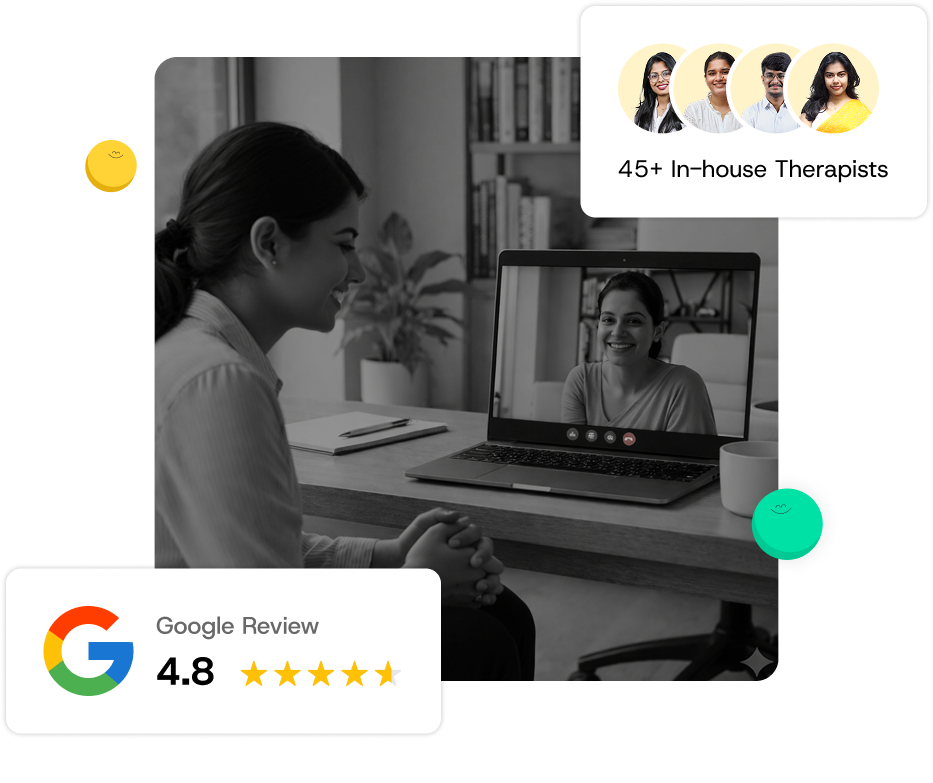

What they say About Stress Counselling

Talk to a therapist who understands Stress

Malayalam & Tamil-speaking · Certified · Sessions from ₹1000 · Book in minutes

Concerns that often Co-Occur with Stress

It is common for stress to occur alongside other mental health concerns. This doesn’t necessarily mean your situation is more serious—it simply means your therapist will take a holistic approach to understand and address the factors contributing to your stress. Oppam therapists are experienced in supporting people with co-occurring concerns through a personalised treatment plan.

Mental health resources for Kerala

Stress counselling Clinics in Calicut and Bangalore

Online Stress counselling available across Tamil nadu and Karnataka, in Malayalam, Tamil, and English.

Any Questions?

Is online therapy as effective as in-person therapy for stress?

Yes — for stress counselling, online therapy has been shown to be equally effective as in-person sessions. Multiple systematic reviews, including a 2021 meta-analysis in JAMA Psychiatry, confirm that CBT delivered online produces comparable outcomes to face-to-face CBT for stress, anxiety, and related conditions. For many Tamil clients — particularly those in the Gulf or UK who face geographic and scheduling barriers — online therapy is actually more accessible and therefore more likely to be continued long enough to be effective. Oppam’s sessions are conducted via secure video or audio call and are held to the same clinical standards as any in-person session.

No. You do not need a formal diagnosis of any kind to begin stress counselling at Oppam. Stress is not a diagnosable disorder in the same way as depression or anxiety — it is a common human response to demanding circumstances. You simply need to feel that your stress is affecting your life and that you want support in managing it. Your therapist will conduct a thorough assessment in your first session to understand your specific situation and design an appropriate treatment plan. No referral from a GP or psychiatrist is required.
Most clients begin to feel meaningful improvement within 6–8 sessions. For stress with a clear, recent trigger — a job change, a bereavement, a relationship crisis — improvement can come faster. For clients whose stress has been accumulating over years, or where stress has led to secondary issues like insomnia or anxiety, the process may take 10–16 sessions. Your therapist will review your progress regularly and adapt the treatment plan accordingly. There is no minimum number of sessions required, and you can stop at any point. Oppam sessions never expire, so you can return whenever you need to.

Stress and anxiety share many symptoms — worry, tension, sleep disruption, irritability — but they are distinct in an important way. Stress typically has an identifiable external trigger: a deadline, a financial problem, a relationship conflict. When the trigger resolves, the stress usually diminishes. Anxiety, by contrast, tends to persist even in the absence of a clear trigger, and is often characterised by anticipatory fear — worry about things that might happen rather than things that are currently happening. In clinical practice, many people experience both simultaneously, and the treatment approaches overlap significantly, which is why your Oppam therapist will conduct a thorough assessment before designing your treatment plan.

Yes — and this is one of the most important and least understood aspects of stress treatment. Chronic stress has well-documented physical effects: it disrupts sleep, impairs digestion, raises blood pressure, suppresses immune function, and increases cardiovascular risk. CBT and relaxation-based therapies have been shown to reduce these physical manifestations alongside the psychological ones. Oppam therapists include psychoeducation about the mind-body connection as part of stress counselling, helping clients understand why they are experiencing physical symptoms and equipping them with specific techniques — breathing exercises, progressive muscle relaxation, structured sleep hygiene — to reduce them.

Yes — completely. Everything you share with your Oppam therapist is held in strict confidence. Nothing is shared with your employer, family, GP, or any third party without your explicit written consent. This applies even if your company has a corporate arrangement with Oppam — your personal sessions are never visible to your employer. Oppam complies with applicable data protection regulations in India, the UAE, the UK, and other jurisdictions where clients are based. The only exception to confidentiality is if there is an immediate risk to life — in which case your therapist is ethically and legally required to take action, and will always try to discuss this with you first.

Therapeutic alliance — the quality of the relationship between therapist and client — is one of the strongest predictors of treatment success. Oppam takes this seriously. If you feel that your therapist is not the right fit for any reason, you can request a free session with a different therapist. There is no judgement and no additional cost for this first switch. You can also use the filtering tools on the Oppam website to match by gender, age range, therapeutic approach, or specific concern before booking. Our clinical team is also available to help you find the right match if you are unsure.

Everything we offer

Join over 40,000+ people who have begun their healing journey

Certified Malayali psychologists · Sessions from ₹1,000 · Available today

Scroll to Top