
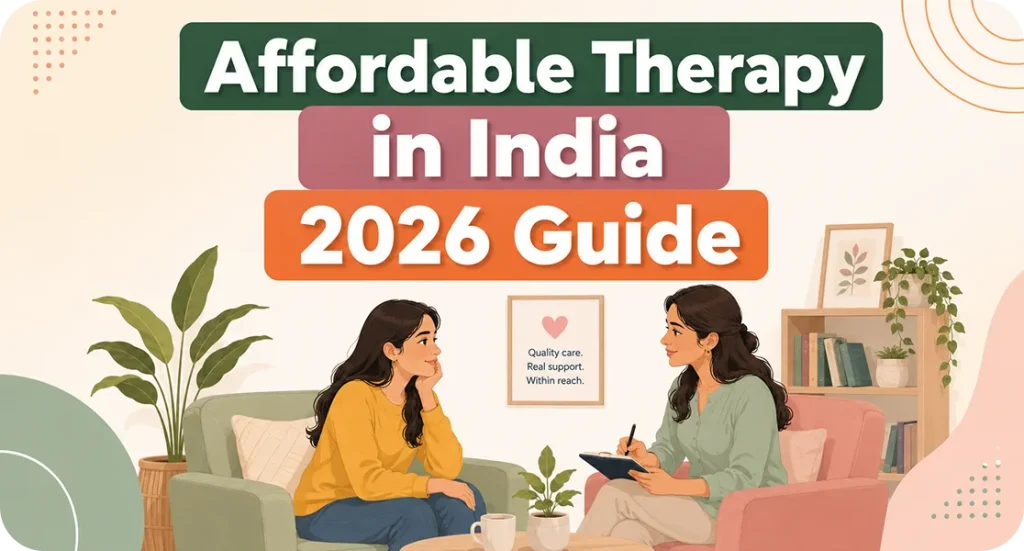
Affordable therapist in India? You’ve finally decided you want to talk to someone. Then you open your phone, search “therapist near me,” and the first few results quote fees that make you close the tab. Maybe you’ve also heard a cousin mention that therapy in Bangalore or Dubai costs more than your monthly grocery budget, and quietly decided it isn’t for people like you. This moment, wanting help but assuming it’s out of reach, is one of the most common reasons Indians delay seeking mental health support, often for years.
Here’s what most people don’t realise: therapy in India in 2026 spans an enormous price range, from completely free government helplines to premium metro clinics charging several thousand rupees a session, and the right fit for your budget almost certainly exists somewhere in between. The confusion isn’t really about whether affordable therapy exists. It’s that nobody has laid out, clearly and honestly, what the actual options cost, which ones are genuinely free, and how to tell a good affordable therapist from a corner being cut.
Need to Talk to Someone?
Book a private online session with a licensed therapist
This guide breaks down real 2026 pricing across formats and cities, explains what your health insurance is now legally required to cover, and walks through free and low-cost pathways, including options built specifically for Malayalam and Tamil-speaking families in India and abroad.
There is no fixed national fee schedule for therapy in India, unlike the UK’s BACP guidelines or Australia’s recommended rates, so prices vary considerably by format, city, and the provider’s qualifications. As a general picture in 2026: online individual therapy typically ranges from ₹1000 to ₹2,500 per session, in-person sessions in metro cities such as Bengaluru, Mumbai, Delhi, and Kozhikode typically run ₹1,500 to ₹4,000, and specialised work such as couples counselling or trauma-focused therapy often costs more, from ₹1,500 up to ₹7,000 in premium clinics. In Kerala specifically, individual therapy generally falls between ₹900 and ₹3,000 per session, with Kochi, Thiruvananthapuram, and Kozhikode clustering closer to the ₹900–₹2,500 range.
The single biggest cost lever is format. Affordable Online sessions remove clinic overheads and travel time, which is why they typically run 20 to 40% cheaper than the equivalent in-person session, and why they’ve become the default entry point for cost-conscious clients across India. A word of caution on the very cheapest end of the market: sessions priced dramatically below these ranges sometimes reflect a trainee or unregistered counsellor rather than a genuine discount, so it’s worth checking credentials regardless of price (more on this below).
Before evaluating paid therapists, it’s worth knowing what’s already free. The Tele-MANAS helpline, run by India’s Ministry of Health and Family Welfare with NIMHANS as its nodal body, offers 24/7 counselling in over 20 languages at zero cost, reachable at 14416 or 1800-891-4416 from anywhere in India. Calls connect you to a trained counsellor for immediate support, and where appropriate, a referral into further care, including video consultations with a mental health professional. This isn’t a stripped-down crisis line; it’s a genuine entry point into the mental healthcare system, and it’s particularly useful if cost is the only thing standing between you and a first conversation.
Government hospitals with psychiatry departments and university teaching clinics also offer sessions from as little as ₹100 to ₹500, staffed by qualified professionals and postgraduate trainees under supervision. Availability and wait times vary considerably by state and hospital, and these settings are typically better suited to structured, longer-term care than urgent same-week support, but they remain one of the most underused affordable options in the country.
What Your Insurance Now Legally Covers
Since October 2022, under Section 21(4) of the Mental Healthcare Act 2017 and a reinforcing IRDAI circular, every health insurance policy sold or renewed in India is legally required to cover mental illness on the same basis as physical illness. In practice, this means in-patient psychiatric hospitalisation and day-care treatment must be covered at parity with physical conditions, with no special sub-limits, no higher co-payment, and, as of 2026, waiting periods for pre-existing mental health conditions capped at a maximum of three years.
The important caveat: outpatient therapy (the ongoing weekly sessions most people actually need) is only covered if your specific policy includes an OPD benefit or wallet, so it’s worth calling your insurer directly and asking, in these exact words, “does my OPD cover clinical psychologist or psychiatrist consultations?” rather than relying on the general brochure. For a claim to be honoured, the professional you see typically needs to be a psychiatrist with an MBBS or MD, or a clinical psychologist registered with the Rehabilitation Council of India, so it’s worth confirming registration before your first session if you intend to claim. If you’re employed by a mid-sized or large company, it’s also worth checking whether an Employee Assistance Programme is already included in your benefits; many now offer four to six free sessions before any personal cost applies.
Sliding Scales, NGOs, and Reduced-Fee Options
Beyond insurance, several routes exist for genuinely reduced-cost, quality care. Many independent therapists and platforms, Oppam included, offer sliding-scale fees for students, those between jobs, or families managing multiple financial pressures at once, though this typically needs to be requested directly rather than advertised publicly. Mental health NGOs and foundations across India increasingly run subsidised or free counselling programmes, often in partnership with colleges, workplaces, or community organisations; a quick call to a university counselling cell or a local NGO can surface options that never show up in a general search. It is entirely reasonable to ask a platform directly, before booking, whether any reduced-fee or first-session-free option is available. Asking does not make you a difficult client. It makes you a resourceful one, and most ethical providers expect the question.
Feeling Overwhelmed?
You’re Not Alone. Get Support from an
Oppam Therapist Wherever You Are
Oppam Therapist Wherever You Are
The South Asian Money Conversation Nobody Has
In many Malayali and South Asian households, spending money on therapy runs into a specific kind of resistance that spending on a doctor’s visit doesn’t: the sense that paying for someone to “just talk” is a luxury rather than healthcare. This is compounded by joint-family financial arrangements, where a young adult or even a working professional may need to justify a recurring monthly expense to parents who genuinely cannot see what a session actually produces. I’ve had clients quietly pay for sessions using their own pocket money or salary specifically to avoid this conversation altogether, which, while understandable, often adds a layer of secrecy and stress on top of whatever brought them to therapy in the first place.
Reframing the conversation, when you choose to have it, from “I’m spending money to talk about my feelings” to “this is the same category of expense as a doctor’s consultation, and here’s what a session costs compared to what we already spend on X” tends to land better than an abstract appeal to mental health awareness. For diaspora families, currency conversion adds another layer entirely: many NRI clients are surprised to learn that booking with an India-based Malayalam or Tamil-speaking platform, even from the UK, Gulf, or Canada, is often significantly cheaper in absolute terms than a local therapist in their country of residence, while still matching or exceeding the cultural fit they’re looking for.
A Practical Exercise: The Three-Question Affordability Check
Before booking with any therapist or platform, run through these three questions rather than choosing purely on price:
- Can I sustain this cost for at least eight to twelve sessions? Meaningful change from most evidence-based approaches takes several sessions, not one, so the more important number is the monthly cost you can genuinely maintain, not the cheapest single session you can find.
- Is the provider’s registration or qualification stated clearly? A clinical psychologist should be able to state their RCI registration; a counsellor or psychiatrist should be able to state their relevant degree. If this information isn’t easily available, that’s worth questioning regardless of price.
- Does the platform offer language and cultural fit, not just a low price? A session that’s cheap but requires you to explain your family structure, religious context, or community stigma from scratch every time is often a worse long-term value than a slightly higher-priced session where that context doesn’t need explaining.
Need to Talk to Someone?
Book a private online session with a licensed therapist
When to Seek Professional Help
If cost has been the only reason you’ve delayed reaching out, even though you recognise ongoing sadness, anxiety, anger, or a struggling relationship in your life, that delay itself is worth acting on now. Consider starting with the free Tele-MANAS helpline if you need to speak to someone today, and consider booking a low-cost first session with a platform like Oppam if you’re ready for ongoing, culturally grounded support in Malayalam, Tamil, or English at a price built for Indian and diaspora budgets. Book your first session with Oppam → to see current pricing and sliding-scale options before deciding what fits
Frequently Asked Questions
How much does online therapy cost in India in 2026?
Online individual therapy in India generally costs between ₹500 and ₹2,500 per session in 2026, depending on the therapist’s experience and the platform. This is typically 20 to 40% cheaper than equivalent in-person sessions in metro cities, largely because online formats remove clinic overheads and travel costs for both the client and the therapist.
Is therapy covered by health insurance in India?
Since October 2022, Indian law requires every health insurance policy to cover mental illness on the same basis as physical illness for in-patient and day-care treatment. Ongoing outpatient therapy sessions, however, are only covered if your specific policy includes an OPD benefit, so you’ll need to check your policy wording or call your insurer directly to confirm.
Where can I get free counselling in India?
The Tele-MANAS helpline (14416 or 1800-891-4416) offers free, 24/7 counselling in over 20 languages, run by India’s Ministry of Health and Family Welfare with NIMHANS as its nodal agency. Government hospital psychiatry departments and university teaching clinics also offer very low-cost sessions, often between ₹100 and ₹500, though availability varies by location.
How do I convince my parents to pay for or approve therapy when they think it's unnecessary?
This is one of the most common concerns among the Malayali and South Asian families Oppam works with. It often helps to frame therapy the same way you’d frame any other healthcare expense, comparing its cost to something the family already spends money on, rather than opening with abstract language about mental health. Bringing a trusted relative who is less resistant into the conversation as an ally can also make a meaningful difference.
Can I use an Indian therapy platform if I'm living abroad, and is it actually cheaper?
Yes, and for many NRI families it works out significantly cheaper than local therapy in the UK, Gulf, Canada, or Australia, even after currency conversion, while still offering the Malayalam or Tamil-language and cultural fit that’s often hard to find locally. This is one of the main reasons diaspora families increasingly choose India-based platforms like Oppam over providers in their country of residence.
How do I know if a very cheap therapist is a bad sign or a genuine discount?
A low price on its own isn’t automatically a red flag, but it’s worth directly confirming the provider’s qualifications: a clinical psychologist should hold Rehabilitation Council of India registration, and a psychiatrist should hold an MBBS or MD. Very low fees sometimes reflect a trainee under supervision, which can be genuinely fine for general support, but it’s a detail worth knowing before you commit, especially for more complex concerns.
How many therapy sessions will I need, and how does that affect the total cost?
Most evidence-based approaches show meaningful change over roughly eight to twelve sessions for a specific, well-defined concern, though this varies by individual and issue. When budgeting, it’s more useful to calculate the monthly cost you can sustain over several months than to focus only on the price of a single session.
External Resources
- NIMHANS: data on treatment gap in India (an estimated 150 million people need mental healthcare, with roughly 1 in 10 currently receiving treatment).
- IRDAI Circular IRDAI/HLT/REG/CIR/177/10/2022: mandatory mental illness parity in health insurance, effective 31 October 2022.
- Mental Healthcare Act, 2017 (Section 21(4)): legal basis for insurance parity between mental and physical illness in India.
- Ministry of Health and Family Welfare / Tele-MANAS: national tele-mental health programme details, helpline access, and language coverage.
- ICMR: 2021 report finding teletherapy reduces overall mental healthcare costs by approximately 40% compared to in-person care.
Struggling?
Talk to an Oppam Therapist
Get the Support You Deserve Online & Confidential