
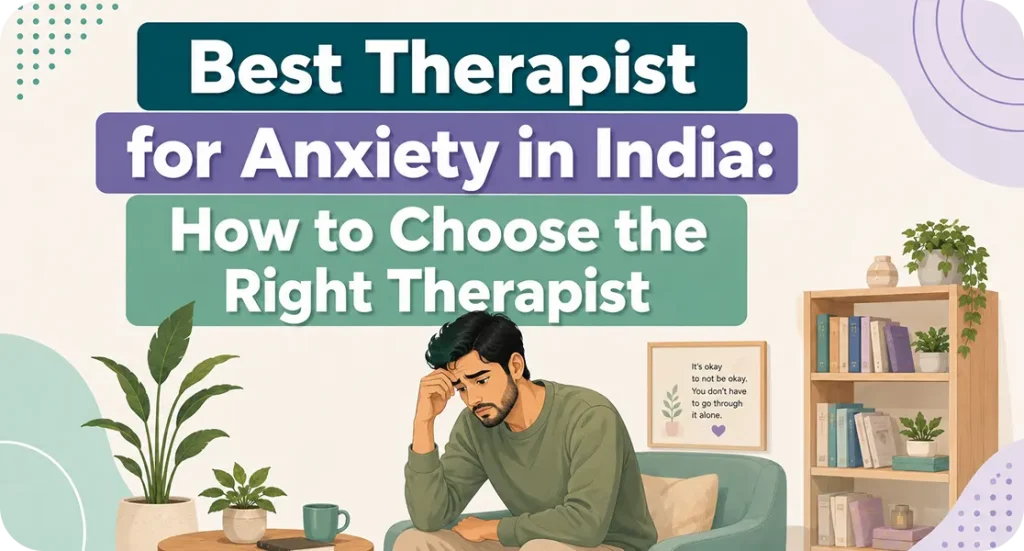
Best Therapist for Anxiety in India? You’ve typed “anxiety therapist near me” into Google at least twice now, scrolled through a dozen profiles that all describe themselves as “compassionate and experienced,” and closed the tab both times without booking. Maybe your chest has been tight for weeks over something you can’t quite name. Maybe you’ve started avoiding calls, meetings, or family gatherings that never used to bother you. And somewhere underneath the search itself sits a quieter worry: what if you choose wrong, spend money you don’t have to spare, and end up with someone who doesn’t actually help?
This hesitation is common, and reasonable. Anxiety therapy isn’t a commodity where every provider offers the same thing; the right fit genuinely changes outcomes. In Kerala and across South Asian communities specifically, there’s an added layer: anxiety often shows up as physical complaints (racing heart, stomach issues, sleeplessness) long before anyone names it as anxiety, and a therapist unfamiliar with that pattern, or with the family dynamics shaping it, can miss what’s actually going on.
Need to Talk to Someone?
Book a private online session with a licensed therapist
This guide walks through exactly what to look for in an anxiety therapist, the treatment approaches with real evidence behind them, the questions worth asking before your first session, and where Oppam fits for Malayalam and Tamil-speaking clients in India and abroad.
Anxiety is not a rare or unusual concern. According to India’s National Mental Health Survey (NMHS) 2016, conducted by NIMHANS, the lifetime prevalence of anxiety disorders across India stands at 3.8%, with meaningfully higher rates in urban areas, where work pressure, commuting stress, and economic insecurity compound the picture. The World Health Organization estimates that roughly 38 million Indians live with an anxiety disorder, yet only around 36.9% of people with anxiety in India ever receive any form of treatment, leaving the majority of cases unaddressed.
That treatment gap matters for this guide’s purpose: if you’re currently searching for a therapist, you are already ahead of most people who share your symptoms, and choosing well from here makes a genuine difference in whether that search turns into lasting relief or a discouraging false start.
Best Therapist for Anxiety in India
Not every “online counsellor” or “life coach” advertising anxiety support has clinical training in treating it. At minimum, look for one of these credentials: a clinical psychologist with a master’s degree (M.Sc. or M.Phil) in clinical psychology, ideally registered with the Rehabilitation Council of India (RCI); a psychiatrist with an MBBS and MD in psychiatry, relevant if medication may be part of your treatment; or a counselling psychologist with recognised postgraduate training and supervised clinical hours. Ask directly, in your first message or consultation call, what the provider’s qualification and registration number is. A professional confident in their training will answer this without hesitation.
Experience with anxiety specifically also matters more than general years in practice. A online therapist who primarily works with couples or career coaching may be a poor fit for panic disorder or health anxiety, even with excellent general skills. It’s entirely reasonable to ask, before booking, “how much of your caseload involves anxiety disorders specifically?”
The Treatment Approaches With Real Evidence Behind Them
Cognitive Behavioural Therapy (CBT) remains the most extensively researched and widely recommended approach for anxiety disorders, including generalised anxiety, social anxiety, and panic disorder. CBT works by helping you identify the specific thought patterns that fuel anxious spirals, and by gradually testing those thoughts against reality rather than avoiding the situations that trigger them. Exposure therapy, often used within a CBT framework, is considered the gold standard for phobias and panic-related anxiety, and involves carefully structured, gradual contact with feared situations rather than sudden confrontation.
Acceptance and Commitment Therapy (ACT) has also built a strong evidence base, particularly for people whose anxiety is tangled up with avoidance of work, relationships, or major life decisions; rather than aiming to eliminate anxious feelings entirely, ACT focuses on building a life aligned with your values even alongside some ongoing anxiety. A good anxiety therapist should be able to name which framework they primarily use and explain, in plain language, how it applies to your specific symptoms, rather than offering vague reassurance about “working through your feelings together.”
Feeling Overwhelmed?
You’re Not Alone. Get Support from an
Oppam Therapist Wherever You Are
Oppam Therapist Wherever You Are
Red Flags Worth Taking Seriously
A few patterns are worth pausing on, even if everything else about a provider looks appealing. Be cautious of anyone who promises a specific, fast timeline for “curing” anxiety, since response varies significantly by individual and severity. Be cautious of a provider who cannot clearly describe their treatment approach when asked directly, or who relies entirely on generic, motivational language rather than a structured method. It’s also worth noticing whether a provider dismisses medication as never necessary or, conversely, pushes medication before genuinely exploring therapy first; the right answer depends on your specific case, and a good clinician holds that possibility open rather than deciding it for you before an assessment.
Anxiety in South Asian Families: What a Good Therapist Should Understand
Anxiety in many Malayali and South Asian households doesn’t always arrive labelled as anxiety. It arrives as chronic headaches, an ulcer that won’t heal, a teenager suddenly refusing to attend tuition, or a parent who has become impossible to reassure about their adult child’s decisions. Somatic presentation, where emotional distress is experienced and described primarily through physical symptoms, is well documented across South Asian populations, and a therapist unfamiliar with this pattern may spend several sessions circling the physical complaints without ever reaching the anxiety underneath.
There’s also a specific family dynamic worth naming directly: in many joint-family and diaspora households, an anxious young adult is often managing not just their own worry but the anticipated reactions of parents or in-laws to every decision, from career choices to marriage timelines. A therapist working with South Asian clients should be comfortable exploring family expectation and obligation as a genuine clinical factor, not a side note to be worked around, because for many clients, that dynamic is a central driver of the anxiety itself, not background noise.
This also extends to how anxiety is discussed, or avoided, within the family unit. In several Malayali households, a family member’s visible worry is sometimes managed collectively through reassurance-seeking, where the anxious person repeatedly asks relatives to confirm that everything will be fine, and relatives, wanting to help, keep providing that reassurance. While well-intentioned, this pattern can quietly reinforce anxiety rather than reduce it, since it teaches the anxious mind that certainty is both necessary and achievable through enough checking. A therapist who understands this cultural pattern of collective reassurance can help the whole family shift toward more sustainable ways of supporting an anxious relative, rather than treating the individual in isolation from the household dynamics maintaining the cycle.
Online vs In-Person for Anxiety Treatment Specifically
For most anxiety presentations, particularly generalised anxiety and social anxiety, online therapy has strong evidence of effectiveness comparable to in-person sessions, and it removes a specific barrier that matters for anxiety in particular: the anticipatory anxiety some people feel about the act of travelling to and attending an in-person appointment. For panic disorder involving specific situational triggers (crowded places, flights, driving), an in-person or hybrid approach that allows for real-world exposure practice sometimes offers an advantage, though many therapists now design structured exposure exercises for clients to carry out in their own environment between online sessions.
Need to Talk to Someone?
Book a private online session with a licensed therapist
A Practical Exercise: The Five-Question First-Call Checklist
Before committing to any therapist, use a short consultation call or introductory message to ask these five questions, and pay attention not just to the answers but to how directly they’re given:
- What is your qualification, and are you registered with a recognised body such as the RCI?
- What treatment approach do you primarily use for anxiety, and why does it fit my situation?
- Roughly how many sessions do people with concerns similar to mine typically need before seeing change?
- Do you have experience working with South Asian family dynamics or cultural context, if that’s relevant to me?
- What does a typical session structure look like, especially in the first four to six weeks?
A confident, specific answer to each of these is a far stronger signal than testimonials or a polished profile photo.
When to Seek Professional Help
If anxiety has been present for several weeks or more, interferes with sleep, work, relationships, or daily decision-making, or has started to shrink your world through avoidance (skipping events, declining opportunities, withdrawing from people you care about), it’s worth booking an initial consultation rather than waiting for it to resolve on its own. Physical symptoms without a clear medical explanation, after appropriate tests have ruled out other causes, are also worth discussing with a mental health professional rather than continuing to treat only the physical symptom. Book your first session with Oppam → to speak with a Malayalam– or Tamil-speaking psychologist trained in evidence-based anxiety treatment who understands the cultural context shaping your specific experience.
Frequently Asked Questions
What is the best type of therapy for anxiety?
Cognitive Behavioural Therapy (CBT), including exposure-based techniques, has the strongest and most consistent evidence base for treating anxiety disorders such as generalised anxiety, social anxiety, and panic disorder. Acceptance and Commitment Therapy (ACT) is another well-supported option, particularly when anxiety is closely tied to avoidance of major life decisions. A good therapist will be able to explain clearly which approach they use and why it suits your specific symptoms.
How do I know if my therapist is actually qualified to treat anxiety?
Ask directly about their qualification (such as an M.Sc. or M.Phil in clinical psychology, or an MD in psychiatry), whether they’re registered with a recognised body like the Rehabilitation Council of India, and how much of their clinical experience involves anxiety disorders specifically. A qualified professional will answer these questions readily and specifically, without vague reassurance in place of a direct answer.
Can online therapy actually treat anxiety effectively, or do I need to see someone in person?
For most anxiety presentations, particularly generalised and social anxiety, online therapy has evidence of effectiveness comparable to in-person treatment, and it removes travel-related anticipatory anxiety that can itself be a barrier to attending sessions. Panic disorder tied to specific situations sometimes benefits from in-person or hybrid exposure work, but many therapists now structure equivalent exercises for clients to complete in their own environment.
Why does my anxiety show up as physical symptoms like stomach pain or headaches instead of just worry?
This pattern, known as somatic presentation, is well documented across South Asian populations and doesn’t mean your anxiety is “less real” than someone who experiences it purely as worried thoughts. A therapist experienced with South Asian clients should be familiar with this pattern and able to work with both the physical and emotional dimensions together, rather than treating them as separate issues.
How do I find a therapist who understands Indian family pressure and won't just apply Western advice?
Ask directly, before booking, whether the therapist has specific experience working with South Asian clients and family dynamics, including joint-family structures, marriage and career expectations, and intergenerational obligation. Platforms like Oppam are built specifically around this need, offering therapists who work with these dynamics as a central part of treatment rather than an afterthought.
Is it possible to get anxiety treatment in Malayalam or Tamil if I'm living outside India?
Yes. Oppam provides anxiety-focused therapy in Malayalam, Tamil, and English through secure online sessions for clients across the Gulf, UK, Canada, Australia, and Singapore, so distance doesn’t mean losing access to a therapist who understands both your clinical presentation and your cultural context.
How much does anxiety therapy cost in India, and how many sessions will I need?
Online anxiety therapy in India typically costs between ₹500 and ₹2,500 per session, depending on the therapist’s experience, with most evidence-based approaches showing meaningful improvement over roughly eight to twelve weekly sessions for a well-defined concern, though this varies by severity and individual circumstances.
External Resources
- NIMHANS / National Mental Health Survey (NMHS) 2016: lifetime prevalence of anxiety disorders in India (3.8%), urban-rural differences, and treatment gap data.
- World Health Organization (WHO): estimated number of Indians living with anxiety disorders and global anxiety burden data.
- American Psychological Association (APA): evidence summary on CBT and exposure therapy as first-line treatments for anxiety disorders.
- PubMed / Journal of Anxiety Disorders: research on Acceptance and Commitment Therapy (ACT) outcomes for anxiety.
- Indian Journal of Psychiatry: data on somatic presentation of anxiety and treatment-seeking patterns in Indian populations.
Struggling?
Talk to an Oppam Therapist
Get the Support You Deserve Online & Confidential