The World Health Organisation estimates that anxiety disorders affect approximately 264 million people globally, with GAD among the most prevalent. In India, the National Mental Health Survey (NIMHANS, 2016) found anxiety disorders to be the most common mental health condition, affecting 3.3% of the population — though this figure is widely considered an underestimate given the cultural barriers to disclosure and help-seeking in South Asian communities.
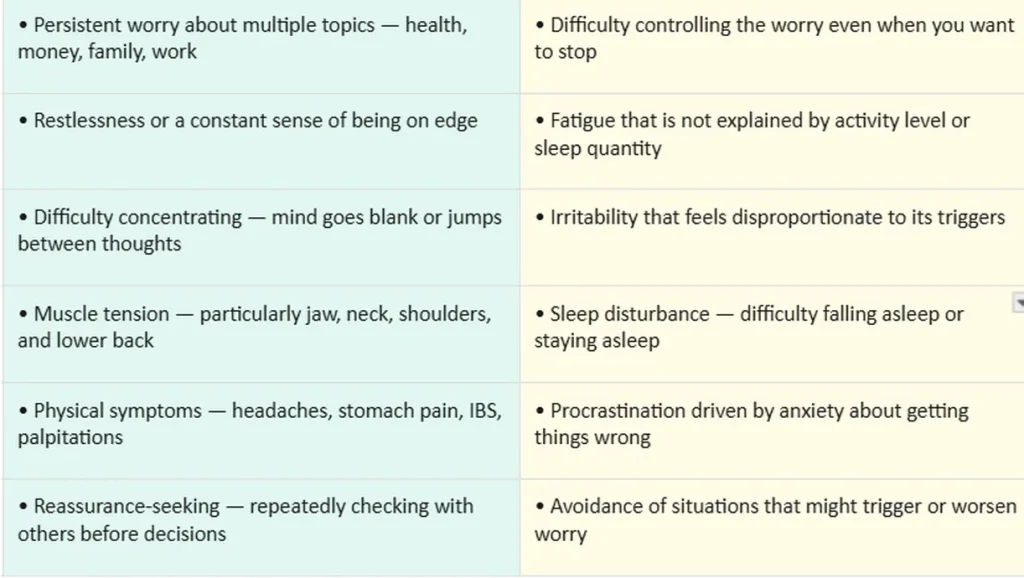
GAD presents through emotional, cognitive, physical, and behavioural symptoms. One of the reasons it is frequently missed in South Asian communities is that the physical symptoms often receive medical attention while the underlying anxiety goes unaddressed.
A pattern worth highlighting for South Asian readers: reassurance-seeking is one of the most common and least discussed behavioural symptoms of GAD. Repeatedly asking a spouse, parent, or friend whether something is okay, whether a decision was the right one, whether you are being perceived correctly — this pattern temporarily reduces anxiety but maintains the disorder by reinforcing the belief that you cannot tolerate uncertainty without checking. It is one of the first behaviours addressed in CBT for GAD.
GAD does not develop randomly. Research identifies a combination of biological vulnerability (genetic predisposition toward anxiety sensitivity), early life experiences (environments where unpredictability, high expectations, or emotional insecurity were present), and specific cultural and situational stressors. Several of these stressors are particularly concentrated in Malayali and South Asian communities.
In many South Asian families, children are raised with an acute awareness of consequence — academic failure has severe implications for the family’s future, career choices carry family honour, relationship decisions affect multiple generations. This creates a cognitive framework in which vigilance and worry are adaptive responses to genuine high stakes. By adulthood, this framework operates automatically: the brain has learned that everything has serious consequences, and worrying is how you prevent catastrophe. In GAD, this protective mechanism has become uncoupled from actual risk — it runs constantly, regardless of the actual stakes of the current situation.
The specific experience of working in the Gulf on a kafala-dependent visa — where employment security, housing, and legal status are all linked to a single employer relationship — creates a sustained state of existential uncertainty that is neurologically indistinguishable from threat. For Malayali workers supporting families back home, the financial consequences of job loss amplify this further. Research from occupational psychology consistently demonstrates that uncontrollable uncertainty is one of the most powerful drivers of generalised anxiety. The Gulf work context, for many, is a GAD incubator.
At the core of GAD is a psychological characteristic called intolerance of uncertainty (IU) — the tendency to find any degree of uncertainty threatening and unacceptable. People with high IU interpret uncertainty as inherently dangerous rather than simply unknown, and deploy worry as a (futile) attempt to resolve it. Research by Dugas and colleagues, published in *Cognitive Therapy and Research*established IU as the central maintaining mechanism of GAD, which is why modern CBT for GAD directly targets this characteristic rather than trying to reduce worry topic by topic.
In South Asian families, anxiety is often framed in moral or spiritual terms — as lack of faith, lack of gratitude, or insufficient trust in God. This framing is not malicious; it reflects a genuine belief system. But it creates a barrier to recognising anxiety as a treatable medical condition, which means that the average South Asian patient with GAD has been living with it for years — often a decade or more — before seeking professional help. By that point, the anxiety has typically shaped career decisions, relationship patterns, and self-concept in ways that require therapeutic work to untangle.
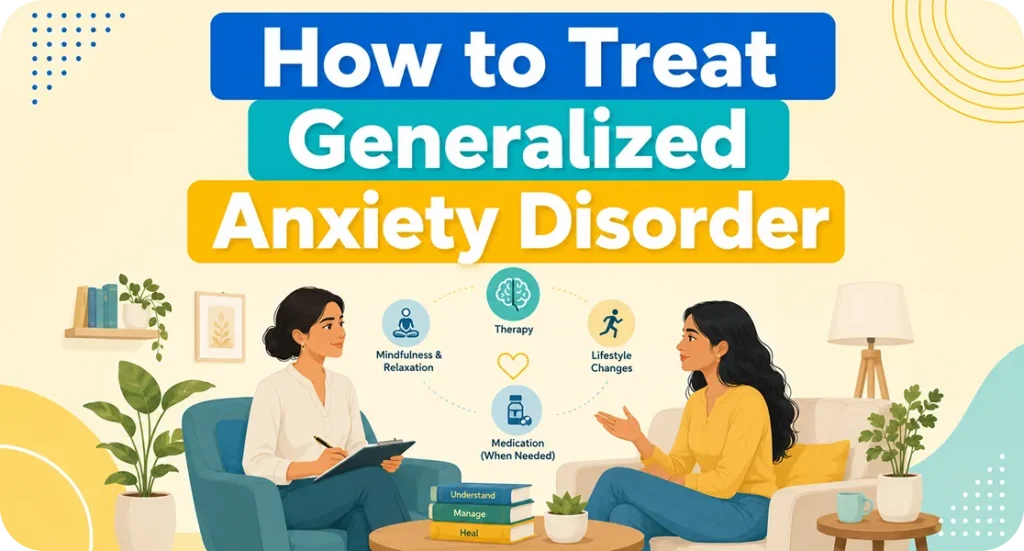
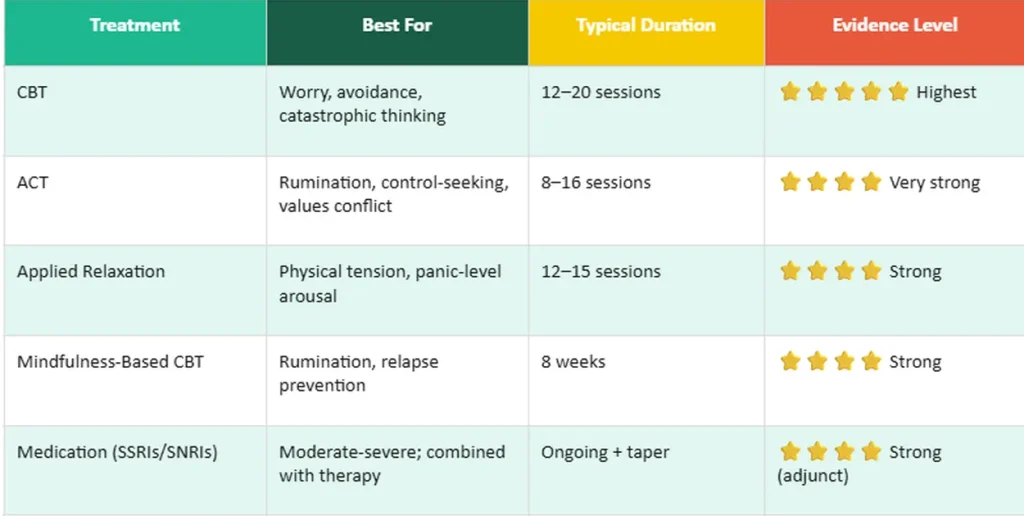
The treatment of GAD is well researched. Multiple effective options exist, and the choice between them — or the decision to combine them — depends on your specific presentation, the severity of your symptoms, your previous response to treatment, and your personal preferences. The table below summarises the primary options before each is covered in depth.
Cognitive Behavioural Therapy is the most extensively researched and most robustly effective psychological treatment for GAD. NICE (UK) guidelines recommend high-intensity CBT as the first-line treatment for GAD that has not responded to psychoeducation and self-help strategies. A comprehensive meta-analysis published in *Psychological Medicine* (Cuijpers et al., 2014) found CBT significantly outperformed waitlist control across all primary outcomes in GAD treatment, with effects maintained at follow-up.
CBT for GAD differs from general CBT in its specific targeting of worry processes. Rather than simply challenging anxious thoughts, GAD-focused CBT addresses the underlying mechanisms that keep worry running.
The cognitive component works by identifying the specific patterns of distorted thinking that fuel GAD: overestimating the probability of negative events, catastrophising the consequences of those events, and underestimating your capacity to cope if the feared outcome occurred. Each of these patterns is examined using a structured process of evidence-gathering and more realistic appraisal. For South Asian clients, this often includes examining the belief that worry itself is protective — that worrying enough about something prevents it from happening — which is one of the most common and most resilient cognitive patterns in GAD.
Because intolerance of uncertainty is the engine of GAD, modern CBT directly addresses it through graduated exposure to uncertainty. This involves identifying situations you currently avoid or manage excessively because of uncertainty — making a decision without researching it exhaustively, not checking a sent message three times, allowing a plan to remain slightly unresolved — and practising tolerating the discomfort this produces. Like any exposure work, this produces short-term anxiety followed by learning: the nervous system discovers that uncertainty is survivable.
A counterintuitive but well-evidenced technique in which all worry is deliberately postponed to a designated 30-minute “worry period” each day. When a worry arises outside this window, it is noted and deliberately deferred. This technique achieves two things: it demonstrates that worry is more controllable than GAD makes it feel, and it concentrates worry into a bounded period rather than allowing it to infiltrate the entire day. Research published in *Behaviour Research and Therapy* (Borkovec et al.) found worry postponement significantly reduced worry frequency and duration in GAD populations.
Behavioural experiments test the predictions that anxiety generates — for example, “if I send that email without checking it five times, something will go badly wrong.” The experiment involves sending the email, observing the outcome, and comparing it with the feared prediction. Over time, this produces an evidence base that directly contradicts the catastrophic predictions of GAD, weakening their credibility and their power to drive avoidance.
Acceptance and Commitment Therapy (ACT) approaches GAD differently from CBT. Rather than trying to reduce or eliminate anxious thoughts and worry, ACT focuses on changing your relationship to them. The core insight is that the problem is not the presence of anxious thoughts — it is the degree to which you get entangled in them, treat them as facts, and organise your life around avoiding them.
ACT uses mindfulness-based techniques to help clients observe anxious thoughts without being captured by them, distinguishing between “I am having the thought that something terrible will happen” and “something terrible will happen.” It then directs attention toward clarifying personal values and committing to actions in line with those values — regardless of whether anxiety is present.
For Malayali clients who have found CBT’s challenge-your-thoughts approach intellectually engaging but limited in its emotional impact, ACT often provides a complementary layer. It is particularly effective for the rumination pattern — the repetitive cycling through past or future scenarios — that characterises GAD in many South Asian clients, and for clients whose GAD has led them to significantly restrict their life through avoidance.
A meta-analysis published in the *Journal of Consulting and Clinical Psychology* (Öst, 2014) found ACT produced significant improvements in anxiety symptoms equivalent to CBT, with comparable effect sizes across GAD specifically.
Applied Relaxation is a structured behavioural technique developed by Lars-Göran Öst, involving the systematic learning of progressive muscle relaxation and its application in increasingly anxiety-provoking situations. Unlike general relaxation techniques, Applied Relaxation trains the client to deploy relaxation rapidly — within seconds — as a direct counter-response to anxiety triggers. It addresses the physiological component of GAD: the chronic muscle tension, elevated heart rate, and physical restlessness that accompany persistent worry.
NICE guidelines include Applied Relaxation as an evidence-based treatment option for GAD alongside CBT. Research published in *Behaviour Research and Therapy* (Öst & Breitholtz, 2000) found Applied Relaxation produced significant symptom reduction in GAD, with outcomes comparable to CBT.
In practical terms for South Asian clients: the physical tension component of GAD is often the most immediately accessible entry point. Many Malayali clients describe their anxiety primarily in physical terms — “my chest is tight,” “my neck and shoulders are always tense,” “I feel sick before any uncertain situation” — and Applied Relaxation provides a direct and evidence-based approach to this physical presentation.
Cognitive Behavioural Therapy (CBT) has the strongest evidence base for GAD and is recommended as the first-line psychological treatment by NICE (UK) and equivalent guidelines internationally. Modern CBT for GAD specifically targets intolerance of uncertainty — the core psychological mechanism that keeps worry running. For moderate-to-severe GAD, combining CBT with medication (typically an SSRI or SNRI) consistently produces better outcomes than either treatment alone. Acceptance and Commitment Therapy (ACT) is a well-evidenced alternative or complement to CBT, particularly for clients whose GAD involves significant rumination or avoidance.
GAD can be brought into full clinical remission — meaning symptoms are no longer clinically significant and are no longer interfering with daily functioning. For many people, this remission is sustained long-term, particularly when therapy provides skills that are practised and maintained after the treatment course ends. For others, anxiety may recur during periods of high stress. What effective treatment provides is not a permanent elimination of anxiety — a neurobiologically impossible goal — but a fundamentally different relationship with anxious thoughts and a robust set of skills for managing them when they arise.
CBT for GAD typically runs for 12 to 20 sessions, with most clients noticing meaningful improvement within the first 8 sessions. ACT and Applied Relaxation follow similar timelines of 8 to 16 sessions. Medication, if prescribed, requires 4 to 8 weeks to produce full benefit and is typically continued for at least 12 months after remission. The total duration varies based on severity, the presence of co-occurring conditions, and how long GAD has been untreated — presentations that have been present for many years typically require longer treatment than more recent ones.
Normal anxiety is proportionate, triggered by specific circumstances, and resolves when those circumstances change. GAD anxiety is persistent (present most days for six months or more), difficult to control, often disproportionate to the actual risk, and moves from topic to topic regardless of whether the triggering situation resolves. The clinical distinction also involves functional impairment: GAD causes significant interference with daily life — sleep, concentration, work, relationships — in a way that normal worry does not. A useful self-assessment question: does the worry run your life, or do you run the worry?
Yes. Oppam provides online CBT and ACT-based therapy for GAD in Malayalam, Tamil, and English, accessible from the Gulf, UK, Canada, Australia, and 45+ other countries. Sessions are conducted via secure video call, available at times that suit Gulf time zones, and require no referral or prior diagnosis. The cultural context of Gulf Malayali life — the specific stressors of kafala employment, financial remittance pressure, family separation, and the social expectation of performing success — is something Oppam therapists understand directly, without needing it explained.
For mild-to-moderate GAD, NICE guidelines recommend starting with psychological therapy (CBT) rather than medication. CBT produces outcomes equivalent to medication for mild-to-moderate presentations and has significantly lower relapse rates when the treatment course ends, because the skills learned in therapy continue to work after therapy finishes. For moderate-to-severe GAD, combining medication with CBT consistently produces better outcomes than either alone. The decision should be made in consultation with both a psychologist and a psychiatrist, taking into account your specific presentation, history, and preferences.
Oppam offers individual sessions at ₹1,000 per 60-minute session. A bundle of four sessions is available at ₹3,600 (₹900 per session), with sessions that never expire. A full CBT course for GAD of 12–20 sessions would therefore cost between ₹10,800 and ₹18,000 at individual rates, or significantly less with the bundle pricing. There is no referral required, no administrative fees, and free rescheduling up to four hours prior to any session. For clients in the Gulf or UK, sessions are accessible online without travel, clinic fees, or the insurance complexity of local private providers.