

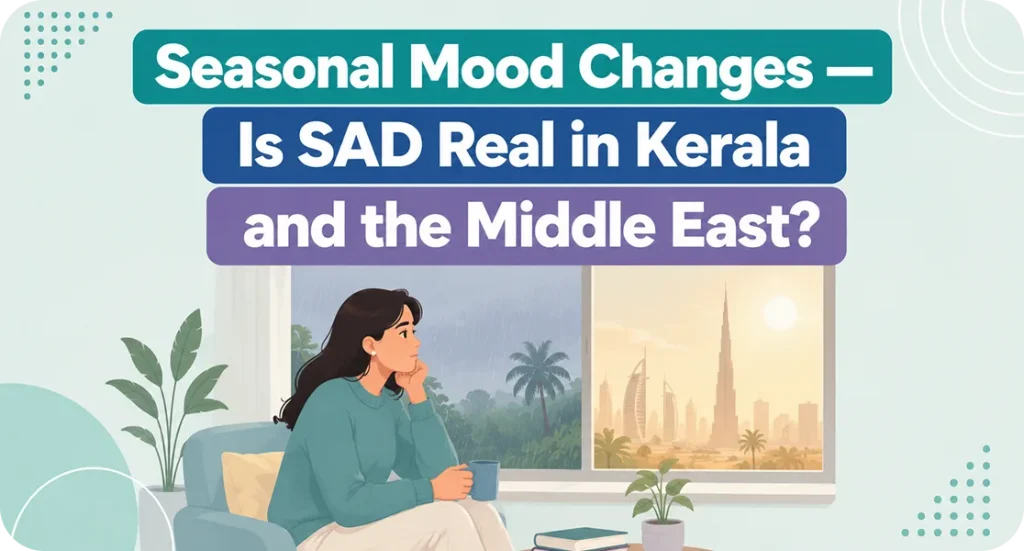
Seasonal Mood Changes in Kerala? Every year, without quite planning it, something shifts. The monsoon arrives in Kerala and the sky closes over. The light changes — not dramatically, but enough. The energy that was present in April is harder to locate in July. Getting out of bed feels heavier. Motivation drops. A flatness settles in that is difficult to explain to anyone who asks, because nothing specific has changed and life by every external measure continues as before.
In Dubai, the same person notices something different. The summer arrives and the heat becomes total , 45 degrees, a sky bleached white, months of indoor living where outdoor activity is simply not possible. The city continues at full pace inside air-conditioned towers, but something about the containment, the sameness of days, the inability to simply step outside and move freely — it wears. By August, a heaviness has accumulated that looks, from the inside, a great deal like the heaviness that the monsoon produced back home.
Need to Talk to Someone?
Book a private online session with a licensed therapist
Seasonal Affective Disorder (SAD) is one of the most well-documented patterns in mood and mental health research. It is strongly associated with reduced light exposure — particularly the short, grey days of northern hemisphere winters — and it has been studied primarily in populations in the UK, Scandinavia, North America, and other high-latitude regions. What has been studied far less is whether SAD, or seasonal mood patterns that resemble it, are real and clinically significant for Keralites, Gulf NRIs, and South Asians living across a range of climatic contexts very different from the northern European winter that defines the original research.
The short answer is yes — but the mechanisms are different, and the presentation looks different. This article explains what SAD actually is, what the evidence says about its occurrence in tropical and arid climates, why Keralite and Gulf populations may be more vulnerable than the standard narrative suggests, and what to do about it.
What Seasonal Affective Disorder Actually Is
Seasonal Affective Disorder is a subtype of Major Depressive Disorder characterised by a recurrent seasonal pattern — depressive episodes that begin and end at roughly the same time each year and are linked to changes in light exposure and circadian rhythm.
The DSM-5 classifies SAD as a Major Depressive Disorder with Seasonal Pattern, requiring that the depressive episodes occur in a predictable seasonal relationship, that full remissions occur at a predictable seasonal point, and that the seasonal episodes significantly outnumber non-seasonal depressive episodes over the course of the person’s history.
The classic SAD presentation is winter-pattern SAD — depressive episodes beginning in autumn or winter and remitting in spring. This pattern is associated with reduced daylight hours at higher latitudes, where the reduction in light exposure is most pronounced. Symptoms include persistent low mood, marked increase in sleep duration (hypersomnia rather than insomnia), increased appetite particularly for carbohydrates, significant fatigue, social withdrawal, and difficulty concentrating.
According to research published in The American Journal of Psychiatry, SAD affects approximately 1 to 6 per cent of the general population in temperate climates, with significantly higher rates at higher latitudes — studies in Alaska, Norway, and Iceland have found rates of 9 to 10 per cent. In southern Europe and lower-latitude regions, rates drop substantially, which has led to the assumption that SAD is essentially absent in tropical and subtropical populations.
This assumption is being increasingly challenged by research — and by the clinical experience of practitioners working with South Asian populations in diverse climatic contexts.
A less commonly discussed pattern is summer-pattern SAD — depressive episodes that emerge in summer rather than winter. This reverse pattern is associated with different mechanisms — heat, humidity, and disrupted sleep from high temperatures rather than reduced light — and may be significantly more relevant to South Asian populations than winter-pattern SAD.
SAD in Kerala: What the Evidence and Clinical Experience Show
Kerala sits between 8 and 12 degrees north latitude — well within the tropical zone where annual variation in daylight hours is modest compared to temperate regions. On this basis, the standard assumption is that SAD should be minimal or absent in Kerala. The clinical picture is more complicated.
The Monsoon and Mood
Kerala’s most significant seasonal transition is not winter. It is the monsoon — the dramatic shift from the dry heat of summer to the prolonged cloud cover, reduced sunlight, and constant rain of June through September. During the monsoon months, direct sunlight exposure can be minimal for days or weeks at a time. The sky is overcast. Outdoor activity is curtailed. Social patterns change.
The biological mechanism of SAD — disruption to the circadian rhythm and melatonin regulation through reduced light exposure — does not require a northern European winter to operate. It requires sufficient reduction in light exposure to produce measurable changes in the hormonal systems that regulate mood, sleep, and energy. Kerala’s monsoon, while not producing the dramatic photoperiod changes of northern winters, may produce sufficient light reduction to trigger seasonal mood changes in vulnerable individuals.
Feeling Overwhelmed?
You’re Not Alone. Get Support from an
Oppam Therapist Wherever You Are
Oppam Therapist Wherever You Are
Research on SAD at low latitudes has consistently found that while overall prevalence is lower than at high latitudes, the condition is not absent. A study published in Psychiatry Research found clinically significant seasonal mood variation in populations in India, with monsoon-associated mood changes the most commonly reported pattern — a finding that aligns with clinical experience among practitioners working with Keralite patients.
The Post-Monsoon Pattern
An equally significant seasonal pattern in Kerala clinical presentations is the post-monsoon period — the transition from the sustained grey of the monsoon to the clearer skies and more intense heat of October and November. For some patients, the lifting of the monsoon is associated with improved mood and energy. For others, the post-monsoon period brings a different kind of difficulty — disrupted sleep from returning heat and light intensity, social obligation reactivation after the relative withdrawal of monsoon months, and the particular anxiety of a year that is drawing towards its end with financial, family, and personal pressures crystallising in Q4.
Rainfall, Isolation, and Indirect Effects
Beyond the direct biological mechanisms, the monsoon produces indirect psychological effects that are clinically relevant. Extended periods of indoor confinement reduce physical activity — which research consistently shows to be a significant buffer against depression. Social isolation increases when movement is curtailed by rain. For Keralite women who manage households and whose social world often exists in the neighbourhood and community spaces that become inaccessible during heavy rain, prolonged monsoon confinement creates conditions for low mood that are partly seasonal in origin.
SAD in the Gulf: The Heat as the Season
The Gulf presents an entirely different seasonal pattern — and one that has received almost no attention in the clinical literature on seasonal mood disorders.
In UAE, Qatar, Kuwait, Bahrain, and Saudi Arabia, the climatic pattern that most affects daily life is not winter darkness but summer heat. Gulf summers — typically May through September — produce temperatures of 40 to 48 degrees Celsius, extreme humidity in coastal regions, and UV radiation levels that make outdoor exposure genuinely dangerous during daylight hours for weeks at a stretch.
The Indoor Confinement Problem
The practical consequence of Gulf summer heat for South Asian NRIs is almost total confinement to indoor, air-conditioned environments for three to five months of the year. The outdoor activities that ordinarily provide physical exercise, natural light exposure, social interaction, and the sensory variety that sustains psychological wellbeing — walking, sport, time in parks or community spaces — become unavailable.
This confinement has direct parallels with the mechanisms of northern hemisphere winter SAD. Reduced natural light exposure — because outdoor time is dramatically curtailed — disrupts melatonin regulation and circadian rhythm. Physical activity drops significantly. Social contact becomes more limited and more mediated by indoor spaces that do not replicate the psychological benefit of outdoor interaction. The sameness of indoor life — the same air-conditioned apartment, the same commute to the same air-conditioned office — produces a sensory monotony that accumulates across weeks and months.
Summer-Pattern SAD in Gulf Populations
The clinical literature on summer-pattern SAD is significantly smaller than on winter-pattern SAD, but what exists is relevant. Research published in Journal of Affective Disorders has identified summer-pattern SAD as a clinically distinct presentation associated with insomnia rather than hypersomnia, agitation rather than lethargy, and loss of appetite rather than carbohydrate craving — a different symptom profile from winter SAD that reflects different underlying mechanisms.
For Gulf NRI workers, the summer pattern is likely further complicated by the specific stressors of Gulf summer: the absence of family members who return to Kerala for the summer, leaving the remaining worker in an emptier and lonelier social environment; the financial pressure of school fees and summer expenses; and the accumulated fatigue of a professional year that for many South Asian workers in the Gulf offers very limited recovery time.
The Vitamin D Connection
Research published in Journal of Affective Disorders has documented a significant association between Vitamin D deficiency and depression, with low Vitamin D levels consistently predictive of depressive symptoms across populations. The Gulf presents a paradox: despite abundant sunshine, Vitamin D deficiency is extremely common among South Asian NRIs in Gulf countries. The reason is the same as the SAD mechanism — outdoor sun exposure is dramatically curtailed by heat, and the indoor lifestyle that Gulf summer necessitates produces Vitamin D deficiency that is physiologically indistinguishable from that produced by Nordic winter.
Need to Talk to Someone?
Book a private online session with a licensed therapist
NIMHANS research has similarly documented high rates of Vitamin D deficiency in Indian populations, including in Kerala, which has abundant sunshine but where indoor work, cultural clothing practices, and skin pigmentation combine to reduce effective Vitamin D synthesis even during non-monsoon periods.
Keralites in the UK, Canada, and Other Diaspora Contexts
For Keralites and South Asians who have migrated to the UK, Canada, Australia’s southern states, or other high-latitude diaspora contexts, the clinical picture of SAD is more directly parallel to the established research — with additional complexity produced by the cultural and acculturation dimensions of the diaspora experience.
In the UK, where the Keralite diaspora is significant, the combination of short winter days, grey skies, cold temperatures, and cultural isolation creates conditions for winter-pattern SAD that are fully consistent with the established literature. Research published in Transcultural Psychiatry has documented elevated rates of seasonal mood disorder among South Asian populations in the UK, with the first winter after migration particularly identified as a period of elevated risk.
The additional layer for Keralite diaspora in northern climates is the interaction between seasonal mood changes and the existing stressors of migration — acculturation stress, social isolation in a new country, cultural dissonance, and the particular homesickness that the contrast between a grey UK November and a remembered Kerala November can produce. These factors do not cause SAD but they amplify its impact and reduce the psychological resources available to manage it.
How to Tell if What You Are Experiencing Is Seasonal
Not every mood change that correlates with seasons is SAD. Understanding the clinical markers helps distinguish seasonal mood variation that is within the normal range from a pattern that warrants professional attention.
The Recurrence Test
SAD is defined by recurrence — the same pattern appearing at roughly the same time across at least two consecutive years. A single difficult monsoon season, or one difficult Gulf summer, does not constitute SAD. A pattern that reliably appears with a particular season and reliably remits when that season ends is clinically significant.
The Functional Impairment Test
As with all mood disorders, the clinical threshold is functional impairment — whether the mood change is affecting your ability to work, maintain relationships, care for yourself, or engage with daily life in meaningful ways. Feeling somewhat lower during the monsoon and then lifting is seasonal mood variation. Feeling so low during the monsoon that work performance drops, social withdrawal widens, and sleep is significantly disrupted for weeks or months is the clinical territory of SAD.
The Symptom Profile
Classic winter-pattern SAD: low mood, significantly increased sleep, carbohydrate craving, weight gain, profound fatigue, social withdrawal, difficulty concentrating.
Summer-pattern SAD or heat-related mood disorder: low mood, insomnia or disrupted sleep from heat, agitation or irritability, reduced appetite, social withdrawal from confinement.
Monsoon-associated mood changes: low mood, fatigue, reduced motivation, social withdrawal, possible increase in sleep, correlating with overcast skies and reduced outdoor activity.
Practical Self-Assessment
If you notice that your mood, energy, sleep, and motivation reliably worsen during a specific season each year and reliably improve when that season ends — and if the impact is sufficient to affect your daily functioning — that pattern is worth discussing with a clinical professional.
What Actually Helps: Evidence-Based Approaches
Light Therapy
Light therapy — exposure to a bright artificial light source (typically 10,000 lux) for 20 to 30 minutes each morning — is the most extensively evidenced treatment for winter-pattern SAD, with a meta-analysis published in Journal of Affective Disorders confirming its efficacy comparable to antidepressant medication for seasonal presentations.
For Keralite patients in the UK, Canada, and other high-latitude diaspora contexts, light therapy is directly applicable and should be considered as a first-line intervention for recurrent winter-pattern mood changes. Light therapy boxes are available commercially and the intervention requires no prescription.
For monsoon-related mood changes in Kerala, or heat-confinement mood changes in the Gulf, the applicability of light therapy is less straightforward — the mechanism is different — but targeted morning light exposure during the limited windows of available daylight remains useful for circadian rhythm regulation.
Physical Activity — The Consistent Evidence
Across all seasonal mood presentations, physical activity is the intervention with the most consistent evidence base. A review published in JAMA Psychiatry confirmed that exercise produces significant reductions in depression symptoms with effects comparable to medication for mild to moderate presentations.
For Gulf NRI workers during summer confinement, this means structured indoor exercise — gym use, home workout routines, swimming in indoor pools — during the months when outdoor activity is not possible. The evidence supports any form of moderate-intensity exercise; the barrier is motivational rather than practical, and it is precisely the motivational deficit of seasonal low mood that makes initiating exercise most difficult and most necessary.
Vitamin D Supplementation
Given the strong association between Vitamin D deficiency and depression, and the high prevalence of Vitamin D deficiency in both Gulf NRI and Kerala populations, supplementation is a low-risk, potentially significant intervention that should be discussed with a GP. Blood testing to establish baseline levels before supplementation is recommended — Vitamin D toxicity from excessive supplementation is real, though uncommon.
CBT for SAD
Cognitive Behavioural Therapy adapted specifically for SAD — CBT-SAD — has a growing evidence base. Research by Rohan and colleagues at the University of Vermont, published in American Journal of Psychiatry, found that CBT-SAD produced outcomes equivalent to light therapy in the short term and significantly better outcomes at long-term follow-up, with lower relapse rates across subsequent seasons. The CBT approach targets the behavioural withdrawal and cognitive patterns that maintain seasonal low mood, building the behavioural and cognitive resources that buffer against recurrence.
Social Connection During Seasonal Low Periods
Research published in PLOS Medicine by Holt-Lunstad and colleagues identified social isolation as carrying health risks comparable to smoking 15 cigarettes per day. During seasonal periods of mood vulnerability — monsoon months in Kerala, summer months in the Gulf, winter months in diaspora contexts — maintaining genuine social connection is both harder and more important than at other times of year.
For Gulf NRI workers whose social world contracts during summer months when family members return to Kerala, deliberate investment in maintaining contact with those who remain in the country — however limited that social world may be — is clinically protective.
When to Seek Professional Help
Seasonal mood changes warrant professional attention when they occur in a recurrent pattern across at least two years, when they produce functional impairment in work, relationships, or daily self-care, or when self-management strategies have not produced meaningful improvement across one or more seasonal cycles
Need to Talk to Someone?
Book a private online session with a licensed therapist
Seek help if the seasonal low mood is accompanied by thoughts of self-harm or hopelessness — these require urgent attention regardless of season. Please contact iCall (9152987821) or the Vandrevala Foundation (1860-2662-345) immediately if you or someone you know is in crisis.
For Keralites experiencing monsoon-associated mood changes, Gulf NRIs managing summer confinement depression, or diaspora South Asians navigating northern hemisphere winters, online counselling in Kerala through Oppam is accessible from wherever you are — Kerala, the Gulf, UK, Canada, Australia — in Malayalam, Tamil, and English, via secure video call from home. Therapists who understand the specific seasonal and cultural contexts of these populations are available without a GP referral. Book your first session →
Frequently Asked Questions
Is SAD real in Kerala or is it only a Western condition?
SAD as classically defined — linked to northern hemisphere winter light reduction — is less prevalent in Kerala than in high-latitude regions. However, clinical and research evidence increasingly supports the existence of seasonal mood patterns in Kerala, most commonly associated with the monsoon season’s prolonged reduction in sunlight and outdoor activity. The mechanisms are similar — disrupted circadian rhythm, reduced light exposure, reduced physical activity, increased social isolation — even if the seasonal trigger is different. For Keralites in diaspora contexts in the UK, Canada, or northern Europe, classic winter-pattern SAD is fully applicable.
Can Gulf summer heat cause depression?
Yes, and this is significantly under-researched. Gulf summer produces near-total indoor confinement for South Asian NRIs across three to five months — dramatically reducing natural light exposure, physical activity, outdoor social interaction, and sensory variety. These conditions parallel the mechanisms of winter SAD in northern climates. Summer-pattern SAD, associated with insomnia, agitation, and appetite loss rather than the hypersomnia and carbohydrate craving of winter SAD, is a recognised clinical variant. The additional stressors of Gulf summer — social isolation from departed family members, accumulated financial pressure — amplify the mood impact.
How do I know if my mood changes are seasonal or something else?
The two key clinical markers are recurrence and functional impairment. If mood changes reliably appear at the same time each year and reliably remit when the season ends, across at least two consecutive years, that recurrent pattern is clinically significant. If the mood change is causing impairment in work, relationships, or daily functioning — not just temporary low energy, but genuine difficulty managing normal responsibilities — it has crossed the clinical threshold. A single difficult season does not constitute SAD. A reliable, impairing, recurrent pattern does.
Does light therapy work for people in Kerala or the Gulf?
Light therapy — 10,000 lux bright light exposure for 20 to 30 minutes each morning — has the strongest evidence for winter-pattern SAD in high-latitude populations, where reduced photoperiod is the primary mechanism. For Kerala monsoon-associated mood changes, morning light exposure during available daylight windows supports circadian rhythm regulation and is a low-risk intervention worth trying. For Gulf summer confinement, the evidence is less direct, but structured morning light exposure and maximising available natural light within indoor environments are reasonable first steps alongside increased physical activity and social connection.
Can online therapy help with seasonal depression in the Gulf or Kerala?
Yes. CBT adapted for SAD — CBT-SAD — has an evidence base confirming outcomes equivalent to light therapy in the short term and superior relapse prevention at long-term follow-up. Online therapy delivers this intervention equivalently to in-person therapy, confirmed by research published in World Psychiatry. For Gulf NRI patients during summer confinement, when leaving home is practically difficult and social isolation is already a clinical concern, online therapy through Oppam in Malayalam, Tamil, or English removes the practical barriers to accessing support during the most vulnerable seasonal period.
Is Vitamin D deficiency connected to seasonal mood changes in Kerala and the Gulf?
Yes, and this connection is clinically documented. Research published in Journal of Affective Disorders confirmed a significant association between Vitamin D deficiency and depression. Despite abundant sunshine in both Kerala and the Gulf, Vitamin D deficiency is extremely common in South Asian populations in both contexts — because indoor work, cultural clothing practices, skin pigmentation, and in the Gulf specifically, the curtailment of outdoor exposure by extreme heat, all reduce effective Vitamin D synthesis. Checking Vitamin D levels with a GP and supplementing where deficient is a low-risk, potentially significant intervention for people with recurrent seasonal low mood.
Why do some Keralites feel worse during the monsoon even when they love the rain?
This is one of the most commonly described experiences by Keralite patients with monsoon-associated mood changes — the intellectual appreciation of the rain coexisting with a psychological state that is measurably worse during it. The mechanism is not primarily about whether you like the rain. It is about light exposure, outdoor activity levels, physical confinement, and circadian rhythm disruption — all of which are affected by the monsoon regardless of aesthetic preference. You can love the monsoon and still be vulnerable to its psychological effects if your biology is sufficiently sensitive to the seasonal changes it produces.
External Resources
- The American Journal of Psychiatry — SAD prevalence data across latitudes (1–6% temperate climates, up to 10% high latitudes); seasonal pattern criteria in DSM-5
- Journal of Affective Disorders — Summer-pattern SAD clinical features; Vitamin D deficiency and depression association; light therapy meta-analysis for seasonal presentations
- JAMA Psychiatry — Exercise producing depression symptom reductions comparable to medication; evidence review across clinical populations
- American Journal of Psychiatry (Rohan et al.) — CBT-SAD producing outcomes equivalent to light therapy short-term; superior relapse prevention at long-term follow-up
- Transcultural Psychiatry — Elevated seasonal mood disorder rates in South Asian diaspora UK populations; first winter after migration as elevated risk period
- PLOS Medicine (Holt-Lunstad et al.) — Social isolation health risks comparable to smoking 15 cigarettes per day; protective role of social connection during mood-vulnerable periods
Struggling?
Talk to an Oppam Therapist
Get the Support You Deserve Online & Confidential