

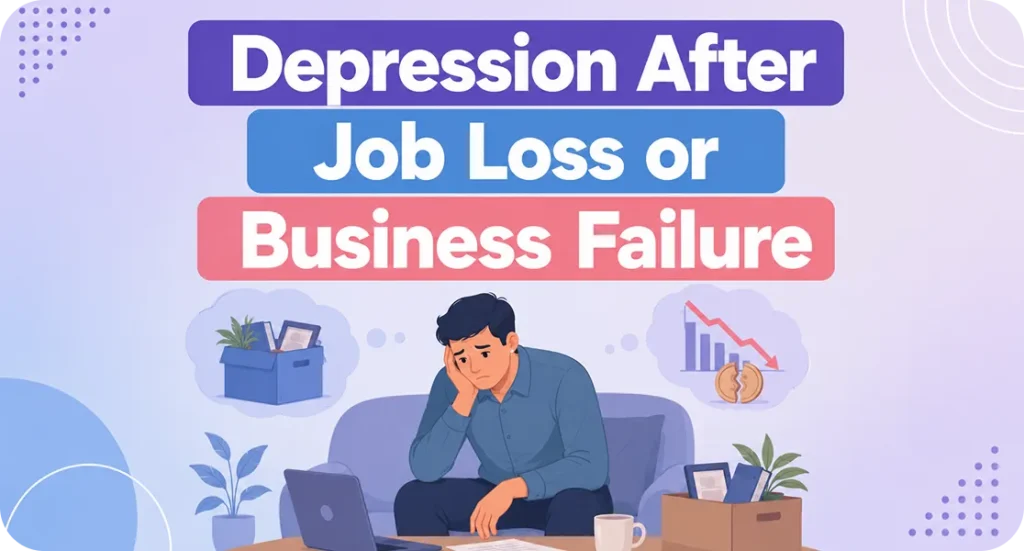
depression after job loss or business failure ? He had been building the business for six years. Every decision, every sacrifice, every early morning and late night had a purpose that was larger than himself, the family’s security, his parents’ pride, the proof that the risk was worth taking. And then, in the space of a few months, it was gone. Not dramatically. Not in a single moment. Just a slow, grinding series of losses until the numbers no longer worked and the decision was made for him.
What followed was not what he expected. He expected to feel devastated and then to recover. What actually happened was different — a flatness that did not lift, a withdrawal from everyone who cared about him, an inability to feel anything much about anything, and a private certainty that he had permanently destroyed everything he was supposed to be.
Need to Talk to Someone?
Book a private online session with a licensed therapist
He did not call it depression. In his family, depression was something that happened to other people — people who were weak, people who had not tried hard enough, people who had nothing to show for themselves. He had tried. He had failed. And now he was managing — barely, invisibly, alone.
This article is written for him. And for every Kerala entrepreneur whose business has not survived, every Gulf NRI whose contract was not renewed, every Tamil professional whose redundancy came without warning, every South Asian person who built their identity around their career and is now standing in the rubble of it wondering who they are.
Job loss and business failure are among the most significant triggers for clinical depression in adult life. The suffering they produce is real, it has a name, and it responds to treatment.
Why Job Loss and Business Failure Hit So Much Harder in South Asian Contexts
Losing a job or a business is painful in any cultural context. In South Asian families — Keralite, Tamil, Gulf diaspora — it is a particular kind of pain that carries dimensions most Western psychological literature does not fully account for.
Identity Fusion With Professional Role
In most South Asian families, what you do is inseparable from who you are. The engineer, the doctor, the business owner, the Gulf worker — these are not just occupational categories. They are identity positions that carry family honour, community standing, and a sense of personal worth that has been constructed over decades.
When the professional role collapses, the identity collapses with it. The man who was the successful NRI in Dubai is now the man whose contract ended. The woman who built a business from nothing is now the woman whose business failed. These are not simply circumstances. They feel like verdicts on the self — permanent, defining, shameful.
Research published in the Journal of Occupational Health Psychology confirmed that the psychological impact of job loss is mediated significantly by the degree to which professional identity is central to self-concept. People for whom work is a primary source of identity show significantly greater rates of depression following job loss than those for whom work is one of multiple identity sources. In South Asian communities, where professional achievement is so consistently the primary measure of worth, this risk is structurally elevated.
The Collective Dimension of Individual Failure
In most Western contexts, a job loss or business failure is experienced primarily as a personal setback. In Kerala and Tamil Nadu, it is simultaneously a family event. Parents who sacrificed for their child’s education, spouses who supported the business through its difficult early years, in-laws whose opinion of the family depends partly on the business’s success, children whose school fees and futures are entangled with the enterprise — all of these people are affected, and the person who has failed knows it.
This collective dimension adds a specific layer to the depression that follows. It is not simply grief about personal loss. It is guilt about what the loss has done to everyone else. It is shame about the community’s knowledge of the failure. It is the particular weight of having been the person others were depending on, and having let them down.
Feeling Overwhelmed?
You’re Not Alone. Get Support from an
Oppam Therapist Wherever You Are
Oppam Therapist Wherever You Are
For Gulf NRI workers whose families in Kerala have reorganised their entire financial existence around the remittance — the house built, the loans taken, the commitments made — losing the job does not feel like losing employment. It feels like losing the structural support of an entire family ecosystem.
The Silence That Compounds Everything
In South Asian communities, financial failure is one of the most heavily stigmatised forms of difficulty. More stigmatised, in many families, than illness. More stigmatised, in many contexts, than relationship breakdown. The social imperative to appear successful — to maintain the image of the person who is managing — means that the depression following job loss or business failure is typically carried in complete isolation.
The person who has failed does not tell their parents the full extent of what has happened. Does not tell their spouse how bad things actually are internally. Does not tell friends who might judge. Does not seek professional support because seeking professional support would require acknowledging the level of distress — and acknowledging the level of distress means acknowledging the failure more fully than the social performance currently permits.
This silence is not weakness. It is the rational response to a cultural environment in which disclosure carries real social cost. But it is also the mechanism by which depression deepens, entrenches, and in the most serious cases, becomes life-threatening.
What Depression After Job Loss or Business Failure Actually Looks Like
Depression following financial or professional loss does not always look like what people expect. Understanding the specific presentation helps both the person experiencing it and the people around them recognise what is actually happening.
The Flatness That Replaces Grief
Many people expect to feel devastated after a business failure or job loss — and initially they often do. What takes them by surprise is when the devastation gives way not to gradual recovery but to a flatness that is in some ways harder to describe and harder to explain to others.
Anhedonia— the clinical term for the loss of capacity for pleasure — is one of the two core symptoms of Major Depressive Disorder according to the DSM-5, and it is frequently the feature of post-loss depression that is most disorienting. The food that used to be enjoyable tastes flat. The family interactions that used to provide genuine warmth now feel like performances. The activities that once provided relief — cricket, cooking, prayer, exercise — no longer produce the feeling they used to. Nothing works as a comfort because the emotional system has stopped responding to ordinary inputs.
This flatness is often misread by family members as indifference, ingratitude, or selfishness. It is none of these. It is a neurobiological state produced by the depression — the result of measurable changes in dopaminergic and serotonergic systems that regulate both motivation and the capacity for reward.
Withdrawal and Isolation
The person who has experienced professional or financial failure typically withdraws from the social world in ways that compound the depression they are already experiencing. Phone calls go unanswered. Invitations are declined. Family gatherings are avoided. Conversations are kept brief and surface-level.
The withdrawal has multiple drivers. There is the shame of being seen in a diminished state. There is the exhaustion of maintaining the performance of normality. There is the genuine absence of the energy that social interaction requires. And there is the specific dread of the questions that will inevitably be asked — about the business, about the job, about what happens next — for which there are no comfortable answers.
Need to Talk to Someone?
Book a private online session with a licensed therapist
According to research published in PLOS Medicine by Holt-Lunstad and colleagues, social isolation is associated with a 26 per cent increased risk of mortality and health outcomes comparable to smoking 15 cigarettes a day. The withdrawal that depression produces is therefore not simply emotionally painful — it is physiologically costly. And in South Asian contexts, where the shame of failure makes withdrawal feel safer than disclosure, the isolation tends to be more complete and more prolonged than it would otherwise be.
Physical Symptoms
Depression after job loss and business failure consistently produces physical symptoms that are frequently attributed to physical causes rather than psychological ones — particularly in South Asian clinical populations where somatisation is well-documented.
Persistent fatigue that does not respond to rest. Headaches that have no identified neurological cause. Gastrointestinal problems — appetite loss, stomach discomfort — that GP investigation does not explain. Disrupted sleep — either insomnia driven by nocturnal rumination about the financial situation, or hypersomnia that functions as escape from a waking life that feels intolerable.
Research published in the Indian Journal of Psychiatry has documented that depression in Indian patients more commonly presents through physical symptoms than through the emotional complaint of low mood — meaning that the depressed Keralite man who has lost his business may present to his GP with persistent fatigue and headaches rather than with depression as the presenting concern. Without a psychological assessment, the physical symptoms are treated and the depression continues.
Cognitive Distortions: The Three Permanences
Cognitive Behavioural Therapy research, drawing on the work of Aaron Beck at the University of Pennsylvania, has identified a specific cognitive pattern characteristic of depression following significant loss. Beck described it as the negative cognitive triad — pervasively negative beliefs about the self, the world, and the future. Following job loss or business failure, this triad typically takes the following specific form.
The negative view of self: “I failed because I am fundamentally inadequate. This proves what I always suspected about myself — that I am not good enough, that I do not deserve success, that I am less than the people around me who have succeeded.”
The negative view of the world: “No one will trust me now. Employers will see the failure on my record. Partners will not want to work with me. The community knows. My reputation is damaged permanently.”
The negative view of the future: “I will not recover from this. The financial damage is too great, the reputational damage is too great, the time lost is too great. This is how things will remain.”
Each of these beliefs feels, during depression, like an accurate assessment of reality. They are not. They are cognitive distortions produced by the depression — predictable features of the depressed mind’s relationship to negative experience, not reliable reports from an objective observer. And they are specifically responsive to CBT — the structured examination and testing of these beliefs produces measurable change in both the beliefs and the depressive state they maintain.
The Gulf NRI Specific Picture
For Gulf NRI workers — a significant proportion of Oppam’s audience — job loss carries dimensions that deserve specific attention.
The Gulf employment model for South Asian workers is structured around the kafala system, which ties legal residency to employment. Losing a job in the Gulf therefore means not simply losing income. It potentially means losing the right to remain in the country — with all the practical and social consequences that entails. The visa clock starts running. Decisions about returning to Kerala or finding alternative employment must be made under time pressure and financial stress simultaneously.
The return to Kerala after Gulf employment ends — particularly when that return is involuntary — is itself a significant psychological transition. The man who left as the family’s provider returns without that role intact. The community, which celebrated his departure and monitored his success, now knows he has returned early. The family, which reorganised its finances around the remittance, must now adjust its expectations. All of this happens while the person is simultaneously managing the depression that the job loss has produced.
Research published in Transcultural Psychiatry has documented elevated rates of depression and anxiety among returned Gulf migrants, with the adjustment period following involuntary return identified as a period of significantly elevated psychological risk. This population — large, identifiable, and with specific clinical needs — remains significantly underserved by existing mental health services in Kerala.
What Actually Helps: Evidence-Based Approaches
Cognitive Behavioural Therapy
CBT is the most extensively evidenced psychological treatment for depression following significant loss events. A comprehensive meta-analysis published in JAMA Psychiatry by Cuijpers and colleagues confirmed that CBT for depression produces effect sizes comparable to antidepressant medication, with superior durability at follow-up.
For depression following job loss or business failure specifically, CBT targets two dimensions simultaneously. The cognitive dimension addresses the distorted beliefs about self, world, and future that the depression produces — the permanences, the catastrophising, the fundamental inadequacy narrative — and subjects them to structured examination against evidence. The behavioural dimension addresses the withdrawal and avoidance that maintain depression by reducing the positive experiences and social connection that would otherwise buffer against it.
Behavioural Activation — the systematic scheduling of meaningful, valued, and pleasurable activities even in the absence of motivation to pursue them — is the behavioural component most directly relevant to post-loss depression. The principle is clinically counterintuitive: you do not wait to feel motivated before acting. You act, and the motivation follows. This reverses the depression-withdrawal cycle by reintroducing positive experience into a life from which it has been evacuated.
Meaning Reconstruction
Viktor Frankl’s work on meaning-making following catastrophic loss — developed from his own experience of concentration camp imprisonment — has produced a clinical framework that is particularly relevant to professional and financial loss. The question is not simply how to recover the circumstances that were lost but how to reconstruct a sense of meaning and purpose that does not depend entirely on the professional role that has collapsed.
For South Asian men whose identity has been so thoroughly fused with their professional and provider role, this is both the most challenging and the most necessary therapeutic work. A therapist who understands the cultural dimensions of this identity fusion — who does not pathologise the depth of the investment in the professional role while also helping the person develop a broader identity framework — produces more effective outcomes than one who approaches the work from a generic Western psychological template.
Addressing Shame Directly
Shame is the emotion most central to depression following professional or financial failure in South Asian contexts, and it is also the emotion most likely to be avoided in therapy if the therapist is not specifically attuned to it. Brené Brown’s research on shame and vulnerability, published across multiple academic and clinical contexts, identifies shame as the feeling of being fundamentally flawed and therefore unworthy of connection — a description that maps directly onto the experience of the South Asian professional who has failed.
Shame-informed therapy — which explicitly names shame as the central emotional experience, normalises it without reinforcing it, and helps the person distinguish between guilt (I did something bad) and shame (I am bad) — is significantly more effective for this population than therapy that treats the depression while avoiding the shame that is maintaining it.
When to Seek Professional Help
Seek professional support if low mood, emotional flatness, withdrawal, or hopelessness following a job loss or business failure has been present on most days for more than four weeks. If sleep is significantly disrupted — either insomnia driven by financial worry or excessive sleep as escape. If you are withdrawing from family and social contact in ways that are widening rather than narrowing over time. If alcohol or other substances have become a regular part of managing the way you feel. If the physical symptoms — fatigue, headaches, appetite loss — have been present consistently without clear medical explanation.
Need to Talk to Someone?
Book a private online session with a licensed therapist
Seek help urgently if there are any thoughts of self-harm, thoughts that the family would be better off without you, or any sense that life is not worth continuing. Please contact iCall (9152987821) or the Vandrevala Foundation (1860-2662-345) immediately if you or someone you know is in this situation. Financial failure, however devastating, is recoverable. Depression that reaches crisis point without intervention is far harder to come back from.
For Keralites and South Asians across Kerala and the diaspora, online counselling in Kerala through Oppam is accessible from home — in Malayalam, Tamil, and English — without requiring a clinic visit, without community visibility, and without the need to explain your cultural context to a therapist who does not share it. Sessions are available without a GP referral. Book your first session →
Frequently Asked Questions
Is it normal to feel depressed after losing a job or business?
Yes, and the evidence is clear. Research consistently identifies job loss and business failure as among the most significant triggers for clinical depression in adult life — particularly for people whose professional identity is central to their self-concept, which in South Asian communities is structurally common. Feeling devastated, flat, withdrawn, and hopeless following professional or financial loss is not weakness or self-pity. It is a predictable psychological response to a significant loss event, and when it persists beyond four to six weeks and impairs daily functioning, it meets the clinical threshold for Major Depressive Disorder — a treatable condition, not a character flaw.
How long does depression after job loss typically last?
Without treatment, depression following significant loss events can persist for months or years. With appropriate treatment — CBT, medication where indicated, or a combination — most people experience significant improvement within 12 to 20 sessions of structured therapy. Earlier treatment consistently produces faster and more complete recovery. According to research published in JAMA Psychiatry, the risk of recurrent depressive episodes increases with each untreated episode — making early intervention important not just for the immediate recovery but for long-term resilience.
Why do South Asian men find it so hard to admit depression after business failure?
Several converging factors create this difficulty. Professional identity is so thoroughly fused with personal worth that admitting depression feels like confirming the failure at a deeper level than merely financial. The cultural framework values endurance and self-sufficiency in men, framing help-seeking as weakness. The community’s knowledge of the failure makes disclosure feel like adding vulnerability to already public difficulty. And the family’s financial dependence on the person creates a sense that they cannot afford to not be okay. Understanding these barriers as structural rather than personal weakness is the first step towards overcoming them.
Can a business failure cause long-term psychological damage?
It can if left unaddressed. Untreated depression following business failure can produce lasting changes in self-concept, ongoing anxiety about future financial security, avoidance of professional risk-taking that prevents recovery, and in some cases, chronic depression or anxiety disorders that persist long after the financial situation has stabilised. Addressed with appropriate clinical support, business failure — however devastating in the moment — does not need to produce lasting psychological damage. The cognitive distortions that make the failure feel permanent and defining are treatable, and the identity reconstruction work that follows can produce a more resilient and multidimensional sense of self than the one that existed before.
Where can I find online therapy in Kerala for depression after job loss?
Oppam offers online therapy in Kerala in Malayalam, Tamil, and English for depression following job loss, business failure, and financial stress. Sessions are available via secure video call from anywhere in Kerala or the South Asian diaspora, with therapists trained in CBT for depression and experienced in the specific cultural contexts of South Asian professional identity, Gulf NRI experience, and the particular shame dynamics of financial failure in closely networked Keralite communities. No GP referral is required. An online therapist Kerala through Oppam understands this context from the inside.
Should I tell my family how bad I am feeling after losing my business?
This decision belongs to you, and there is no universal right answer. What is clinically clear is that complete isolation — carrying the full weight of both the financial difficulty and the depression privately — consistently makes both worse. Some degree of honest disclosure to at least one trusted person is protective. Whether that person is a family member or a therapist depends on your specific family context and the degree to which disclosure would be met with support or with additional pressure. Many people find that beginning with a therapist — in a confidential space where the full experience can be disclosed without social consequence — creates the clarity and stability needed to then have honest conversations with family.
Is depression after financial failure different from ordinary grief?
Grief and depression share features — low mood, withdrawal, reduced motivation — but are clinically distinct. Grief following loss is typically proportionate to the loss, has a trajectory of processing over time, and does not necessarily impair global functioning. Depression is more pervasive, more persistent, and often disconnected from any realistic assessment of the situation — the negative cognitive triad of self, world, and future extends far beyond the actual loss. The most clinically relevant distinction is whether the low mood, flatness, and hopelessness are lifting over time or deepening despite changed external circumstances. If external circumstances are improving but the psychological state is not, depression rather than grief is the more accurate clinical framework.
External Resources
- JAMA Psychiatry (Cuijpers et al.) — Meta-analysis of CBT for depression; effect sizes comparable to medication; superior durability at follow-up; importance of early intervention
- Journal of Occupational Health Psychology — Psychological impact of job loss mediated by degree to which professional identity is central to self-concept; elevated depression risk when work is primary identity source
- PLOS Medicine (Holt-Lunstad et al.) — Social isolation associated with 26% increased mortality risk; health impact comparable to smoking 15 cigarettes per day
- Indian Journal of Psychiatry — Somatisation of psychological distress in Indian clinical populations; physical symptom presentation of depression; delayed psychological referral
- Transcultural Psychiatry — Elevated depression and anxiety rates among returned Gulf migrants; adjustment period following involuntary return as high-risk period
Struggling?
Talk to an Oppam Therapist
Get the Support You Deserve Online & Confidential