
Take that first step - Use "NEW15" to get 15% off on your first session!

Take that first step  Use "NEW15" to get 15% off on your first session! Take that first step  Use "NEW15" to get 15% off on your first session! Take that first step  Use "NEW15" to get 15% off on your first session!

19 min read

Why Can’t I Sleep Even When I’m Tired? Causes, Science, and What to Do

Why Can't I Sleep Even When I'm Tired | sleep problems affected my life?
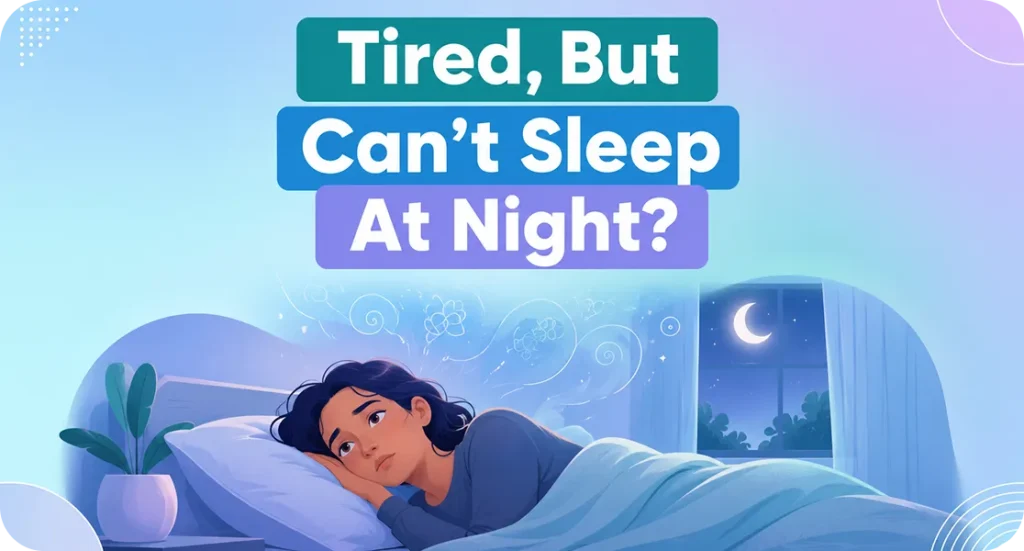
Why Can’t I Sleep Even When I’m Tired? It is 1am. You have been awake since 5am. Your body aches, your eyes are heavy, and all you want is to sleep. You lie down, close your eyes — and your mind starts. The meeting is tomorrow. That conversation from three weeks ago. A vague, shapeless anxiety that has no name. An hour later, you are still awake, now also frustrated and increasingly convinced that something is wrong with you
This experience — being exhausted but unable to sleep — is one of the most disorienting and demoralising sleep problems a person can face. It has a name, it has causes, and it has treatment. You are not broken. You are experiencing one of the most common presentations of sleep difficulty that mental health professionals work with.
In Kerala, in the Gulf, and across the Malayali diaspora, sleep problems are quietly widespread — and quietly dismissed. Parents tell their children to stop being dramatic. Gulf workers lie awake in shared accommodation, separated from family, certain that their inability to sleep is just a phase. Women managing households and careers describe lying awake at 3am cataloguing tomorrow’s tasks, having long normalised the experience as part of life.
This article explains what is actually happening in your brain and body when you cannot sleep despite being tired, covers the most common causes of difficulty sleeping, and outlines what evidence-based treatment looks like. It also explains when sleep problems cross the line into something that needs professional attention — and what that support looks like.
Sleep problems — sometimes called sleep difficulties or sleep conditions — refer to any persistent pattern of disrupted, insufficient, or non-restorative sleep that affects daytime functioning. They range from difficulty falling asleep (sleep onset insomnia), to waking repeatedly through the night (sleep maintenance insomnia), to waking too early and being unable to return to sleep, to sleeping what appears to be a full night but waking feeling completely unrefreshed.
The specific experience of being tired but unable to sleep is a signature feature of sleep onset insomnia — and it is almost always driven by the nervous system remaining in a state of physiological arousal despite physical fatigue. Understanding why this happens requires a brief explanation of what sleep actually needs in order to occur.
According to the American Academy of Sleep Medicine, clinically significant insomnia — the most common sleep disorder — is defined as difficulty falling or staying asleep occurring at least three nights per week for at least three months, causing distress or functional impairment. By this definition, insomnia affects approximately 10–30% of the global adult population. In South Asia, culturally specific stressors and the widespread stigma against discussing sleep health as a medical concern means the condition is significantly underreported.
Recognising what type of sleep disruption you are experiencing is the first step toward addressing it. The symptoms below cover the most common presentations. They are organised not as a clinical checklist but as descriptions of the actual lived experience of poor sleep — the kind that is often dismissed as “just stress” until it has been present for months or years.
  • Lying awake for 30 minutes or more before falling asleep most nights
  • Waking 2–4 times per night and struggling to return to sleep
  • Waking 1–2 hours earlier than intended with racing thoughts
  • Feeling physically tired but mentally alert when you lie down
  • Dreading bedtime because you expect to lie awake
  • Waking feeling exhausted despite spending 7–8 hours in bed
  • Relying on your phone or television to distract yourself into sleep
  • Noticing that you sleep better away from home, such as during holidays or travel
  • Irritability, difficulty concentrating, or low mood during the day
  • Difficulty with memory or decision-making linked to poor sleep
  • Physical symptoms such as headaches, muscle tension, or sensitivity to noise
  • Increased anxiety or depressive symptoms that worsen with poor sleep
The last four items on this list are particularly important. Sleep disruption symptoms rarely stay contained within the night. Poor sleep and anxiety reinforce each other in a bidirectional cycle: anxiety makes sleep harder, poor sleep increases anxiety sensitivity, which makes sleep harder still. The same relationship exists with depression — poor sleep is both a symptom and a cause of low mood.

Understanding Your Sleep Cycle

To understand why you cannot sleep when tired, it helps to understand how quality sleep is meant to work.
Healthy sleep consists of repeated sleep cycles, each lasting approximately 90 minutes. Each cycle moves through four stages: three stages of non-REM sleep (progressing from light to deep slow-wave sleep) and one stage of REM (rapid eye movement) sleep, during which most dreaming occurs and emotional memory consolidation happens. A typical night involves four to six of these cycles.
For sleep to begin, two systems need to align. The first is sleep pressure (also called the homeostatic sleep drive) — the accumulating need for sleep that builds throughout the day as a chemical called adenosine builds up in the brain. By the time most adults are tired in the evening, adenosine levels are high enough that sleep should come relatively easily. The second system is your circadian rhythm — the internal 24-hour biological clock that regulates the timing of sleepiness and wakefulness through the hormone melatonin.
When you are exhausted but cannot sleep, it means that sleep pressure is present — your body does need sleep — but something is preventing the nervous system from downshifting into the state required for sleep onset. That something is almost always physiological hyperarousal: the brain and nervous system operating at a level of alertness incompatible with sleep, driven by stress, anxiety, conditioned wakefulness, or a combination of all three.
Healthy sleep occurs in repeated cycles, usually lasting around 80–110 minutes. Each cycle moves through four stages:

  • Stage 1 non-REM: The transition from wakefulness to light sleep
  • Stage 2 non-REM: Body temperature drops, muscles relax, and heart rate slows
  • Stage 3 non-REM: Deep, slow-wave sleep that supports physical restoration and immune function
  • REM sleep: A stage associated with vivid dreaming, learning, memory processing, and emotional regulation

Most adults complete approximately four to six sleep cycles per night, although cycle length and stage distribution vary throughout the night. Deep sleep is usually more prominent earlier in the night, while REM periods become longer toward morning.

Research published in *Sleep Medicine Reviews* (Riemann et al., 2010) describes this hyperarousal as the central neurobiological mechanism of insomnia — it is not simply worrying at bedtime, but a measurable elevation in cortical activity, heart rate, and metabolic rate that persists across the 24-hour cycle in people with chronic insomnia, not just during the night.
Important points to remember

  • Feeling tired does not always mean the nervous system is ready for sleep.
  • Trying too hard to force sleep can increase alertness and frustration.
  • Irregular sleep schedules can weaken the alignment between sleep pressure and the circadian rhythm.
  • Caffeine can reduce the effect of adenosine and delay sleepiness, even when consumed several hours earlier.
  • Bright light and screen exposure at night can interfere with circadian sleep signals.
  • Stress, anxiety, pain, medications, medical conditions, and sleep disorders can also contribute to persistent sleep difficulty.
  • One poor night does not necessarily indicate insomnia.
  • Chronic insomnia generally involves repeated sleep difficulty combined with daytime impairment over an extended period.

Research has described hyperarousal as an important mechanism in chronic insomnia. It is not limited to worrying at bedtime; it may involve increased cognitive, emotional, and physiological activation that continues during both the day and night. This helps explain why someone can feel deeply fatigued while their nervous system remains too alert for sleep to begin easily

What Causes Sleep Problems?

Sleep disturbance causes fall into several overlapping categories. For most people, what started as a short-term response to a specific stressor — a job loss, a bereavement, a period of intense work pressure — has been maintained and deepened by psychological and behavioural factors that outlast the original trigger.
Anxiety is the single most common driver of the “tired but cannot sleep” experience. When the brain perceives a threat — whether that threat is a real danger or a recurring worry about work, family, or finances — it activates the sympathetic nervous system, releasing cortisol and adrenaline and raising physiological arousal. This is the exact opposite of what sleep requires. The body does not distinguish between a physical threat and a mental one: a racing mind about tomorrow’s presentation produces the same cortical activation as a genuine emergency.
According to a meta-analysis published in *Psychological Medicine* (Alvaro et al., 2013), anxiety disorders were associated with more than three times the risk of insomnia compared to the general population. For South Asian communities — where anxiety is frequently undiagnosed, normalised as “stress,” and rarely treated — this pathway from unaddressed anxiety to chronic sleep problems is particularly common.

The Role of the Sleep Schedule

An irregular sleep schedule is one of the most underestimated contributors to persistent sleep problems. The body’s circadian clock requires consistency to function correctly. Sleeping at significantly different times on weekdays versus weekends, sleeping in late to compensate for poor sleep the night before, or taking long afternoon naps all disrupt the circadian rhythm and reduce sleep pressure at bedtime. Gulf workers with rotating shifts, mothers whose sleep schedule is dictated entirely by children’s needs, and NRI professionals managing time-zone-dependent work calls are particularly affected by schedule irregularity.

Conditioned Wakefulness

One of the less discussed but clinically significant causes of difficulty sleeping is what psychologists call conditioned wakefulness — a learned association between the bed and wakefulness rather than sleep. When a person has spent many nights lying awake in bed, the bedroom environment itself becomes a cue for arousal rather than relaxation. This is why some people fall asleep easily on the sofa watching television but become instantly alert the moment they get into bed. The brain has learned that bed equals wakefulness, and this association is surprisingly durable.

Gulf Expat Sleep Challenges

For Malayali workers in the Gulf, sleep problems carry a specific texture. Shared accommodation, heat, noise, homesickness, and the particular stress of knowing that your family’s financial security depends on your continued employment create a chronic low-level arousal state that persistently compromises sleep health. Night shift work — common in Gulf healthcare, hospitality, and industrial sectors — further disrupts the circadian rhythm in ways that cannot be fully compensated for by daytime sleep. Research from the Gulf region documents elevated rates of sleep disorders among South Asian migrant workers, though the true prevalence is likely higher than reported due to reluctance to seek medical attention.

Screen Use and Light Exposure

Blue light emitted by phones and screens suppresses melatonin production, delaying the onset of sleepiness by up to 90 minutes. For most people who use their phone in bed — a habit that is near-universal — this represents a significant circadian disruption that compounds other sleep problems. The content consumed on screens before sleep also matters: social media, news, or work emails all provide cognitive and emotional stimulation that maintains arousal at a time when the brain needs to downshift.

Depression and Sleep

Depression and sleep and health are intimately connected. Early morning waking — waking two or more hours before your intended wake time and being unable to return to sleep — is a specific sleep disturbance symptom strongly associated with clinical depression. Hypersomnia (sleeping excessively but still feeling unrefreshed) is common in atypical depression. If your sleep problem is accompanied by persistent low mood, loss of interest in activities, or a sense of hopelessness, the sleep problem and the depression need to be addressed together.

Types of Sleep Problems

Not all types of sleep problems are the same, and the distinctions matter for treatment.

Insomnia

The most common sleep disorder. Characterised by difficulty falling asleep, staying asleep, or waking too early, occurring at least three nights per week for three months or more, with associated daytime impairment. Insomnia can be comorbid with anxiety, depression, or chronic pain, or can present independently.

Sleep Anxiety

A specific pattern in which anticipatory anxiety about whether you will be able to sleep becomes its own driver of wakefulness. The fear of not sleeping creates the arousal that prevents sleep — a self-fulfilling cycle that can maintain insomnia long after the original precipitating cause has resolved.

Psychophysiological Insomnia

A form of insomnia maintained by learned arousal and maladaptive sleep behaviours, even in the absence of ongoing psychological distress. The bedroom has become associated with wakefulness; the body’s autonomic arousal spikes at bedtime as a conditioned response.

Circadian Rhythm Disorders

When the internal clock is shifted significantly from the conventional sleep-wake cycle — sleeping naturally at 3am and waking at noon, for example — this is a circadian rhythm disorder rather than insomnia. It requires different treatment, including strategic light exposure and melatonin timing.

How Sleep Problems Affect Mental Health

The relationship between sleep and mental health is bidirectional and potent. Poor sleep does not simply make a person tired — it measurably alters brain function in ways that affect emotional regulation, cognitive performance, and psychological resilience.
Research from the University of California, Berkeley (Walker, 2017) using neuroimaging demonstrated that sleep deprivation produced a 60% increase in amygdala reactivity — the brain’s threat-detection centre — compared to well-rested participants. In practical terms, this means that poor sleep makes you significantly more emotionally reactive: more anxious, more irritable, more likely to interpret neutral events as threatening, and less able to regulate emotional responses.
For South Asian communities where emotional self-regulation is already under significant pressure — the demands of Gulf work culture, the weight of family expectation, the isolation of diaspora life — this amplification of emotional vulnerability by poor sleep creates a genuinely serious cumulative burden. Healthy sleep habits are not a lifestyle preference; they are a foundation of mental health.
According to research published in *JAMA Internal Medicine* (Irwin et al., 2015), chronic insomnia is associated with a fourfold increased risk of developing depression over the following year, and a twofold increased risk of anxiety disorders. Sleep problems are not simply a symptom of mental health difficulties — they are a risk factor that, if unaddressed, substantially increases the probability of developing them.

The Most Effective Treatment for Sleep Problems: CBT-I

The most evidence-based psychological treatment for insomnia and sleep problems is Cognitive Behavioural Therapy for Insomnia (CBT-I), recommended as the first-line treatment for chronic insomnia by NICE (UK), the American College of Physicians, and the European Sleep Research Society — above sleep medication.

CBT-I addresses both the cognitive and the behavioural factors that maintain insomnia. It typically runs over five to eight sessions and includes:

    • Sleep restriction therapy: temporarily reducing time in bed to consolidate sleep and rebuild sleep pressure
    • Stimulus control: re-establishing the bed as a cue for sleep rather than wakefulness (e.g. only using the bed for sleep, getting out of bed if awake for more than 20 minutes)
    • Sleep hygiene: addressing specific behaviours that disrupt the sleep cycle (screen use, caffeine, irregular schedules)
    • Cognitive restructuring: challenging and reframing the unhelpful beliefs about sleep that maintain anxiety (e.g. “if I don’t sleep 8 hours I can’t function”)
    • Relaxation techniques: progressive muscle relaxation and breathing techniques that activate the parasympathetic nervous system
    • Paradoxical intention: a counterintuitive technique in which the client deliberately tries to stay awake — which removes the performance pressure that makes sleep harder.

A meta-analysis published in *Sleep* (Trauer et al., 2015) found that CBT-I produced clinically significant improvements in sleep onset latency, wake time after sleep onset, and sleep quality — and that these improvements were maintained at 12-month follow-up. This durability distinguishes CBT-I from sleep medication, which is effective while taken but does not address the underlying mechanisms.

A practical exercise from CBT-I you can try tonight: the 20-minute rule. If you have been lying awake for approximately 20 minutes without falling asleep, get out of bed. Go to another room and do something calm and quiet — reading a physical book (not a screen), listening to quiet music, or gentle stretching. Return to bed only when you feel sleepy again. The goal is to break the association between the bed and wakefulness. This feels counterintuitive, but the evidence supporting it is robust.

When Should You Seek Professional Help for Sleep Problems?

Sleep problems warrant professional attention when they have persisted for more than three months, are occurring three or more nights per week, and are affecting your daytime functioning — mood, concentration, work performance, or relationships. You do not need to reach a threshold of severe suffering before seeking support.

  • You have had difficulty sleeping for three months or more, most weeks
  • You lie awake for more than 30 minutes before falling asleep most nights
  • Sleep problems are affecting your mood, concentration, or performance at work
  • You are using alcohol, over-the-counter medication, or supplements regularly to manage sleep
  • Sleep problems are accompanied by persistent low mood, anxiety, or a sense of hopelessness
  • You dread going to bed because you expect to lie awake
  • You have tried sleep hygiene changes consistently for several weeks without improvement
  • A partner or family member has reported that you snore heavily, stop breathing, or move excessively during sleep (possible sleep apnoea — requires medical assessment)
A psychologist in Kerala online through Oppam can assess whether your sleep difficulties are primarily driven by anxiety, depression, conditioned wakefulness, or a combination — and provide structured CBT-I or appropriate therapeutic support. Online counselling in Kerala and internationally through Oppam is available without a referral, without a waiting list, and in Malayalam, Tamil, and English.

Frequently Asked Questions

Why am I so tired but can't sleep?

The most common reason is physiological hyperarousal — the nervous system is in a state of activation (driven by stress, anxiety, or learned wakefulness) that is incompatible with sleep onset, even when physical fatigue is high. Sleep requires both physical tiredness and nervous system downregulation. When anxiety or chronic stress keeps cortisol and adrenaline elevated, the physiological conditions for sleep cannot occur regardless of how tired your body is. This is not a character failing or a sign that something is fundamentally wrong with you — it is a treatable condition with a clear biological explanation.

What are the most common causes of difficulty sleeping?

The most common causes of difficulty sleeping are anxiety and psychological stress, an irregular sleep schedule that disrupts the circadian rhythm, conditioned wakefulness (a learned association between bed and being awake), excessive screen use before bed, caffeine consumed too late in the day, depression (particularly early morning waking), and hyperarousal linked to chronic life stressors. In South Asian communities specifically, the additional stressors of Gulf expat life, immigration adjustment, family pressure, and financial responsibility compound these standard causes significantly.

How does the sleep cycle work and why does it matter?

The sleep cycle is a repeating 90-minute sequence of four sleep stages, from light to deep non-REM sleep and then REM sleep. A full night of healthy sleep involves four to six complete cycles. Deep sleep (slow-wave sleep) is when the body repairs and the immune system is most active. REM sleep is when emotional memory processing and consolidation occur. Disrupted or insufficient sleep means fewer complete cycles, less deep sleep, and impaired emotional regulation the following day. Waking consistently during the same part of the cycle — for example, always at 3am — often indicates a specific mechanism (anxiety, blood sugar fluctuation, or circadian disruption) worth investigating

Is it normal to wake up at 3am every night?

Waking briefly between sleep cycles is normal — most adults wake several times per night without remembering it. Waking at 3–4am and being unable to return to sleep is not simply normal ageing or poor sleep hygiene. In particular, early morning waking (waking 1–2 hours before your intended rise time, unable to return to sleep, often with low mood or racing thoughts) is a clinically recognised pattern strongly associated with depression and anxiety. If this is a consistent experience, it warrants a psychological assessment rather than another attempt at sleep hygiene improvements.

Can online therapy help with sleep problems?

Yes. CBT-I (Cognitive Behavioural Therapy for Insomnia) — the gold-standard treatment for chronic insomnia — is as effective when delivered online as in person, according to a meta-analysis published in Sleep Medicine Reviews (Zachariae et al., 2016). Online CBT-I is also recommended in NICE guidelines as a first-line treatment. Oppam’s psychologists are trained in CBT approaches that address both sleep and the anxiety or depression commonly driving it. Accessing a sleep therapist online through Oppam means you can begin treatment without a referral, without a waiting list, and in your preferred language.

I am a Keralite in the Gulf and I cannot sleep. Is this common?

Very. Research documents significantly elevated rates of sleep disorders among South Asian migrant workers in the Gulf, driven by a combination of factors: shared accommodation that limits sleep quality, heat, irregular work schedules and shift work, homesickness and separation from family, and the chronic background stress of employment and visa dependency. Gulf-based Malayali workers often normalise poor sleep for years, attributing it to their circumstances rather than recognising it as a treatable condition. Oppam offers online counselling accessible from the Gulf, in Malayalam, at times that suit Gulf time zones.

How much does sleep counselling cost in Kerala or online?

Oppam offers individual sessions at ₹1,000 per 60-minute session. A bundle of four sessions is available at ₹3,600 (₹900 per session), with sessions that never expire. There is no referral needed, no waiting list, and sessions are available online — accessible from Kerala, UAE, UK, Canada, and beyond. Compared to in-person private psychology in Kerala or specialist sleep clinics in the Gulf, this represents significantly better access and value. CBT-I for insomnia typically runs for five to eight sessions.

External Resources

Mental health isn’t a luxury It’s your right

Feeling tired, stuck, overwhelmed or just not like yourself lately?
Take a pause. Talk to someone who gets it.

There’s more like that

Scroll to Top