

How to Manage Stress at Work ? You finish one task and three more appear. Your manager’s message arrives at 10pm. The appraisal cycle has started and you are already behind. You carry the weight of your family’s financial expectations — the EMI back home, the school fees, the parents who are getting older. And somewhere in the middle of all of it, you have forgotten what it felt like not to be stressed.
Work stress is not a modern invention, but the particular shape it takes for Malayali and South Asian professionals — whether in Kerala, the Gulf, or the UK — carries a cultural density that generic productivity articles never address. The pressure to perform, the inability to say no, the shame of appearing less than capable in front of a manager or a peer from home: these are not minor context details. They are the specific texture of workplace stress for millions of South Asian professionals, and they require an equally specific response.
Need to Talk to Someone?
Book a private online session with a licensed therapist
This guide, written and reviewed by Oppam’s Chief Psychologist Mubashira Rahman, covers what work-related stress actually is, how to recognise it before it becomes something more serious, what the evidence says about managing stress at work, and when professional support becomes the most effective tool available. It is written for people who are still functioning — still showing up — but for whom the gap between functioning and thriving has become very wide.
Workplace stress is the physiological and psychological response that occurs when the demands of work exceed the resources and capacity a person has to meet them. It is not the same as challenge or pressure — moderate levels of pressure are associated with improved performance and engagement. Stress becomes problematic when the demands are chronic, perceived as uncontrollable, or occur in an environment where the person feels undervalued or unsafe.
The Health and Safety Executive (HSE, UK) defines work-related stress as a harmful reaction people have to undue pressures and demands placed on them at work. According to HSE data, stress, depression, or anxiety accounted for 51% of all work-related ill health cases in the UK in 2022/23 — making it the single largest cause of workplace absence. In India, a 2023 survey by the Indian Staffing Federation found that 47% of Indian employees reported significant levels of workplace stress, with IT, healthcare, and finance sectors reporting the highest rates.
For South Asian professionals specifically, job stress carries layers beyond the workload itself: the cultural pressure to appear competent and uncomplaining, the financial responsibility to family members who depend on your income, the specific dynamics of working in a Gulf or multinational environment where cultural norms around hierarchy, deference, and emotional expression differ from what you were raised with. Understanding work stress requires understanding this full picture — not just the hours and the deadlines.
Recognising signs of stress at work is harder than it sounds, because chronic stress normalises itself. When you have been operating under sustained pressure for months or years, the symptoms stop feeling like symptoms and start feeling like personality. You tell yourself you are just someone who worries, someone who cannot switch off, someone for whom work is always on the mind.
The following are the most clinically significant indicators that what you are experiencing is not simply the demands of a busy professional life, but a stress response that has moved beyond what your nervous system can absorb without cost.
- Persistent difficulty switching off after the working day ends
- Waking at night with work-related thoughts or anxiety
- Irritability or a short temper that affects personal relationships
- Physical symptoms such as headaches, jaw tension, and shoulder or neck pain
- Digestive problems, including IBS, stomach pain, or nausea before work situations
- Fatigue that is not relieved by sleep or rest
- Difficulty concentrating or making decisions that were previously straightforward
- Procrastination caused by anxiety about doing tasks imperfectly
- Increasing cynicism, detachment, or resentment toward work
- Reduced performance despite working longer hours and putting in more effort
- Withdrawing from colleagues, friends, or family
- Using alcohol, food, or excessive screen time to decompress after work
Work stress and anxiety frequently co-occur and reinforce each other. Sustained job stress raises baseline anxiety, which in turn makes future stressors harder to manage. If you recognise several of these signs and have been experiencing them for more than a few weeks, it is worth considering not just the workload but the anxiety it may be generating.
The causes of work-related stress are well-documented in occupational psychology literature. The HSE identifies six primary categories — known as the Management Standards — that, when poorly managed, reliably produce stress in the workplace. These are not abstract concepts: each one maps directly onto experiences that South Asian professionals describe in clinical settings.
The most straightforward cause: too much work, insufficient time, unclear priorities, or work that consistently requires skills beyond the person’s current capacity. For Gulf professionals, this is often compounded by a reluctance to flag capacity issues to management — partly cultural (appearing capable is essential to employment security) and partly structural (complaining about workload risks visa-dependent employment).
Lack of Control
Research consistently demonstrates that the degree of control a person has over their work is one of the strongest predictors of whether pressure becomes damaging job stress. The Karasek Demand-Control model, one of the most influential frameworks in occupational health psychology, shows that high demands combined with low control produce the most harmful stress profile — associated with significantly elevated risk of cardiovascular disease, anxiety, and depression. Roles that involve high accountability but low autonomy are particularly toxic.
Feeling Overwhelmed?
You’re Not Alone. Get Support from an
Oppam Therapist Wherever You Are
Oppam Therapist Wherever You Are
Difficult relationships with managers, colleagues, or clients are among the most emotionally draining sources of employee stress. This includes environments where criticism is routine and recognition is absent, where gossip and political dynamics create constant uncertainty, and where bullying or harassment — overt or subtle — goes unaddressed. For South Asian professionals in Gulf or Western workplaces, navigating cultural differences in communication style and hierarchy adds an additional layer of interpersonal stress that can be exhausting to sustain over years.
Role Ambiguity and Conflict
Unclear job descriptions, conflicting expectations from multiple managers, or being asked to act against personal or professional values all create sustained work tension. Role ambiguity is particularly common in rapidly growing organisations and in roles that span multiple teams or functions. When you are not sure what is expected of you — or when you receive contradictory expectations — the nervous system remains in a state of low-level threat readiness that depletes capacity over time.
Job Insecurity
Fear of redundancy, contract uncertainty, or the specific job pressure of visa-dependent employment in the Gulf generates a chronic background stress that affects concentration, sleep, and relationship quality. The particular anxiety of knowing that losing your job means losing your right to remain in the country — and the financial consequences for the family depending on you at home — is a stress profile that occupational health frameworks built in Western contexts rarely account for adequately.
Several stressors specific to South Asian professionals deserve explicit naming because generic stress caused by work literature consistently omits them. The cultural impossibility of saying no to a manager. The expectation of being perpetually available because family back home needs to see you as successful. The pressure of being the first in your family to reach a certain professional level and therefore being unable to admit difficulty. The intersection of caste, religion, or community with workplace dynamics. These are not secondary factors — for many South Asian professionals, they are the primary drivers of mental stress from work.
When Work Stress Becomes Workplace Burnout
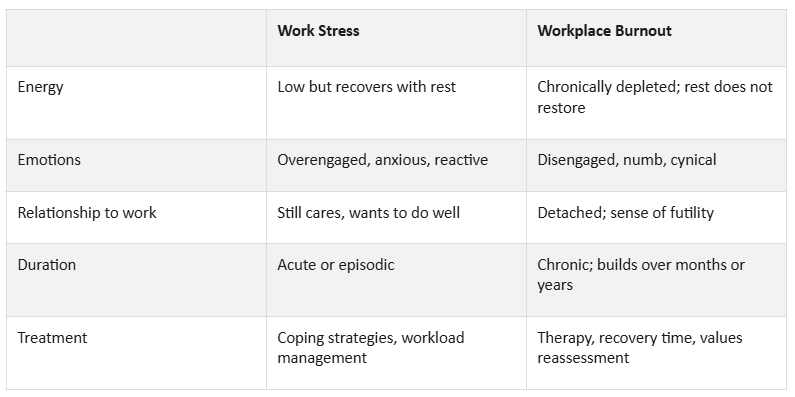
Workplace burnout is not simply severe work stress. It is a distinct clinical syndrome recognised by the World Health Organisation in ICD-11 as an “occupational phenomenon” characterised by three dimensions: exhaustion (a chronic depletion of energy that rest does not replenish), cynicism or depersonalisation (emotional distancing from work and the people in it), and reduced professional efficacy (a growing sense that your efforts no longer produce meaningful results).
The distinction matters because burnout and stress require different responses. Stress responds to workload reduction and better coping strategies. Burnout typically requires more substantial intervention — a significant period of recovery, therapeutic support, and often a fundamental reappraisal of the relationship between work and self-worth. Attempting to manage burnout with productivity strategies alone tends to worsen the condition.
According to research published in *Burnout Research* (Leiter & Maslach, 2016), burnout develops gradually through a process of progressive disengagement — a series of adjustments to chronic stress that cumulatively erode engagement, motivation, and identity. By the time most people recognise burnout in themselves, the erosion has been underway for months or years
How Workplace Stress Affects Mental Health
Sustained work stress and anxiety are not separate problems that happen to coexist — they are neurologically intertwined. Chronic stress caused by work activates the HPA axis (the body’s stress-response system), maintaining elevated cortisol levels that, over time, damage the hippocampus (a brain region involved in memory and emotional regulation) and increase the reactivity of the amygdala (the threat-detection centre). In plain terms: chronic work stress makes you more anxious, less able to regulate emotions, less able to remember clearly, and more likely to interpret neutral events as threatening.
According to a large-scale study published in *The Lancet Psychiatry* (Harvey et al., 2017) covering 1.1 million UK workers, job strain was associated with a significantly elevated risk of common mental health disorders — particularly anxiety and depression — with the risk increasing proportionally with the duration and intensity of the stress exposure. The study found no safe threshold: there is no level of chronic work stress that does not carry mental health cost over time.
For South Asian professionals, the mental health consequences of workplace stress are often compounded by the cultural barriers to addressing them. Admitting work stress feels like admitting inadequacy. Seeking professional help feels disproportionate. And the internalised message that others have it harder — the Gulf worker comparing himself to a labourer on a construction site, the Kerala professional comparing herself to a migrant domestic worker — can prevent people from recognising that what they are experiencing is clinically significant and deserves support.
Evidence-Based Strategies for Managing Stress at Work
The following strategies are drawn from occupational psychology research and clinical practice. They are organised from the most immediate (things you can do today) to the more structural (things that require longer-term change). Sustainable stress management at work requires both.
1. Name What You Are Feeling — Specifically
Research from UCLA (Lieberman et al., 2007) demonstrated that naming an emotional state — “I feel anxious about this deadline” rather than just experiencing the anxiety — measurably reduces activity in the amygdala. This is not a platitude: affective labelling is a neurologically active process. The specificity matters. “I feel overwhelmed” is less effective than “I feel anxious because I do not know how to prioritise these three competing tasks.” The specificity creates a cognitive handle on the experience that the nervous system can work with.
2. Create a Structural Boundary Between Work and Non-Work
One of the most damaging developments in modern work — accelerated by remote and hybrid working — is the erosion of the temporal boundary between work time and personal time. Handling stress at work sustainably requires that this boundary exist and be maintained. This means a physical shutdown routine at the end of the working day (closing applications, writing a brief next-day task list, changing clothes if working from home), not checking work messages after a defined time, and communicating this boundary clearly to managers and colleagues. In cultures where availability is equated with commitment, this requires explicit internal permission: being unavailable after hours is not a character flaw.
3. Apply the Demand-Control-Support Model
The most durable approach to reducing stress in the workplace is not coping harder — it is changing the conditions that generate stress. The Demand-Control-Support model (Karasek & Theorell) identifies three levers: reducing demands (through negotiation, delegation, or prioritisation), increasing control (seeking more autonomy over how work is done), and increasing support (building relationships with colleagues or a manager who can provide resource, recognition, and problem-solving). Most people under work stress default to managing the demand without touching control or support — and find their coping strategies insufficient as a result.
4. Use Structured Problem-Solving for Work Worry
Unstructured worry about work problems maintains anxiety without solving them. Coping with stress at work is more effective when worry is converted into structured problem-solving: writing down the specific problem, identifying what is within your control and what is not, generating three possible responses, and choosing one to act on. The remainder — the aspects that are genuinely not within your control — are returned to awareness with a deliberate “I have done what I can; the rest is not mine to carry.” This sounds simple but requires practice, particularly for people raised in environments where responsibility for others’ wellbeing was internalised very early.
5. Regulate the Nervous System — Not Just the Mind
Cognitive strategies work better when the nervous system is not in a state of high arousal. Evidence-based physiological regulation techniques include: diaphragmatic breathing (slow, deep breaths with a longer exhale than inhale, which activates the parasympathetic nervous system — a 4-count inhale, 6–8 count exhale, repeated for 5 minutes); brief physical movement between work sessions (even a 5-minute walk significantly reduces cortisol); and progressive muscle relaxation (systematically tensing and releasing muscle groups, which reduces the physical tension that work stress accumulates in the body). These are not wellness recommendations — they are neurologically grounded interventions with substantial evidence behind them.
6. Address the South Asian-Specific Stressors Directly
Dealing with stress at work for South Asian professionals often requires work that goes beyond generic stress management. The belief that saying no is disrespectful, that needing help is shameful, that your worth is equivalent to your productivity — these are not simply habits. They are deeply internalised cultural frameworks that determine how you respond to every demand placed upon you. CBT and ACT-based therapy specifically address these frameworks, not by dismissing their cultural roots but by examining whether they are serving you well in your current professional context, and by building the capacity to respond differently when they are not.
Need to Talk to Someone?
Book a private online session with a licensed therapist
Work stress warrants professional support when the strategies above are not producing sufficient relief, or when the stress has progressed to the point where it is affecting your health, your relationships, or your ability to function. Specific indicators:
- Work stress has been present consistently for more than three months
- Physical symptoms — insomnia, headaches, digestive problems, fatigue — are persistent and not improving
- You are experiencing symptoms of anxiety or depression alongside work stress
- Work stress is affecting your relationships at home — you are more irritable, more withdrawn, or less present with your family
- You have recognised signs of burnout: chronic exhaustion, cynicism, and a sense that your efforts do not matter
- You are using alcohol, substances, or excessive screen use regularly to manage how you feel after work
- Thoughts of resignation, changing career, or leaving are persistent but you feel trapped rather than empowered
- You have considered self-harm, or thoughts of escape from your situation feel intrusive
Need to Talk to Someone?
Book a private online session with a licensed therapist
A psychologist in Kerala online through Oppam can help you distinguish between work stress, burnout, anxiety, and depression — and provide structured, evidence-based support tailored to your specific context. Online counselling in Kerala and across the Gulf, UK, and Canada through Oppam requires no referral and is available in Malayalam, Tamil, and English.
Frequently Asked Questions
What is the difference between work stress and workplace burnout?
Work stress and workplace burnout are related but distinct. Stress involves high pressure that creates anxiety and overwhelm, but the person remains engaged — they still care, they still want to perform well, they are just struggling to manage the demands. Burnout involves a progressive depletion of that engagement: exhaustion that rest does not repair, cynicism or emotional detachment from work and colleagues, and a growing sense that effort produces nothing meaningful. The WHO recognises burnout as an occupational phenomenon in ICD-11. Importantly, the interventions are different: productivity strategies and coping skills help with stress but are often insufficient for burnout, which requires more substantial recovery and therapeutic support.
What are the most common signs of stress at work?
The most common signs of stress at work include difficulty switching off after work, sleep disruption linked to work thoughts, persistent physical symptoms (headaches, digestive problems, muscle tension), irritability that spills into personal relationships, difficulty concentrating, reduced performance despite increased effort, procrastination driven by anxiety, increasing cynicism about work, and withdrawal from colleagues or social contact. One of the most overlooked signs is the normalisation of these symptoms — when a person has been under sustained work stress for long enough, the symptoms stop feeling like symptoms and start feeling like personality.
How do I handle stress at work when I can't change my workload?
When workload itself cannot be reduced — a common reality for Gulf professionals with limited employment flexibility — the most effective strategies target the other two variables in the Demand-Control-Support model: control and support. Increasing your sense of control over how you work (even in small ways: the order of tasks, your physical workspace, when you take breaks) measurably reduces stress even when overall volume stays constant. Increasing support — building one meaningful relationship with a colleague who understands your pressures, or accessing professional support through therapy — provides the relational and cognitive resource that makes sustained demands more manageable.
Is work stress causing my anxiety and depression?
The relationship between work stress and mental health is bidirectional. Chronic workplace stress is a well-documented risk factor for anxiety disorders and depression — research published in The Lancet Psychiatry found that job strain significantly elevated the risk of common mental health disorders. At the same time, pre-existing anxiety or depression makes work stress harder to manage, creating a reinforcing cycle. Whether work stress is causing, worsening, or being worsened by anxiety or depression is an important clinical distinction that affects how treatment should proceed. A psychological assessment through Oppam can help clarify which dynamic is operating in your case.
Can online counselling help with workplace stress in Kerala or the Gulf?
Yes. CBT and ACT-based therapy for workplace stress and anxiety are as effective when delivered online as in person, according to multiple systematic reviews. Online counselling is particularly well-suited to professionals managing work stress because sessions can be scheduled around work commitments, accessed from any location including the Gulf, and attended without the logistics or stigma of in-person clinic attendance. Oppam offers online counselling for workplace stress in Malayalam, Tamil, and English, with no referral required. Sessions are available across Kerala, UAE, Saudi Arabia, UK, Canada, and beyond.
I am a Gulf Malayali and my work stress is related to visa pressure and job insecurity. Can therapy help?
Yes, and this specific context is one that Oppam therapists understand without needing it explained. The intersection of employment insecurity, visa dependency, family financial responsibility, and the cultural pressure to appear successful regardless of internal reality is a distinct stress profile that generic occupational health resources rarely address. CBT for work stress can help you develop more flexible responses to the aspects of your situation that are genuinely outside your control, while identifying the cognitive patterns — particularly those linked to catastrophic thinking about job loss and family shame — that are amplifying the stress beyond what the situation itself warrants. Therapy does not change your visa status; it changes your relationship to the uncertainty it creates.
How much does workplace stress counselling cost?
Oppam offers individual counselling sessions at ₹1,000 per 60-minute session. A bundle of four sessions is available at ₹3,600 (₹900 per session) — sessions never expire and can be used at whatever pace works for you. There is no referral required and no waiting list. Work stress typically responds well within six to twelve sessions of CBT or ACT. Compared to in-person private psychology in Kerala, the Gulf, or the UK, online counselling through Oppam provides equivalent clinical quality at significantly lower cost, with the added benefit of sessions in Malayalam or Tamil if that is your preference.
External Resources
- Health and Safety Executive (HSE), UK — Workplace stress statistics and evidence linking work-related ill health with stress, anxiety, and depression.
- Harvey et al. (2017), The Lancet Psychiatry — Research on job strain and the increased risk of common mental health conditions among workers.
- Karasek and Theorell — Demand–Control–Support Model — A foundational framework explaining how high demands, low control, and limited support contribute to workplace stress.
- Lieberman et al. (2007), Psychological Science — Evidence that naming or labelling emotions can reduce emotional reactivity in the brain.
- Leiter and Maslach (2016), Burnout Research — Research on how burnout develops and how it differs from ordinary workplace stress.
- World Health Organization, ICD-11 — Recognition of burnout as an occupational phenomenon associated with chronic workplace stress.
Struggling?
Talk to an Oppam Therapist
Get the Support You Deserve Online & Confidential