

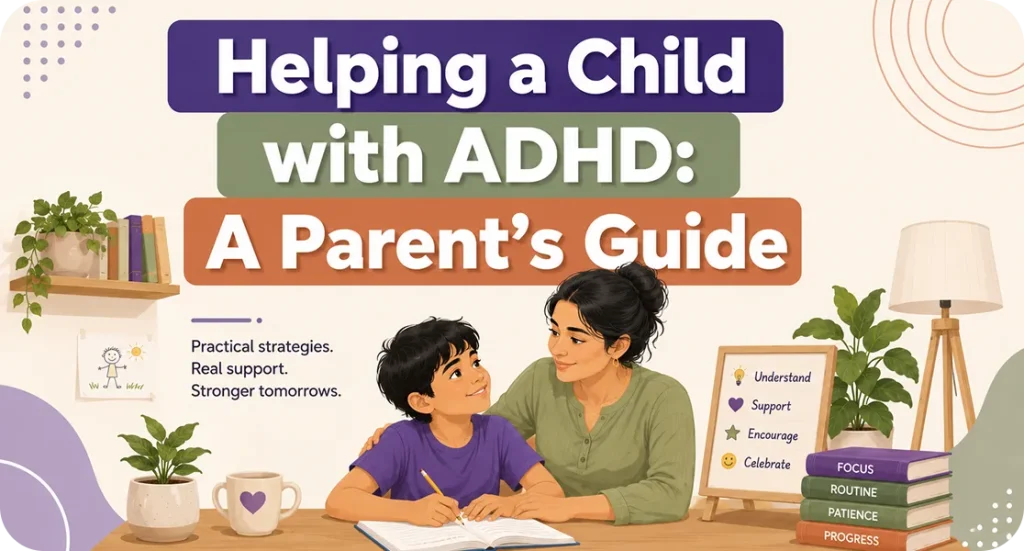
Helping a Child with ADHD, The school has called again. Your nine-year-old wasn’t being disruptive on purpose, the teacher says, but he interrupted the lesson four times, left his seat twice, and still hasn’t turned in Monday’s homework. At home, you’ve noticed the same pattern for years: half-finished tasks, forgotten instructions given thirty seconds ago, sudden bursts of energy that seem to come from nowhere. Somewhere along the way, a relative may have suggested he simply needs firmer discipline. You suspect it’s something else.
If you’ve started wondering whether your child has Attention-Deficit/Hyperactivity Disorder (ADHD), you are not alone, and you are not imagining it. ADHD is one of the most common neurodevelopmental conditions in childhood, yet in Kerala and across South Asian communities it remains widely under-recognised, often mistaken for poor upbringing, laziness, or a “naughty” temperament that will be outgrown with strict handling.
Need to Talk to Someone?
Book a private online session with a licensed therapist
This guide explains what ADHD actually looks like in children, what the research says about effective, non-punitive support, and how South Asian families in particular can approach diagnosis and treatment without the shame that so often surrounds it, whether you’re raising your child in Kerala, dubai, or Kuala Lumpur.
ADHD is not simply “a child who has too much energy.” Clinically, it presents in three patterns: inattentive (difficulty sustaining focus, forgetfulness, losing belongings, appearing not to listen), hyperactive-impulsive (fidgeting, difficulty staying seated, interrupting, blurting out answers), and a combined type, which includes features of both. Girls are more often affected by the inattentive presentation, which is quieter and easier to miss, meaning many girls go undiagnosed well into adolescence while boys with the more visible hyperactive presentation get flagged earlier.
The distinguishing clinical feature isn’t the presence of these behaviours occasionally; every child forgets a homework sheet sometimes. What matters is whether the pattern is persistent (present for six months or more), appears across more than one setting (school and home, not just one), and meaningfully interferes with academic performance, friendships, or daily functioning. A child who struggles to focus during a boring lecture but plays chess with total concentration for an hour doesn’t necessarily have ADHD; a child who cannot sustain attention even on activities they genuinely enjoy is showing a different picture.
Indian data on ADHD prevalence has historically been patchy, but the picture has become clearer in recent years. A systematic review and meta-analysis of 19 Indian studies found a pooled prevalence of roughly 6.3% among schoolchildren, with school-based studies reporting higher rates (around 7.5%) than community-based samples, largely because classroom demands make attention and impulse-control difficulties more visible. Regional studies have found even higher rates in some South Indian samples, with one large preschool survey reporting prevalence as high as 8.8%.
According to the Indian Journal of Psychiatry’s clinical practice guidelines, ADHD is frequently under-diagnosed in India, in part because traditional explanations for a child’s restlessness or inattention (a “naughty phase,” insufficient discipline, or even spiritual explanations in some communities) delay families from seeking a formal clinical assessment. This is not unique to any one region or income group. It reflects a broader gap between how common ADHD actually is and how comfortable families feel naming it, discussing it, or seeking support for it.
The South Asian Layer: Discipline, Shame, and "Just Try Harder"
In many Malayali and South Asian households, a child’s inattention or restlessness is read through a moral lens before a medical one. “He just needs more discipline,” a grandparent might say, or “She’s not trying hard enough.” These responses come from genuine care and high expectations around academic performance, not malice, but they place the burden of a neurodevelopmental difference entirely on the child’s willpower, which ADHD, by definition, affects.
This becomes particularly painful in academically competitive environments, where a child’s marks are treated as a direct reflection of the whole family’s standing. A child with untreated ADHD in a Kerala school system that prizes rote memorisation and long study sessions can end up carrying years of being called careless, lazy, or difficult, long before anyone considers that the underlying issue might be neurological rather than a matter of effort. I have worked with teenagers, both in Kerala and among Gulf-based Malayali families, who only received an ADHD diagnosis after years of being told to simply concentrate harder, and who describe genuine relief on finally understanding why concentrating “harder” never worked the way it did for their classmates.
What Actually Helps: The Evidence-Based Approach
The strongest evidence base for managing childhood ADHD, particularly in primary-school-aged children, points toward Behavioural Parent Training (BPT), sometimes delivered alongside classroom-based behavioural supports. Rather than trying to talk a child out of impulsive behaviour, BPT trains parents to structure the environment (predictable routines, broken-down instructions, immediate and consistent feedback) in ways that make success more achievable for a brain that struggles with executive function.
Feeling Overwhelmed?
You’re Not Alone. Get Support from an
Oppam Therapist Wherever You Are
Oppam Therapist Wherever You Are
Research published in the Journal of the American Academy of Child and Adolescent Psychiatry has found that behavioural interventions, when implemented consistently at home and school, produce meaningful improvements in daily functioning, and that combining behavioural strategies with medication (where a psychiatrist judges it appropriate) tends to outperform either approach alone for children with more significant symptoms. Whether medication is appropriate for your child is a decision to make with a qualified psychiatrist, not a general practitioner or a well-meaning relative; this article does not recommend a specific treatment path for any individual child.
Cognitive Behavioural Therapy (CBT), adapted for children with ADHD, can also help older children and teenagers develop concrete strategies for organisation, emotional regulation, and self-monitoring, particularly once a child is old enough to reflect on their own patterns rather than relying entirely on adult-structured routines.
A Practical Exercise: Breaking Tasks Into "Next Steps"
One of the simplest, most effective tools for a child with attention difficulties is replacing multi-step instructions with a single visible next step:
- Instead of “go get ready for school,” write or say one instruction at a time: “Put on your shirt.”
- Wait for that step to be completed before giving the next one, rather than listing the whole sequence upfront.
- Use a visual checklist on the fridge or bedroom door for repeated routines (uniform, brush teeth, bag packed), so the child can self-check rather than relying on you to remember.
- Praise the completed step specifically (“You got your bag ready without me reminding you”) rather than only correcting the missed ones.
- Keep instructions to one sentence. A child with ADHD is not ignoring you; a long instruction often genuinely doesn’t stick past the second clause.
This approach reduces the daily friction that erodes both the child’s confidence and the parent’s patience, and it works whether you’re managing a school-morning routine in Thrissur or a homework hour in Toronto.
Building Consistency Between Home and School
One of the most overlooked factors in supporting a child with ADHD is alignment between the home environment and the classroom. A child who is given clear, one-step instructions and immediate positive feedback at home but returns to a classroom with thirty students and a single overworked teacher will still struggle, through no fault of either the parent or the teacher. Where possible, it helps enormously to share specific, practical strategies with your child’s school rather than a general diagnosis label alone: preferential seating near the teacher rather than at the back, permission to stand or move briefly between tasks, instructions broken into written steps rather than delivered only verbally, and short, frequent check-ins rather than a single long task with a distant deadline.
In many Kerala schools, and in some diaspora schools with large class sizes, teachers may be sympathetic but under-resourced to implement individualised support without a parent actively requesting it and, where possible, providing a simple written note from a psychologist outlining specific accommodations. This is not about demanding special treatment; it is about levelling a playing field that is currently tilted against a child whose brain processes attention differently, not worse.
Academics, Screens, and the Diaspora Pressure Cooker
For NRI families, ADHD often collides with an additional layer of pressure: the sense that a child must “prove” the value of the family’s migration through academic achievement. A child struggling to complete homework independently in a demanding Canadian or UK curriculum, while also navigating a new culture and possibly a new language of instruction, can be misread as unmotivated when the underlying issue is attentional. Screen time also deserves a measured, not alarmist, mention here: while excessive screen use doesn’t cause ADHD, children with ADHD often gravitate toward highly stimulating apps and games because they provide the kind of constant, rapid feedback their brains are drawn to, which can make screen-time boundaries a particularly frequent source of family conflict worth addressing directly with a clinician rather than through blanket restriction alone.
When to Seek Professional Help
Consider a formal assessment if your child’s inattention, impulsivity, or restlessness has been present for six months or more, occurs both at home and at school, and is noticeably affecting friendships, academic performance, or family life beyond what feels like ordinary childhood energy. Other signals worth taking seriously include a teacher independently raising concerns, your child expressing frustration or low self-esteem about “always getting into trouble” despite trying, or a family history of ADHD, since it has a meaningful genetic component.
An assessment does not commit you to a specific treatment path. It gives you and your child clarity, and clarity, more than any single strategy, is usually what changes a family’s relationship with a difficult behaviour. Book your first session with Oppam → to speak with a Malayalam- or Tamil-speaking psychologist who can guide you through what an assessment involves and what support might look like for your specific child.
Need to Talk to Someone?
Book a private online session with a licensed therapist
Frequently Asked Questions
How do I know if my child has ADHD or is just being a normal energetic kid?
The key difference is persistence, breadth, and impact. Ordinary childhood energy varies with context and mood; ADHD-related symptoms are present across multiple settings (school and home), persist for six months or longer, and noticeably interfere with academic work, friendships, or family life. If you’re unsure, a formal assessment by a qualified psychologist or psychiatrist is far more reliable than a checklist you find online.
What is the best way to discipline a child with ADHD?
Traditional discipline that relies on the child remembering a rule after being told once, or feeling sufficiently ashamed to change behaviour, tends to be less effective for ADHD because the difficulty is neurological rather than motivational. Structured routines, immediate and specific feedback, and consistent consequences delivered calmly tend to work far better than punishment alone.
Can ADHD be managed without medication?
Yes, for many children, particularly those with milder symptoms, behavioural strategies and structured parent training produce meaningful improvement on their own. For children with more significant symptoms, a psychiatrist may discuss medication as part of a combined approach. This decision should always be made individually with a qualified specialist, not based on general advice.
My family doesn't believe in ADHD, they think it's just bad parenting. How do I handle this?
This is an extremely common concern among the Malayali and South Asian families we work with. It often helps to separate the conversation from labels initially, focusing instead on specific, observable struggles (“he’s finding it hard to finish his homework even when he wants to”) rather than opening with a diagnosis. Sharing information from a trusted paediatrician or psychologist, rather than relaying it secondhand, can also carry more weight with sceptical relatives.
Is ADHD support available for Malayali or Tamil families living abroad?
Yes. Oppam provides online assessment guidance and ongoing support in Malayalam, Tamil, and English for families across the Gulf, UK, Canada, Australia, and Singapore, so you’re not limited to providers unfamiliar with your language or cultural context, even while navigating a foreign school system.
How much does an ADHD assessment or ongoing support cost through online therapy?
Costs vary depending on whether you need an initial consultation, ongoing behavioural parent training sessions, or a referral for formal diagnostic assessment; current pricing is listed on Oppam’s booking page. Many families begin with a single consultation to understand what type of support (behavioural, educational, or a referral for formal diagnosis) is the right next step before committing to a longer programme.
Will my child need to be assessed in person, or can this be done online?
Initial conversations, behavioural strategy sessions, and parent coaching can typically be done entirely online. A formal diagnostic assessment for ADHD sometimes requires structured observation or standardised testing that may need an in-person component depending on your location; your Oppam psychologist can advise on the right pathway and, where needed, refer you to an appropriate specialist near you.
External Resources
- Systematic review and meta-analysis of ADHD prevalence in India, pooled prevalence data across 19 Indian studies (school-based vs. community-based rates).
- Indian Journal of Psychiatry, Clinical Practice Guidelines for the Assessment and Management of ADHD (Shah, Grover, Avasthi).
- American Academy of Child and Adolescent Psychiatry (AACAP) / PubMed, evidence on Behavioural Parent Training and combined behavioural-medication approaches.
- World Health Organization (WHO), global data on neurodevelopmental disorders in children.
- NHS (UK), parent-facing guidance on ADHD assessment pathways, for diaspora-relevant framing.
Struggling?
Talk to an Oppam Therapist
Get the Support You Deserve Online & Confidential